



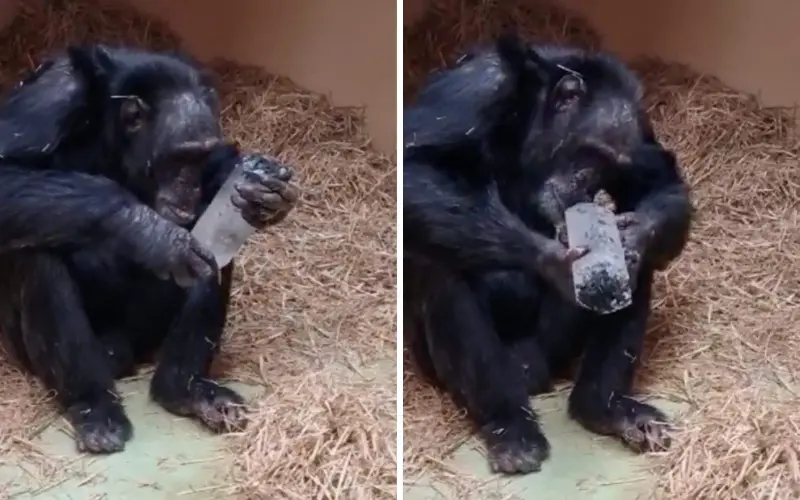
Marilyn Monroe sang that “diamonds are a girl’s best friend”, but a new study suggests that a love of crystals is a universal experience.
Scientists found that chimpanzees can distinguish crystals from other stones, implying that lapidary fascination may be hardwired in our DNA.
It has long been known that our ancestors collected gems, because they have been found at archaeological sites with early human remains.
However, researchers in Spain have found that chimps are able to distinguish semi-precious stones from a pile of regular pebbles within seconds, drawn to their transparency and multi-faceted shape.
The primates were so fascinated with crystals that they had to be bribed by researchers to return them.
The authors said that early humans and our primate ancestors may have been drawn to large, angular rocks because they stood out from the soft curves of their natural environment of clouds, trees, and mountains.
“We were pleasantly surprised by how strong and seemingly natural the chimpanzees’ attraction to crystals was,” said Prof Juan Manuel García-Ruiz, a professor of crystallography at the Donostia International Physics Centre in San Sebastián.
“This suggests that sensitivity to such objects may have deep evolutionary roots.”
Modern humans diverged from chimps between six and seven million years ago and share substantial genetic and behavioural similarities with them.
To find out if a penchant for gemstones was one of them, the researchers split nine chimps into two groups, with each given access to crystals.
In the first experiment, a large, angular quartz crystal was placed on top of a pedestal inside the chimps’ enclosure with a regular, rounded rock placed on an identical pedestal nearby.
While both rocks initially caught attention, the apes quickly disregarded the rock and grew fascinated with the crystal, removing it, inspecting it from all angles and transporting it to their indoor sleeping area.
Although interest declined over time, keepers were forced to trade the crystal for bananas, snacks and yoghurt to retrieve it.
A second experiment found that the chimps could identify small quartz and calcite crystals from a pile of 20 pebbles within seconds.
Even when opaque pyrite stones, which have a different shape to quartz, were added to the pile, the primates were still able to pick out the original stones.
“The chimpanzees began to study the crystals’ transparency with extreme curiosity, holding them up to eye level and looking through them,” Prof García-Ruiz said, explaining that they would analyse them for hours.
One chimp carried a selection of rocks in its mouth and then privately separated three crystals, suggesting it wanted to hide them from its fellow primates.
The researchers found that transparent and polyhedral crystals – those with multiple faces – were most attractive to the chimps, which might explain the high value human gem collectors place on large multi-faceted gemstones, which tend to sparkle more.
Archaeological evidence shows that early humans collected gemstones as many as 780,000 years ago.
Prof García-Ruiz said that, based on chimps’ shared fascination with precious rocks, “we now know that we’ve had crystals in our minds for at least six million years”.
The study was published in the journal Frontiers in Psychology.