



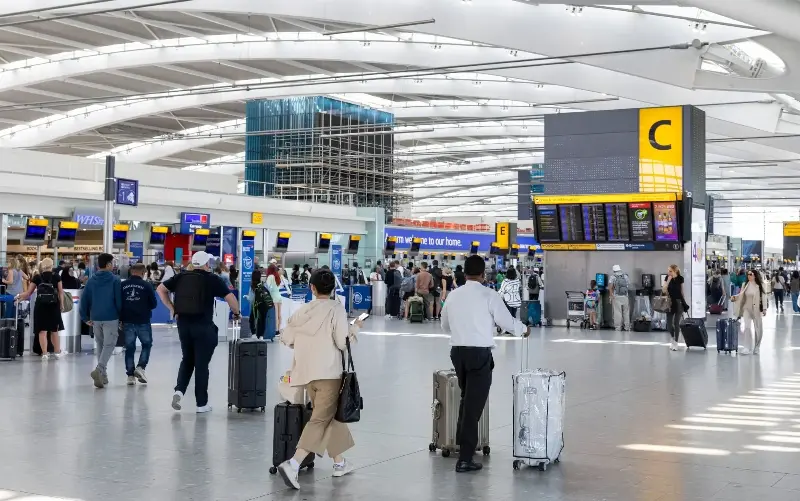
Pop quiz: which major international airport does not have a Terminal 1? It could only be Heathrow. Europe’s busiest hub has grown so fast in recent decades that it has become a bit of a make-do-and-mend airport.
Some elements work brilliantly – the Elizabeth Line, Terminal 5, Terminal 4, the passport E-gates in all terminals, and the Virgin drive-in business-class check in at Terminal 3. Other elements are so old that demolition cannot come soon enough. Yes, I’m looking at you T3, with your low ceilings, bad lighting and long walks to the boarding gates.
And, this being Heathrow, some elements are so potty that they beggar belief. No, not the recent fire and power cut which grounded all flights. Did you know that the T2 baggage systems still use those in T1, which closed a decade ago?
Or that there is a completed tunnel designed for a train shuttle between the main T2 building and its satellite almost a quarter of a mile away but no trains use it because there, er, are no trains?
Neither Heathrow Airport nor the airlines could agree on how a shuttle would be funded. So it’s a very long walk today to the gates instead.
But things might – just might – be about to change for the better. Last month Heathrow Airport published plans for a multi-billion pound upgrade – and later this week will set out its proposals for a controversial third runway. With or without a third runway, Heathrow managers hope to complete a revamp of the airport’s core facilities by 2040.
The biggest change will come in what is now known as the airport’s central terminal area, where T1, T2 and T3 sit. Under Heathrow’s proposals, the abandoned T1 will finally be knocked down and T2’s main terminal building will expand northwards into the space T1’s demolition creates to become more than twice its current size. Trains will finally start shuttling between the main T2 building and its satellites.
Airlines currently in T3, notably Virgin Atlantic, Emirates, Cathay Pacific, American and Delta, will move into the expanded T2. This will enable demolition of T3 to begin. Once that has been completed, two new satellites for T2 will be built parallel on the land previously occupied by T3.
A new tunnel from the south side of Heathrow will make it easier for passengers driving up from the south to access T2 because it will lead directly to the new central terminal area. Currently, the only access to that area is via the often congested tunnel on the northern side of the runway off a spur from the M4 motorway.
While all that is going on, a third satellite for T5 will open on land between the existing main terminal and the M25. This should enable all British Airways flights to take off and land from T5 for the first time. Some BA services still depart from T3.
Once all the building work is finished Heathrow’s terminal space will expand by more than 150,000 square metres. Heathrow’s shareholders – which include French private equity group Ardian – will initially contribute £2 billion in new equity towards the investment programme which will cost north of £10 billion, the airport says.
Terminal 4, home to Qatar Airways, Etihad and Air France, will remain unaffected, except for its name. Heathrow managers acknowledge that with only three main terminal buildings in future they will have to rename the terminals 1, 2 and 3 but it is not clear which will be which number.
The train stations – Heathrow Express, Elizabeth Line and Piccadilly Line Underground stations – will also need to be renamed.
Heathrow has submitted its plans for approval by the Civil Aviation Authority, after which it needs to secure planning permission. The Government has indicated it is minded to approve big infrastructure projects. If the work does go ahead, what will it mean for passengers?
The new layout will be more efficient and should enable Heathrow to offer more flights, increasing the number of passengers which pass through the airport from 84 million a year now to up to 94 million – and far more than that if the third runway is approved.
Placing the main terminals and satellite hubs in a series of parallel lines between the two runways – a “toast rack” as it is known – will make it quicker and easier for jets to taxi before take off and after landing, which should reduce delays. The arrangement of gates at T3 currently creates cul de sacs where planes can get delayed. Heathrow expects its plans to ensure that 80 per cent of flights depart on time.
Passengers will also enjoy faster access to terminals and greater simplicity. Three terminals are easier to remember than five.
But what most passengers will appreciate more than anything will be the latest technology. Heathrow is keeping quiet on that for now but if you’re reading, Thomas Woldbye, Heathrow’s CEO, Telegraph readers would like:
- City centre bag drops: Check in and baggage drop at railway terminals in London city centres. Our hold baggage should be scanned and transferred into a secure hold on the train, so we can walk off the train into the terminal with our hand luggage while our hold baggage is unloaded and transferred to the aircraft.
- More facial recognition: Outdated body scanners and X-ray machines should be replaced by new security scan arches. We want to simply walk through slowly with our hand luggage while both our clothes and the contents of our bags are screened. Facial recognition is essential, so that there is no need to stop at immigration or to show our boarding pass at the gate – or to enter the lounges.
- Fewer long walks: Please use great design and tech to make walking distances to the gates shorter – or easier. Ideally both. Far too many airport terminals these days are designed for aircraft, not passengers. The distances you have to walk at the current T2 and T3 can be far too long. And how about putting the arrivals hall in the new terminals on the upper floors, rather than in the dungeon as is the case today? That would lift the spirits after 23 hours from Australia.
The only downside of all the construction and innovation will be likely higher fares. Under the current regulatory model, Heathrow is allowed to recoup spending on airport improvements through the landing fees it charges airlines, which are typically passed on to customers through ticket prices.
Heathrow has asked regulators to approve a 17 per cent increase in landing charges to help to pay for the initial £10bn investment: over the next five years the charge would increase to about £33.26 per passenger, up from the current average of £28.46 – around a £5 increase.
The request is likely to be opposed fiercely by the airlines that use the airport, which has been accused of overcharging and exploiting its position as the premium London hub to charge too much.
But, Mr Woldbye, if you give us our laundry list of innovations, we’ll stump up.