



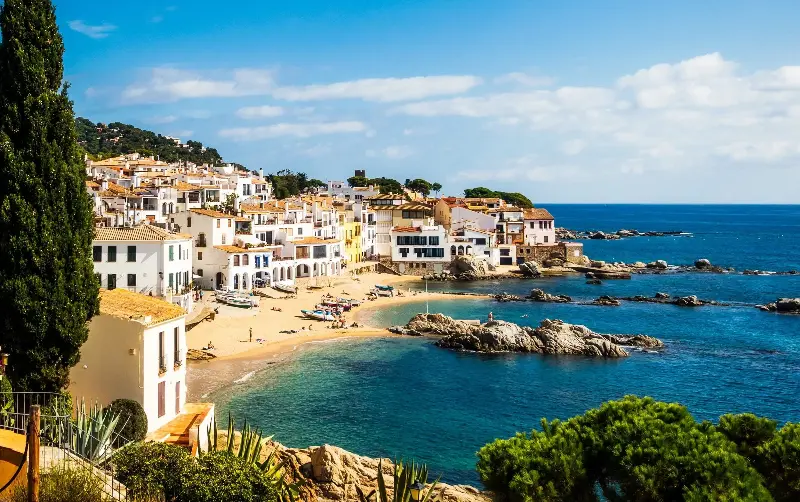
The name says it all. Meaning “wild coast” in Spanish, the Costa Brava is one of Europe’s most romantic, unspoilt stretches of coast. Where else, less than a two-hour flight from Britain, can you explore rugged pink clifftops with the teal-coloured Mediterranean glittering below, framed by grand arabesque pines?
It’s a scene reminiscent of France’s Côte d’Azur, of course, but with independent hotels and exceptional food (including no fewer than 15 Michelin-starred restaurants with a total of 20 stars between them) – generally at a fraction of the Côte d’Azur’s prices.
Gloriously wild in parts and tastefully manicured in others, the Costa Brava also has some of the finest Blue Flag beaches in Europe: from broad, sandy stretches to elegant horseshoe bays and secluded smugglers’ coves. Beyond that there are spectacular coastal walks and world-class golf courses – as well as diving, snorkelling and sailing, four Salvador Dalí museums, and outstanding Greco/Roman ruins.
In this guide:
- How to spend your weekend
- When to go
- Where to stay
How to spend your weekend
Day one: morning
After breakfast, head into Girona’s Old Town. Crane your neck as you ogle the vaulted ceiling in the vast Gothic Cathedral before exploring the Call – one of the best-preserved Jewish quarters in Western Europe. Visit the Jewish Museum and the recently refurbished Arab Baths, then explore the independent shops and boutiques in the narrow cobbled lanes.
Take a footbridge across the River Onyar and head to one of the terrace cafés lining the Plaça de la Independència for a quick coffee before setting out on the road. Try Café Royal for a cortado – the Spanish equivalent of a macchiato, i.e. espresso with a shot of frothy hot milk.
If you want to really explore the Costa Brava’s best nooks and crannies, a car is the best way. Drive about 40 minutes to the bay of Llafranc and the historic Hotel Llafranch’s restaurant La Plaça. Gaze out to sea on the terrace whilst savouring seafood paella with salty, almost nutty-tasting rice and fresh mussels and prawns.
Afternoon
Turn right onto the seafront promenade Passeig Cipsela, and follow the signs to the Camino de Ronda footpath in the direction of Calella de Palafrugell. The path winds around the pine-clad rocks for about 15 minutes, but take your time as you’ll want to admire the picturesque coastal views.
Arriving at Calella de Palafrugell, walk down onto Platja de Canadell – a lovely gravelly beach overlooked by pastel-coloured 19th-century villas – then carry on walking to the main seafront promenade. Choose an ice cream from L’Enxaneta’s exceptional selection: the coffee and pistachio are particularly good, and children love the Kinder Egg flavour.
Late
After changing at your hotel, drive about 10 minutes inland into the nearby town of Palafrugell (Calella de Palafrugell is its satellite beach town) for dinner. Mas Oliver on the edge of town serves traditional, hearty Catalan fare in a 15th-century stone farmhouse. Look out for the butifarra (Catalan sausage) and grilled lamb chops as well as rice dishes and grilled fish.
Day two: morning
The morning food market near Palafrugell’s Plaça Nova is one of the best in the region. You’ll rub shoulders with top chefs as you ogle everything from plump tomatoes to fresh seafood, choice cuts of meat, local honeys, spices and dried fruit.
After a browse in the market, stop at the Museu del Suro – the Cork Museum. The museum explores the fascinating history of the local cork industry, with clever family-friendly exhibits such as dolls dipping in water to show how cork floats.
Walk about five minutes down the road for lunch at Pa i Raim – a beautifully converted Modernista (Art Nouveau) villa, which serves up fine-dining Catalan dishes at reasonable prices. Don’t miss the tempura langoustines (served on satay-style skewers) and be sure to leave room for pudding.
Afternoon
Drive about 20 minutes north east, to the walled and moated medieval village of Peratallada. Here you can wander along twisting cobbled streets, past stone buildings laced with creepers and bougainvillea, and up to the castle – which was built between the 11th and 14th centuries. The stone archways are a photographer’s dream. On your way back down, stop for a coffee or the local custard-thick hot chocolate in one of the cafés on the cloistered Plaça de les Voltes, such as Pou Dolç.
Late
Freshen up at your hotel before heading back east to Sa Rascassa, a bijou restaurant with rooms in the tiny cove of Aiguafreda. Between June and September, there’s also a small chiringuito – El Vermut – on the beach. Watch the waves as you sip a glass of local wine or the richly hoppy Catalan beer Voll-Damm. Then wander around the corner to Sa Rascassa’s delightful gravelled garden for a light dinner of fresh grilled or baked fish and Mediterranean vegetables with Romesco sauce.
For a post-dinner drink, head back into Begur to La Lluna – a converted townhouse with arched stone ceilings. Enjoy one of the heady house cocktails or a G&T, to a soundtrack of jazz, blues and Eurodisco.
When to go
A decent dose of sunshine is reasonably guaranteed throughout most of the year. If you’re not bound by school holidays and can visit during May, June or September, these are brilliant months to enjoy the joint benefits of warm temperatures and lower hotel rates, while avoiding the crowds of July and August.
Having said that, if you’ve set your heart on perfecting a tan in sizzling heat, high summer is the time to choose. If you do come during those peak months, you’ll find the region busy but not over-run, and you can still enjoy relatively secluded beaches without having to knock elbows with half of Europe.
From February to April and October to November the weather is generally pleasant: you might catch springtime electric storms or autumn rains, but these don’t usually last for many days.
Where to stay
Luxury living
There’s a sense of hushed luxury as soon as you walk into Mas de Torrent, a five-star country house hotel set in gorgeous countryside. You’re within easy reach of some of the Costa Brava’s loveliest beaches, as well as golf courses and Medieval villages. Otherwise the hotel itself has a secluded outdoor pool and luxurious Zen-inspired spa.
Boutique bolthole
Hostal Empúries has the kind of location most hotels dream of, on a horseshoe bay, facing out to sea. The Mediterranean is about three steps over the road. Originally built as a restaurant for archaeologists excavating the superb Greco/Roman ruins just a few yards along the beach, the hotel has since been reinvented as a sleek, eco-friendly, modern boutique hotel and was the first in Europe to be awarded LEED Gold Certification (the high watermark of sustainable hotel certification) in 2010. The hotel also features a spa, lavender-filled kitchen gardens and a restaurant with a wonderful sea view terrace.
Budget beauty
Located on a spectacular hillside near the medieval village of Begur, Hostal Sa Barraca feels more like going to stay with a friend’s kindly Spanish grandparents than an impersonal hostal or hotel. This remarkably good-value (adults only) pension has some of the most stunning sea views on the Costa Brava, which unfolds in front of you on the terrace; you can smell the fresh pine from the woods next door. You’re less than a 10-minute drive from the gorgeous beaches at Aiguablava and Sa Riera. Llafranc, Tamariu, and the expansive sandy beach and medieval village at Pals are all within easy driving distance too.
How to get there and how to get around
Girona Costa Brava airport is less than half an hour’s drive into Girona or between 45 minutes and an hour’s drive to the coast and is serviced by Ryanair from various UK airports including London Stansted, Manchester, Bournemouth and Bristol. Barcelona airport is around an hour and a half’s drive south of the Costa Brava.
Alternatively, take the Eurostar from London to Paris. The train from Paris to Girona then takes around 6 hours. Once you’re there, the easiest way to explore the Costa Brava’s villages, towns and beaches is by car. Sixt has car rental offices at both Girona and Barcelona airports as well as Girona station. Sarfa also runs buses between Barcelona and various Costa Brava towns and trains run from Barcelona to Girona and Figueres.
Know before you go
Essential information
- Flight time: Approximately two hours to Girona or Barcelona
- Currency: Euro (€)
- Further reading: en.costabrava.org
- Emergency numbers/contacts: Medical, fire and police: 112. Local police: 092
- British Consulate in Barcelona: Avenida Diagonal 477, 13a Planta, 08036 Barcelona (00 34 902 109356 or 00 34 913 342194; gov.uk)
Local laws and etiquette
- When it comes to tipping: about five per cent for taxis and restaurants, €1 (80p) for hotel porters. Bars and cafés don’t normally expect tips unless you’re sitting at an outdoor terrace, where it’s polite to leave 30c-50c (25p-45p).
- If you don’t have one, apply for a UK Global Health Insurance Card so you’re eligible for state medical treatment if you need it.