



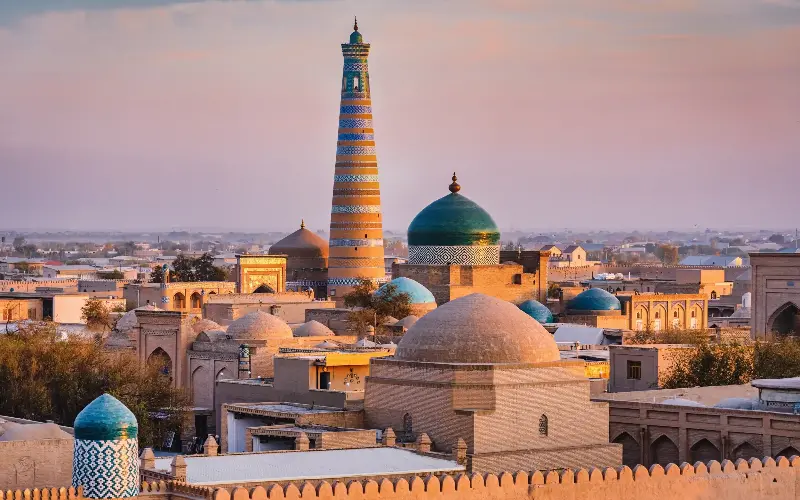
It was only after an hour of wandering through Itchan Kala, the walled inner city of Khiva, that I realised I hadn’t seen another soul.
A cold, crisp day on the fringes of Uzbekistan’s Karakum and Kyzylkum deserts, the sky had cast a giant blue net over a place where people have lived for more than 2,500 years. As the morning fog lifted, sandy alleyways gave way to tiny lanes, which briefly opened onto squares before meandering into networks of secret stairways and gilded wooden door frames. Things that quietly pulsated with history, yet no one around to tell it. How people had managed to walk and trade and simply exist in this place where even a whisper felt too big was a mystery.
In the 21st century, such places rarely stay hidden gems. And so it is with Khiva. The prized Silk Road site does not attract as many visitors as its sister cities Bukhara and Samarkand – a combined 2.5 million fewer annually – but the Uzbek government intends this year to launch a new high-speed train between Khiva and the capital, Tashkent. It will reduce the journey from the current overnight sleeper of 15 hours to a relatively brisk daytime venture of just seven. This is a development that is set to change Khiva forever.
Almost all of Khiva’s historical splendours are held inside the medieval Itchan Kala. An open-air museum littered with palaces and mosques, madrasahs and mausoleums, visitors may guffaw when arriving at its main entrance, the Western Gate. How historical is a place dominated by hawkers selling bottles of Coca-Cola and buttery popcorn? But by dodging them and passing through the mud-brick gate, these same visitors soon lay eyes on the grand Muhammad Amin Khan Madrasah.
Built between 1851 and 1855 by the Khan (ruler) of the same name, the madrasah functioned as an Islamic school for the elite, priming 260 young men at a time for a life in court. Today, it houses the Orient Star Khiva Hotel. Inside, arches lead to a courtyard where these men once wandered and pondered the stars. The dusty stones they trod could be the same ones visitors walk on today, for 80 per cent of the Orient’s interior is original, with the students’ former madrasah cells transformed into 78 chic guest rooms.
Moving from the madrasah to the nearby Kunya-Ark, I became convinced that Khiva’s one million annual visitors were made up entirely of wedding parties. Couples drifted solemnly through the streets, trailed by their families and professional videographers. Eventually, the Ark – the Khan’s palace – came into view. Built and expanded from the 17th century, here is his mosque and residence, and his grand kitchen where Uzbekistan’s famous plov – a dish of aromatic pilaf rice and meat – was cooked. And, of course, his concubines’ harem, which spills into a discreet network of corridors leading directly to his room.
Though the Khans’ rules were often brutal – criminals were punished by stoning, beheading, impalement, amputation, the gouging of eyes – the resources pumped into the arts betrays a gentility. The façade of each building here features tall, tiled alcoves, flanked by expanding geometric designs. Islam forbids the depiction of humans and animals, so artists created abstract patterns to express God’s infinite nature. Blue and turquoise represent the heavens and peace, white conveys purity. Stylised vines, flowers and palmettes wrap themselves around each frame, symbolising paradise, growth, fertility and, above all, creation.
Directly outside Kunya-Ark is a sparse square where public executions were once held. Today, it is flanked by overpriced cafés and domestic tourists who pose for photographs outside the 1871 Muhammad Rahim Khan Madrasah. In turning their backs on it, these people miss a fascinating portal into a tradition that precedes the Khanate.
By the time the Arabs arrived in Khiva in the eighth century, the fire-worshipping religion Zoroastrianism had thrived for almost 2,000 years. Over time, Islamic traditions superseded Zoroastrian culture, but many aspects survived. I drew my hand across the madrasah’s walls and tried to make out the grooves of a row of small green crosses. Zoroastrian remnants, the Khiva Crosses represent the four elements of human life.
“The Muslims were used to seeing these symbols,” a guide at the madrasah’s entrance told me. “They kept them not only because they were comforting, but because they respected the faith which had come before.” Around the corner, my new guide led me through Itchan Kala’s ancient lanes into the dingy Juma Masjid (Friday mosque), where I was faced with four stout Uzbek babushkas (grandmothers). Through wit and charm, the guide sweet-talked our way behind the curtained construction works.
The majority of Islam’s most important and oldest places of worship sit in the Middle East, but the Juma Masjid is one of its forgotten sanctuaries. Built in the 10th century, just 300 years after Islam emerged, it is propped up by more than 200 wooden pillars, some of which are 1,000 years old. Made entirely of wood, the mosque is designed not in the traditional dome shape, but a rectangle – a fascinating glimpse of what early Islam looked like. Lurking in a shadowy corner sat a decidedly un-Islamic concrete box, shoddily topped by a discoloured dome. “It is a Zoroastrian fire pit,” the guide told me. “When the Arabs came, they kept it as a sign of respect and turned it into a well. You won’t find anything else like it in the Islamic world.”
Khiva is an immensely walkable city, and just a minute from the mosque lies a structure that signalled an era of change. Not entirely dissimilar to industrial buildings found in Cardiff, Manchester or Liverpool in its brickwork, the Islam Hoja Madrasah was Khiva’s first Russian language school.
By the time Hoja, prime minister of the Khanate, had built the madrasah in the early 1900s, Imperial Russia had already made inroads into Khiva. Hoja saw his new guests as the embodiment of modernity. Soon, he had ideas about secular education, limits on administrative power, and a relaxation of conservative Islamic culture. He allowed women to be educated for the first time in the Khanate’s 400-year history, and even had Christian crosses sealed into the cylindrical buffers around the madrasah’s exterior walls, which you can still see today.
This gently sloping building was the beginning of the end for the Khanate. Hoja’s reforms were seen as heretical and a threat to Islamic rule. In 1913, he was assassinated. Seven years later, the Khanate was dissolved after the victorious Bolsheviks rolled into town and established the Khorezm People’s Soviet Republic. The expansion of Itchan Kala’s Islamic architectural legacy officially ceased, turning the dusty, walled city into a time capsule that would only be opened up to the world 70 years later with the fall of the USSR. Visitors can still explore this city without the crowds, almost as it was back then – but with the imminent introduction of the new trains, this may not be the case for long.
Essentials
Uzbekistan Airways flies direct from London to Tashkent from £600 return. A first-class return sleeper train from Tashkent to Khiva starts from £80. Rail tickets must be booked in advance via the Uzrailwaysticket app to secure a place (the price of a return ticket on the new train has not yet been announced). The Orient Star Khiva Hotel has doubles from £40 per night, with breakfast. Itchan Kala is free to enter, but an all-access ticket for its sites costs £15.