



“I have always imagined Paradise will be some kind of library,” said the writer, Jorge Luis Borges. And it seems he wasn’t the first to think that. Many have pursued their own vision of heaven on earth: a space where knowledge is both preserved and venerated, and where architecture conspires with intellect to elevate the human spirit.
Paradise, in this sense, has two dimensions. There are the books themselves – repositories of memory, imagination and insight – and there is the building that houses them. And so a great library must serve as a vast, meticulously ordered storehouse and at the same time inspire us to reach for the shelves and read.
At the heart of a great library lies the reading room, with a lofty ceiling and ranks of old oak tables. Sunlight streams in from picture windows before yielding, at dusk, to the softer glow of the reading lamps. Wood panelling absorbs the shuffle of feet, the rustle of pages and now, inevitably, the tapping of laptop keys. Here, silence is not emptiness but encouragement. This is the space where minds expand and worlds unfold.
Inspired? Here are ten libraries you must seek out.
1. The Library of Celsus, Ephesus, Turkey
AD 110
No books and no reading rooms survive, but this glorious façade, rebuilt from its own ruins, is the single most impressive building on the archaeological site of Ephesus and a vestige of one of the greatest libraries of antiquity.
Commissioned in the early second century AD by a Roman consul in memory of his father, Tiberius Celsus, it was originally home to some 12,000 scrolls. These were destroyed by a fire, probably lit by marauding Goths in AD 262, and the façade was later tumbled by an earthquake. But the reconstruction gives a wonderful insight into its former grandeur.
Open daily 8am-7pm (8.30am-5pm from November 1–March 31), as part of a visit to the site; visitephesus.org/en
2. The Vatican Apostolic Library, Vatican City, Italy
1475
The origins of this spectacular collection of some two million books and manuscripts date back to the bibliophile and former librarian, Pope Nicholas V (1397-1455), who first began the process of properly cataloguing and amalgamating the papal collections. These include the Codex Vaticanus (c. AD 325–350), one of the foundation texts for the Old and New Testaments.
Technically, however, the library was founded in 1475, and the building which houses the collection today was commissioned by Pope Sixtus V in about 1587. He was responsible for its central showpiece, the great Sistine Hall, with its frescoed arches and columns.
To use the library reading rooms, you need to be a scholar, but you can see the Sistine Hall as part of a visit to the Vatican Museums, open Monday-Saturday, 8am-8pm; museivaticanitickets.com
3. The Library of El Escorial, Spain
1563
The enormous El Escorial Monastery was built by Philip II of Spain in the Sierra de Guadarrama as his retreat from Madrid, and one of its greatest showpieces is the 55m-long library.
Flooded with light from the seven great windows which overlook the Patio de los Reyes on one side and five overlooking the grand terrace on the other, its great barrel-vaulted ceiling is decorated with a series of seven frescoes depicting the liberal arts. Treasures include more than 40,000 volumes, and there is an especially rich collection of Latin, Greek, and Hebrew manuscripts.
Open Tuesday-Sunday, 10am-6pm, as part of a visit to the monastery; patrimonionacional.es
4. The Wren Library, Trinity College Cambridge
1676
There are so many wonderful libraries in Britain, but if I had to pick a favourite, it would be this. Constructed between 1676 and 1695 to Sir Christopher Wren’s designs and closing off one side of Trinity’s cloistered Nevile’s Court, the building is raised above a colonnade, its great arched windows overlooking the courtyard on one side and the River Cam on the other.
The bookcases were embellished with carvings by Grinling Gibbons, and there is a statue of Byron, who was at Trinity from 1805-08, by Thorvaldsen. Other treasures include Isaac Newton’s notebook from 1660-61 and the manuscript of Winnie the Pooh.
Normally open Monday-Friday, 12pm-2pm; admission free
5. Trinity College Library, Dublin, Ireland
1733
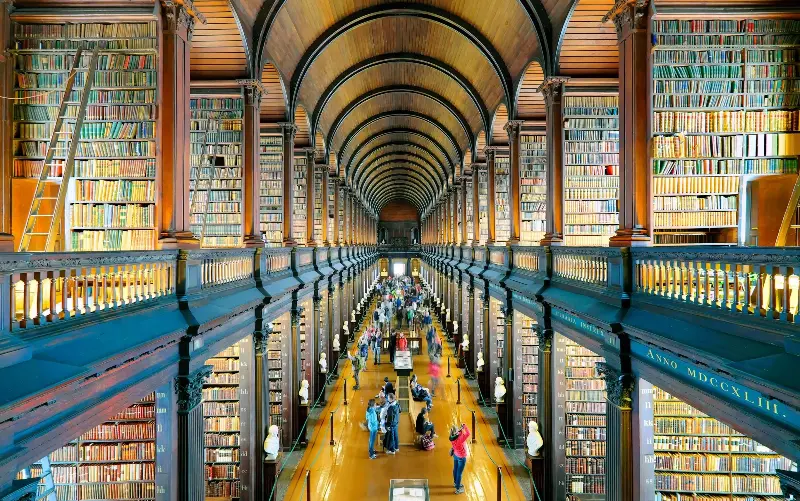
It’s rare for a library to be among the top attractions in a city, but over a million visitors a year flock to see the great Long Room of Trinity College Library and its wonderful illuminated manuscript, the eighth-century Book of Kells.
The 213-foot Long Room of the original library building is defined by its 15 bays of two-storey timber shelves which line each side and – normally – house 200,000 books. Currently a restoration project means that most of the shelves are empty, but the library will remain open until the end of 2027, when it is expected to close until about 2030.
Open Monday-Friday, 9.30am-4:30pm; Saturday, 9.30am-5pm and Sunday, 10am-4.30pm. A ticket is combined with the Book of Kells Experience; visittrinity.ie
6. The Royal Portuguese Cabinet of Reading, Rio de Janeiro, Brazil
1887
More famous for beaches than bibliophiles, Rio is in fact home to one of the great cultural institutions of the Portuguese world. The Cabinet of Reading was founded by a group of expatriate Portuguese as a way of promoting the culture of their homeland. Its headquarters is this library, built between 1880 and 1887 to evoke the golden age of Manueline architecture under the Portuguese monarch King Manuel (1495–1521).
Outside, the façade of the building was inspired by the Jerónimos Monastery in Lisbon and built with stone shipped from Portugal. But the centrepiece is the reading room, with its three storeys of galleried bookshelves, embellished with filigree and gilded carvings, all lit from above by a stained glass ceiling. It is home to some 400,000 books and rare manuscripts.
Open to visitors weekdays 10am-5pm; realgabinete.com.br
7. The Sainte-Geneviève Library, Paris
1851
This library, which is run by the Sorbonne Nouvelle University in Paris, was founded on the collection of the city’s sixth-century Abbey of St Geneviève. But equally inspiring is its iron-framed 19th-century reading room with two parallel barrel vaults spanning the rows of wooden reading desks – Victorian railway grandeur overarching a seat of learning.
It houses some two million volumes and manuscripts, including the 12th-century Bible of Manerius (c 1185) and a 16th-century illuminated New Testament made in the abbey itself.
Open Monday-Saturday, 10am-10pm; bsg.univ-paris3.fr
8. The George Peabody Library, Baltimore, USA
1878
The philanthropist and banker George Peabody spent most of his life in London but wanted to create a library in Baltimore, where he began his career. He donated $300,000 for a Peabody Institute of Music and a library “for the free use of all persons who desire to consult it.”
Now part of Johns Hopkins University, it is more famous for its architecture than its collection, vast though that is. Its centrepiece, known as the Peabody Stack Room, is a great atrium, designed by local architect Edmund G Lind and constructed around five tiers of cast-iron balconies, lined with bookshelves, the whole illuminated by a latticed skylight.
Generally open Monday-Thursday, 10am-5pm; library.jhu.edu/library-hours/george-peabody-library
9. The Rampur Raza Library, Uttar Pradesh, India
1904
If the Rampur Raza looks more like a palace than a library, it’s because that is what it once was. The origins of the collection, which focuses on Indo-Islamic books and manuscripts, lie in the libraries of the Nawabs of Rampur in the late 18th century, but it has been much expanded since and is named after Sir Raza Ali Khan Bahadur, who was a nawab from 1930 to 1966.
In the 1950s, it was moved to the Hamid Manzil, a historic building in Rampur, constructed in 1904 and designed by British architect WC Wright. The collection holds important manuscripts (including the first translation of the Qur’an into the Pashto language), Islamic calligraphy, miniatures, illustrated works in both Arabic and Persian, and printed books in Sanskrit, Hindi, Urdu and Pashto. It is now owned by the Indian government.
Open daily, 10.30am-10pm; rampur.nic.in
10. Tianjin Binhai Library, Tianjin, China
2017
Designed by Dutch architectural firm MVRDV for Tianjin’s Binhai complex of cultural buildings, this curvaceous five-storey building could theoretically house 1.2 million books. But things are not what they seem. Currently much of the stock is illusory: painted spines on “terraces” of shelves which follow the sinuous lines of the walls and ceilings. Nevertheless, it still has 200,000 books and is a fantastical place, like a sort of architectural brain.
Open Monday, 2pm-9.30pm; Tuesday-Sunday, 9.30am-9.30pm; bhwhzx.cn