



Think of a Canary Island, any Canary Island. I bet tiny El Hierro wasn’t the first one to pop into your head. A vaguely triangular nugget just 19 miles wide, it’s a speck of dust on the atlas, tucked 85 miles to the south-west of Tenerife and far from mass tourism’s beaten track. Yet it once assumed a significance out of all proportion to its size.
Back in the second century, Greco-Roman astronomer Ptolemy selected it as the most westerly point of the known world – the end of the Earth, the zero meridian – and it retained its special status even after the “New World” of the Americas was discovered, until Greenwich officially assumed the mantle in 1884.
It’s still a geographical anomaly. As part of Spain, there’s an argument that it’s the furthest south-west you can go in Europe, despite being 190 miles off the west coast of Africa. Head westwards from El Hierro and there are 3,000 miles of Atlantic Ocean before you arrive in Florida; your first landfall to the south would be Antarctica.
Over the past decade or so I’ve visited the six other main Canary Islands on several occasions. (For the pedants among you, I’m not counting La Graciosa, the islet just off the north coast of Lanzarote that was given full island status in 2018 for no readily apparent reason.) They all have their peculiarities, from César Manrique’s grotto-like home on Lanzarote to La Palma’s gleaming observatories. But El Hierro remained an enigma: the last on my list, the final tick box.
It turned out to be perhaps the strangest Canary Island of all.
Walk this way
El Hierro’s inaccessibility is borne out by the visitor numbers. In 2024 an astonishing seven million people visited Tenerife, but just 26,000 tourists made their way to El Hierro, and a paltry 4,100 of those weren’t Spanish.
Whatever your nationality, you don’t come here for the cuisine (which is nevertheless perfectly good: try the “wrinkled” potatoes, or – if you are braver than me – the local winkles, which are very well thought of). Equally, you won’t be lolling around on a beach; El Hierro’s black lava shores have a nasty habit of plunging precipitously down into the Atlantic.
Instead, the few that take the three-hour ferry (or 40-minute propeller plane) over from Tenerife will almost certainly be here for a hiking holiday. I was following an itinerary provided by Inntravel, which offers a self-guided, week-long walking tour, with luggage transported for you between hotels.
An additional guided “extension” day is also available, in the company of Paulo Cossovel, an Italian who moved to El Hierro with his wife Enrica back in 2003.
Paulo picked me up from the 40-room Parador de El Hierro (the largest hotel on the island) for a walk from the pretty hillside village of El Pinar to La Restinga, the port at the island’s southern tip.
As we followed a trail carved through the lava fields decades before by the feet of over-laden fishermen’s wives, talk turned – as it often does in El Hierro – to volcanology, sustainability and the weather. In that order.
Volcanic attraction
El Hierro is said to have a larger number of volcanic craters per square mile than anywhere else in the Canaries, but really that’s just window dressing. The whole thing is basically one massive volcano rising from the depths of the Atlantic and venting eastwards at the rate of 2cm a year.
It’s also young in geological terms – a mere 1.2 million years old, compared to Lanzarote’s 20 million years – and still occasionally prone to a spot of light bubbling.
Over the millennia, huge landslides (El Golfo on the north coast, El Julan on the South and Las Playas in the south-east) have carved out its axe-head shape from what was once a more uniform cone. More recently, in 2011 an offshore eruption just south of La Restinga turned the water bright green and added countless tonnes of volcanic material to the seabed.
In the south of the island, this all makes for a bleakly fascinating landscape that falls slowly towards a barren coast, signs of human life confined to a complicated tracery of dry-stone walls and the occasional abandoned farmstead.
As we followed tracks that swirled with molten shapes like hot toffee, Paulo pointed out the local morphology: green-clad volcanoes, their craters compressed as if by a giant thumb, and hornitos, cracked, pipe-like structures created by lava “spattering”.
Going green
Green energy is El Hierro’s other big thing. On an island with an official population count of just 11,000 (and far fewer year-round residents), sustainability looks like an achievable goal. Five wind turbines now deliver most of the island’s needs, with solar power due to top it up in the coming years.
Water remains a big issue, though. El Hierro has no rivers, no streams, no natural lakes. Paulo was gently despairing about the fact that the key cash crops here are pineapples and bananas, both of which depend on vast quantities of fresh water either being drawn via long galleries connected to aquifers or from El Hierro’s six desalination plants.
What moisture there is comes from the trade winds – “the big artist” of the island, according to Paulo – which condense into “horizontal rain” (mist, to you and me) above about 800ft. Peculiar microclimates mean vegetation that flips between plantations of prickly pears, giant heather trees and groves of long-needled Canarian pines.
We stopped for coffee next to La Restinga’s neat little harbour. As Europe’s southernmost port, this frontier town is now the locus of a very modern problem: the first landfall for Senegalese migrants seeking refuge in the EU. Last May, seven people drowned as their boat capsized in the port following a 10-day crossing from the African coast.
Stranger things
Just how odd does El Hierro get? “It is extremely difficult to describe the variety El Hierro has,” said Paulo, “but it always surprises visitors, making my job much easier. It’s not me – it’s the island.”
Over the following days, I discovered what he meant, as my walking notes took me from El Mocanal in the north, via the island’s capital Valverde (little more than an outsized village), to the farming hub of Frontera and onwards to Balneario Pozo de la Salud, a delightful little three-star hotel set right on the shore at Sabinosa in the north-west.
The seven-hour hike from El Mocanal to Frontera is perhaps the most impressive route. It starts at the Manrique-designed Mirador de la Peña, with its epic view of the El Golfo plains, then takes in the mist-shrouded farmland of Meseta de Nisdafe and the caldera of the Fireba volcano, where the clouds pour over the spine of the island in waves, before it winds downwards towards the coast.
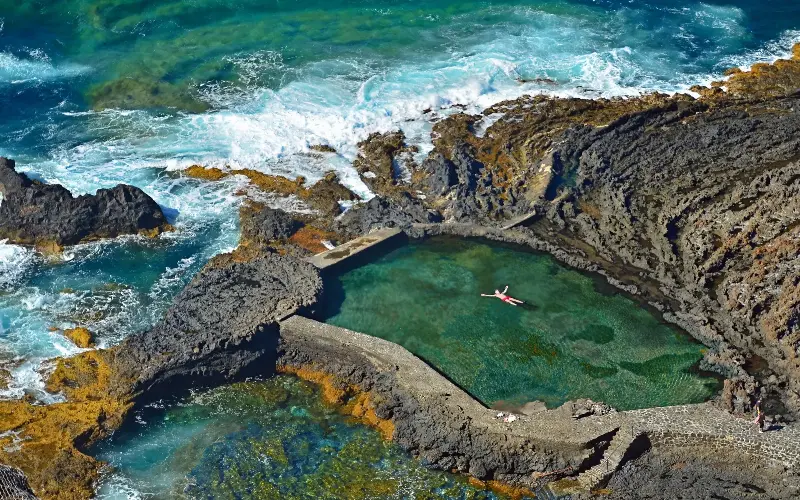
Every day brought new peculiarities, from the grove of twisted junipers – a symbol of the island – crouched on the hillside above Sabinosa, to the volcanic swimming pools at Pozo de Las Calcosas and La Maceta on the north coast, reinforced with concrete against the Atlantic.
Flocks of canaries – drabber than the captive versions, but just as charming – jetted from bush to bush, but I rarely encountered other walkers.
“Proper” tourist attractions are few and far between, although I spent a pleasant hour or so at Guinea, the site of a village abandoned in the 1950s following a prolonged drought and now an outdoor museum, the rooms decked out as they would have been 70 years ago.
I also visited the adjacent breeding centre for the “giant” lizard of El Hierro, a threatened reptile that grows to a slightly disappointing 70cm long.
Anyone fit enough to negotiate its steep paths will have a wonderful holiday here, but El Hierro can also be unsettling. On my last day, a shorter stroll took me to the malpais (badlands) of the Punta de la Dehesa in the north-west. Formed by an eruption in 1793, it’s a brutal landscape: spiked, harsh and forbidding, impossible to tame.
Here, the Atlantic batters away relentlessly, nibbling away at the lava fields to form dramatic arches and blow holes, a reminder of how exposed this island is to the power of the ocean.
For Paulo, being on the edge is what makes El Hierro so special: “In a world where you think you can control everything,” he told me, “it’s comforting in a way to know that you can’t.”
Essentials
Ben Ross was a guest of Inntravel, which offers a self-guided nine-night El Hierro: Canary Islands Walking – Extended trip from £1,305pp, based on two sharing, including nine nights’ B&B, seven dinners, two picnics and one lunch, and a private guided tour of the lava fields. Flights to El Hierro, via Tenerife, extra. Available any day to December 31 2026. Seven-night trips are also available, from £820pp.