



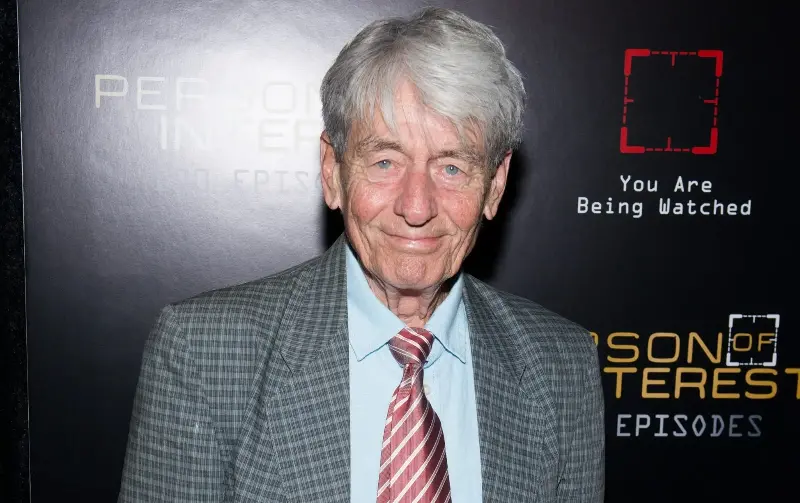
John Nolan, who has died aged 87, was a character actor largely seen in authority roles on stage and screen during the 1970s and 1980s; in later life, he became familiar to a wider audience from appearances in the projects of his nephews Sir Christopher and Jonathan Nolan, notably as the leading antagonist of the latter’s hugely successful US television series Person of Interest (2011-16).
Christopher Nolan remembered his uncle as “the first artist I knew… He taught me more than anyone about the search for truth in acting and the joys of creative achievement.” John Nolan played a policeman in Following (1998), Christopher’s first feature, and was later Douglas Fredericks, a board member of Wayne Enterprises, in his nephew’s Batman Begins (2005) and The Dark Knight Rises (2012), and the Blind Man in his Dunkirk (2017).
As John Greer, a former MI6 officer with the ruthless self-assurance of a Roman senator, Nolan, already in his mid-seventies, brought to Person of Interest all the crisp tones and commanding presence that Hollywood desires from a classically trained British villain.
Increasingly regarded as prescient, the series, created by Jonathan Nolan, centres on an artificial intelligence, the Machine, coded by a reclusive genius, Harold Finch (Michael Emerson), which identifies terrorist threats to America by secretly monitoring all forms of communication.
The programme, which ran to more than 100 episodes, evolved into a searching examination of the ethics of a surveillance state. Greer was revealed as the human agent of a rival AI, Samaritan, which had none of the residual traces of humanity of Finch’s monster. In thrall to its embodiment of logic and power, Greer eventually sacrifices himself in a bid to give it unchallenged control of society.
The younger brother of his nephews’ father, Brendan, John Francis Nolan was born in Woolwich on July 22 1938. He studied acting at the Drama Centre in London and then joined the company of the Royal Court Theatre.
In 1967 he was cast as Romeo opposite Francesca Annis’s Juliet in a production at the Richmond Theatre. The following year, he joined the Royal Shakespeare Company at Stratford, appearing as Brutus’s follower Clitus in Julius Caesar and in John Vanbrugh’s The Relapse, directed by Trevor Nunn, at the Aldwych.
Articulate and free-spirited, he left the RSC in 1970 to appear in the title role of the BBC television adaptation of Daniel Deronda, George Eliot’s final novel. Nolan then played a scientist in Doomwatch (1970-71) and a bohemian artist in Depression-era Manchester in Shabby Tiger (1973).
There were also guest appearances in series of the time such as The Sweeney, and Return of the Saint, in an episode also featuring Rula Lenska. On the big screen he was a naval officer in the Nelson biopic Bequest to the Nation (1973), prominent in the horror of Terror (1978), and in the film version of Jackie Collins’s The World is Full of Married Men (1979).
In 1980 Nolan took the lead at the Bristol New Vic in a trilogy he had adapted from Dostoevsky, but thereafter turned increasingly to directing and running workshops. He had founded Quinton Arts, a production company, with his wife Kim Hartman, the actress perhaps best known as Private Helga in the sitcom ’Allo ’Allo!
Nevertheless, Nolan was still seen occasionally in series such as Silent Witness, and on the stage, always his first love, in Tom Stoppard’s The Coast of Utopia (Olivier, 2002), directed again by Nunn, and as the dipsomaniac quack in Tennessee Williams’s Small Craft Warnings (Arcola, 2008). Recently he had portrayed the speaker of the imperial council in the TV prequel Dune: Prophecy.
He is survived by his wife, whom he married in 1975, and by their son and daughter.
John Nolan, born May 22 1938, died April 11 2026