



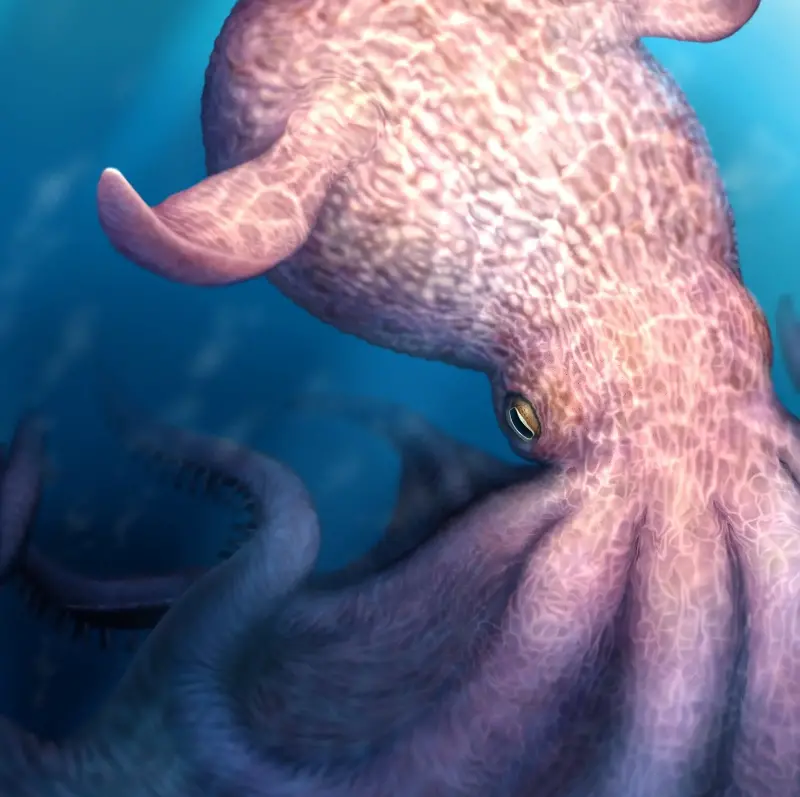
The legend of the kraken has long set fear into the heart of sailors, known as it is for devouring ships and leaving no survivors.
While the mythical animal’s taste for seafarers is yet to be proven, research has revealed that kraken-like octopuses roamed the ocean 100 million years ago and were so big they ate dinosaurs.
The creatures, which lived during the Late Cretaceous period about 100-72 million years ago, may have grown up to 19m in length, four times the size of a great white shark, and rivalled other ferocious apex predators long thought to dominate ancient oceans.
For decades, scientists believed that prehistoric oceans were ruled entirely by large vertebrates such as sharks and giant reptiles, with invertebrates serving as prey.
But the findings suggest that giant cephalopods did not merely lurk in the shadows, but rivalled and even targeted other giant predators such as mosasaurs.
Researchers at Hokkaido University analysed fossilised jaw bones from two types of ancient octopus, finding that these soft-bodied creatures were anything but defenceless.
By analysing the bones’ wear and tear – which was similar to damage seen in modern shell-crushing cephalopods – the scientists concluded the animals were “active carnivores that frequently crushed hard shells and bone”.
The study, published in the journal Science, identified two species, Nanaimoteuthis jeletzkyi and Nanaimoteuthis haggarti, which appear to have been apex predators. In the largest specimens, the jaws were heavily worn and blunted, indicating repeated use against tough, skeletal prey.
Using AI-assisted CT scans, the team discovered additional fossil jaws embedded within rock formations, enabling them to reconstruct the structure and size of the animals with unprecedented precision.
Measurements of the jaws suggest that N. haggarti in particular reached extraordinary sizes, with estimated total body lengths of between seven and 19m, potentially making it the largest invertebrate ever identified.
Unlike many other invertebrates, ancient octopuses abandoned protective shells early in their evolutionary history. Instead, they developed soft bodies, high mobility, keen eyesight and high intelligence. These traits may have enabled them to become active hunters capable of tackling large prey.
The wear patterns on the fossils indicate that these animals probably used powerful beaks to crush and dismantle their food, while their long, flexible arms helped them to seize and manipulate victims – behaviour associated with advanced cognition in modern octopuses.
The authors said: “Long after the rise of vertebrate top predators, octopuses evolved body plans capable of rivalling them.”