



Scotland probably has more islands than you think it does. On the map, there are more than 790 of them – although just 93 of them are permanently inhabited – and each has its own history, personality and superiority complex. But strange things can happen on these islands too, and amid all the silvery sands and charming croft villages, there are just as many surprises.
Here are 10 fascinating quirks – all of them helping to make Scotland’s isles unique.
1. Ulva: the island that closes on Sundays
Tiny Ulva, found off the west coast of Mull, is a rarity. Bought with help from the Scottish Land Fund in 2018 by its six residents to avoid the island’s abandonment, this isle of no cars, no shops, no tours, no postcards and no cheery guides has been put back on the map by two unlikely stewards – Australian interior designers Banjo Beale and husband Ro Christopher. The pair rebooted The Boathouse restaurant earlier this year, and their BBC show, Banjo and Ro’s Grand Island Hotel, charts their attempt to renovate the dilapidated mansion Ulva House into the island’s first boutique stay.
The result of all that good community work? Ulva will now close on Sundays, with the Ulva Ferry cancelling all its two-minute weekend sailings, so the 16 residents can recharge amid unprecedented visitor interest. No man is an island, they say, but exceptions are made on the Sabbath, apparently.
Ulva Ferry runs on demand from Monday to Friday. For more information, visit theboathouseulva.com
2. North Ronaldsay’s seaweed-eating sheep
Across the firth from Sanday lies North Ronaldsay, an island only three miles long and, when viewed from the air at least, apparently little more than curves of cream sand and flat green fields. Crofts dot Orkney’s northernmost island and everything appears normal, but a closer look highlights something wonderfully unusual. A rare breed of native sheep grazes on pastures so close to the coast that they’ve evolved to survive on seaweed, brown kelp and dulse, adapting their meal times to the tidal rhythm. As with yarn and knitwear from the island, the result is surprising – it gives the meat a salty and gamey taste prized in lamb.
Fly from Kirkwall to North Ronaldsay with Loganair, from £16 return; loganair.co.uk
3. Fidra: the real Treasure Island
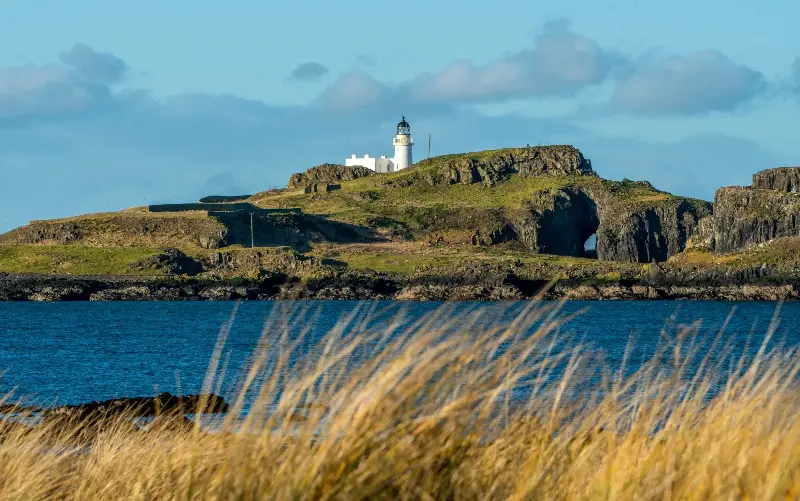
Of all the beaches to discover on the East Lothian coast, perhaps Yellowcraig is the loveliest. The sweep of sand is situated within easy reach of Edinburgh, a few miles west of North Berwick. A gorgeous, uninhabited island, Fidra, floats just offshore in the Firth of Forth, windswept and stacked.
In summer, when the sea turns brilliant blue and the sand glows gold, the island looks straight out of fiction, which it well might, as Fidra was the chief inspiration for Robert Louis Stevenson’s swashbuckling map in Treasure Island. The writer spent his childhood holidays on the coast, and the idea sharpens when learning his father, Thomas, and cousin, David, designed Fidra’s lighthouse.
Sightseeing cruises from North Berwick to Fidra, £20/9 adult/child; sulaboattrips.co.uk
4. Islay’s circular church
No Hebridean church is stranger than Scotland’s only completely round kirk. Topping out Bowmore’s Main Street on Islay, Kilarrow Parish Church has no corners, with a bow-fronted pew and a single central pillar supporting the coved ceiling roof. Legends persist on the island. One tells of the 18th-century chapel being built in a perfect circle so the devil had no corners to hide in. Another that Satan was once chased out by the congregation, only to hide in a whisky cask at the Bowmore Distillery at the road’s end. Boy, he’d have been so lucky.
Fly from Glasgow to Islay with Loganair, from £93 each way; loganair.co.uk
5. Ailsa Craig’s championship secret
Staring out at this tea-cosy-shaped island 10 miles west of Girvan, you’d be right to wonder about it, partly because the volcanic plug is so striking and partly because it is so strange. While uninhabited, Ailsa Craig is home to a clutter of gannet and guillemot colonies, making it one of the country’s prime birdwatching sites, and its bald-top defines the seascape along the South Ayrshire coast. On a RIB trip from Troon Marina, you can also learn how speckled, quartz-free microgranites are quarried there – and only there – for curling stones for the Olympics and World Championships.
Crackin Sea Tours offers RIB tours of Ailsa Craig, from £90pp; crackinseatours.co.uk
6. The final frontier on Unst
To the northernmost inhabited British Isle, where the lash of waves and squawking of skua and puffins – known locally as “tammie norries” – is only interrupted by the blasting of rockets into orbit from SaxaVord, the hilltop location of the UK’s first fully licensed vertical launch spaceport. Though launches are highly restricted, with residents first in line for viewings, a limited number of viewer passes are available for test flights. It’s the British Isles, but not as we know it, Jim.
For more information, visit saxavord.com
7. Raasay’s long and winding road
A story like this could only really happen on a forgotten island. It starts in Arnish, a crofting township on Raasay’s north in the late 1960s, when Inverness county council turned down the community’s request to build a lifeline road to connect it to the rest of the island.
Decades later, after Arnish was reduced to just two residents, one of them, lighthouse keeper and crofter Calum MacLeod, took matters into his own hands with a pick, an axe, a shovel and a wheelbarrow. It took him 10 years, but his steel-eyed grit saw the groundbreaker build 1.75 miles of single-track road across steep climbs, bog and moorland by hand, by himself. In the 1983 New Year Honours List, Calum was awarded the British Empire Medal.
CalMac ferries from Sconser on Skye to Raasay, from £5.30pp return; calmac.co.uk
8. Jura: where Big Brother was born
Travel can make for unlikely inspiration. Beset with tuberculosis, George Orwell travelled from London to the island of Jura – where there are more red deer than people – to plot out, draft and type his dystopian masterpiece, Nineteen Eighty-Four. He rented Barnhill, a far-flung farmhouse without electricity or hot water and, over several stints in the southern Hebrides, created his totalitarian superstates and Airstrip One.
Ferries from Tayvallich to Jura cost £27.50 each way; jurapassengerferry.com
9. Loch Lomond’s wallaby island
By yon bonnie banks of Loch Lomond, you’d probably not realise you were in the company of an unlikely troupe of wild wallabies. Inchconnachan, privately owned by Soho House founder Nick Jones and broadcaster Kirsty Young (note, it’s currently up for sale with a £3m price tag), is uninhabited apart from a dozen or so of the marsupials, which arrived thanks to the island’s former owner.
In the 1940s, Lady Arran Colquhoun transported the mini kangaroos north from her Hertfordshire home, alongside other exotic animals, including llamas and alpacas. Spot one today on a boat trip, and it delivers the Trossachs’ definitive through-the-looking-glass moment.
For more information on Loch Lomond and The Trossachs National Park, visit lochlomond-trossachs.org
10. Rock and roll on Sanda
It’s no secret that Kintyre’s most famous part-time resident is Sir Paul McCartney, but for a while in the late 1960s he wasn’t the only rock star with an eye on his own slice of coastal bliss. Off the peninsula’s southeast is Sanda, a speck in the Firth of Clyde but one once owned by Cream singer and bassist Jack Bruce, originally from Glasgow. The most commonly asked question is why – this isn’t Mustique or Montserrat – but this coast has enough romantic isolation and windswept drama to lure other daydreaming rock stars. Local legend has it that Sir Mick Jagger also attempted to buy nearby Gigha. A strange brew, indeed.
Mull of Kintyre Sea Adventures offers three-hour boat trips to Sanda, from £80/60 adult/child; mokseaadventures.co.uk