



I love museums. I enjoy the sense of discovery, the chance to compare great works of art and piece together how they connect with the narratives of history. I revel in the atmosphere of contemplation and reflection (though that is not quite so easy to find nowadays), and I am a great believer in going back and getting to know them even better.
But to pick the world’s best is tricky. We all have our own preferences. I have a bias towards painting and sculpture and, for me, a great museum also has to be a large one. Of course, there are many wonderful small museums – but they can’t compete with the heavyweights. To be truly great, a museum must have strength in depth – a collection which comprises many masterpieces and remarkable artefacts. It will take time to get to know, of course, but it will reward repeated visits over many years.
I was tempted to include the National Palace Museum in Taipei, for its unrivalled collection of Chinese art, and the Tokyo National Museum, the Japanese equivalent, but along with The Hermitage in St Petersburg – which is effectively inaccessible to us for the time being – they were pipped at the post by these, my top ten.
Kunsthistorisches Museum, Vienna
This is my favourite museum in Vienna and, indeed, anywhere. For a quiet visit, and a spectacular collection of paintings, nowhere can beat it. The Kunsthistorisches holds the jewels from the imperial Habsburg collection amassed over several centuries, but it gets relatively few visitors compared with its rivals in Paris, Madrid and St Petersburg. This means that you can enjoy some of the greatest works by Brueghel and Rubens, Titian and Tintoretto, Velazquez, Vermeer and Veronese in peace.
Why go in 2026:
Classic views of Venice, London and Vienna by Canaletto and Bellotto (his nephew) form a special exhibition from March 24 to Sept 6 (khm.at/en).
Louvre, Paris
The Louvre has a chequered history from a curatorial point of view – from raids by the rabble and the demolition of the Tuileries palace, to the theft of the Mona Lisa and the latest heist of jewellery. But its holding of art and antiquities – based mostly on the Bourbon’s Royal Collection which was “nationalised” during the Revolution, plus paintings and artefacts looted by Napoleon – matches those of the British Museum and National Gallery combined.
Why go in 2026;
Michelangelo/Rodin: Living Bodies explores the contrasting approaches of the two great sculptors to the human form, from April 15 to July 20 (louvre.fr).
British Museum, London
The gold standard for all public museums since it was founded by an Act of Parliament in 1753 which guaranteed that its collection was available free to “all studious and curious people”. From the Parthenon Marbles to the Rosetta Stone, Ming vases and the Lewes Chessmen, it offers a unique overview of the world’s historic civilisations, a landmark in human culture and learning in its own right.
Why go in 2026:
The arrival of the Bayeux Tapestry this autumn (dates to be announced) is expected to be the museum’s most popular exhibition ever (britishmuseum.org).
National Gallery, London
Unusual among the world’s greats because, like the British Museum, it was founded, not on royal collection, but through philanthropy, donations and grants from the state. The collection has been brilliantly constructed so that it now comprises major works by virtually every important European artist from 1250 to 1900. True, it’s short on women painters, but that is a universal failing and no other gallery in the world can give such a comprehensive account of all the major schools.
Why go in 2026:
The great Spanish artist, Zurburán, is the subject of a rare retrospective from May 2 to Aug 23 (nationalgallery.org.uk).
Metropolitan Museum of Art, New York
Founded in 1870, the Met is a relative newcomer compared with its great European rivals, but in some respects it outshines them. No other museum has such a comprehensive collection of significant art from so many cultures. The thought and care invested in displaying the exhibits is outstanding. Its unique collection of period rooms – from a frescoed 2,000-year-old Roman bedroom to historic boudoirs, drawing rooms and salons from France, Italy and England – are the jewels in the crown.
Why go in 2026:
Raphael: Sublime Poetry includes more than 30 of his paintings and 170 drawings, March 29 to June 28 (metmuseum.org).
Vatican Museums, Rome
The papal collections have been making waves since the high Renaissance when Pope Julius II had the Belvedere villa connected to the Vatican Palace, and installed some of the greatest sculptures rediscovered from ancient Rome in the monumental courtyard. He also commissioned Raphael to decorate his private chambers along with Michelangelo and others to fresco the Sistine Chapel. It now comprises several different museums combined into a labyrinthine series of galleries and endless corridors, but there are glittering prizes at every turn.
Why go in 2026:
The museums rarely hold special exhibitions, but after the Jubilee Year of 2025, when the number of visitors soared, this year should make for an easier, quieter time (museivaticani.va/en).
Prado, Madrid
From the 16th to the 18th centuries, the Spanish Habsburg kings were among Europe’s most sophisticated cultural patrons, inviting the most famous artists, such as Rubens, El Greco, Velasquez and Goya, to Madrid and acquiring hundreds of works from others, such as Titian, who were based abroad. The result is this fabulous collection housed in a purpose-built gallery which was first opened to the public in 1818.
Why go in 2026:
Queen Isabella Farnese and the Museo del Prado examines the legacy of Queen Isabella Farnese (1692–1766), whose collection included 350 paintings now in the Prado. Until May 24 (museodelprado.es).
Grand Egyptian Museum, Giza, Cairo
The GEM finally opened fully only last November, and I have yet to visit. So I am relying on my colleague Chris Leadbeater’s confirmation that, despite a nearly 12-year delay, the wait was worth it. The vast new building houses the ultimate collection of ancient Egyptian artefacts, with a grand entrance staircase flanked by effigies of many of the stars of the pharaonic pantheon, the riches from the tomb of Tutankhamun and dozen of other galleries arranged of other treasures. It’s all arranged in historical order from 7000 BC through to the fourth century AD.
Why go in 2026:
Because the wait is finally over (gem.eg).
The Uffizi, Florence
The Uffizi provides a unique window into the history of Florentine Renaissance art through the finest and most representative collection of paintings – all of it housed in the former Medici office building. The spectacular sequence of galleries features seminal works by Giotto, Martini, Botticelli, Raphael, Leonardo and Michelangelo, among many others. And it also includes masterpieces from great artists from further afield such as Titian and Caravaggio, plus a great Rembrandt self-portrait.
Why go in 2026:
Lorenzo the Magnificent in Florence will reconstruct the Medici collection as it was in 1492, the year Lorenzo died. Coming autumn 2026 (dates to be announced), it is bound to be busy – book your entry time well in advance (uffizi.it).
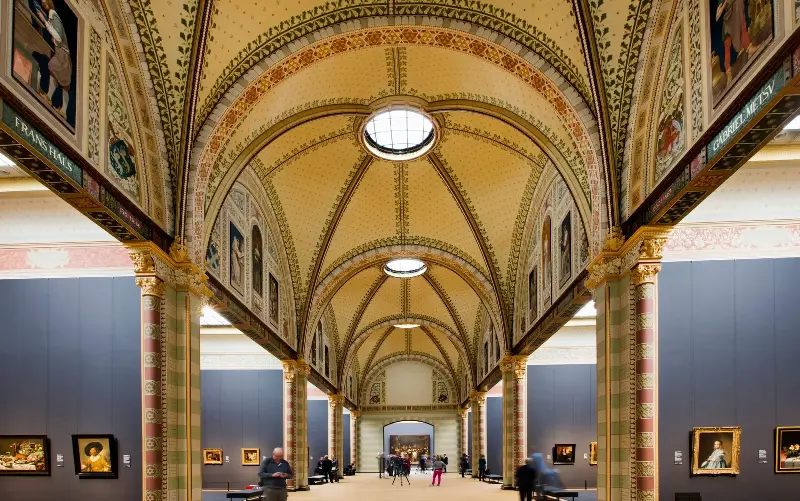
Rijksmuseum, Amsterdam
I agonised. Should my last pick be the Musée d’Orsay for its 19th-century treasures, MOMA in New York for its great 20th-century collection, or the Rijksmuseum with its riches from the 17th century when Holland was one of the world’s great naval, trading and colonial powers?
I picked the last of these because the Dutch museum also traces the longer cultural history of the country. Nevertheless, the big attraction is the Gallery of Honour, with its masterpieces by Vermeer, Jan Steen, de Hooch and Rembrandt, culminating in The Night Watch, which you can currently see being restored in its own gallery.
Why go in 2026:
A splendid new exhibition, Metamorphoses, includes works by Titian, Caravaggio, Rubens and Rodin, all inspired by Ovid’s epic poem. Feb 6 to May 25, 2026 (rijksmuseum.nl).