



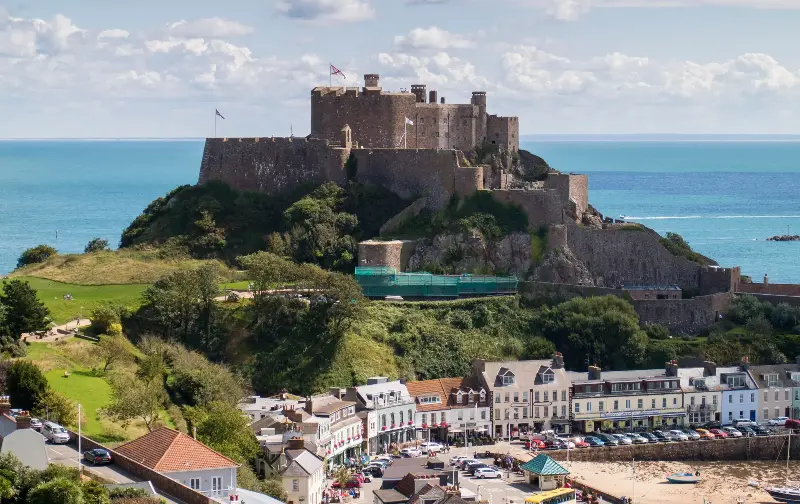
Looking east from the battlements of Jersey’s Mont Orgueil Castle, France seems almost close enough to touch. Well, it’s less than 15 miles away; by comparison, the English motherland is 85 miles distant.
Mont Orgueil was built in the 13th century, when King John lost Normandy, but Jersey and Guernsey pledged allegiance to the English crown – though it got its name (“Mount Pride”) when it was briefly captured by the French. The moniker stuck. A British bastion with a French name. How very Channel Islands.
These floating bailiwicks have always been defined by their closeness to France, both in terms of cultural exchange and strategic importance. Here, historically, the enemy could be kept in sight. Now, that old enemy is not only invading again but being positively encouraged.
In 2025, Guernsey reported a surge in French visitors, with numbers up 74 per cent on 2024, largely due to new Brittany Ferries services from St Malo, timed to enable a full day trip. This had a knock-on effect, with more French tourists exploring the smaller isles such as Sark and Alderney; now, even tiny Herm (population: 65) is seeking to court more vacanciers from the continent. By contrast, Jersey saw French arrivals drop – so it is focusing on rectifying that in 2026.
Their passage will continue to be eased, too. In light of the imminent introduction of ETAs for travel between Britain and Europe, governments of both Crown Dependencies have voted to extend the scheme that allows French visitors to enter for day trips using ID cards, rather than passports – handy, as around half don’t have one. The message seems clear: people of France, bienvenue!
Baked beans meets moules marinière
But what are French visitors coming for? Rewind a few decades, and these islands were decidedly English escapes, offering cheap booze, duty-free and old-fashioned seaside charm. Tourism has changed substantially since – and local businesses are keen to insist that all visitors are equally welcome – but what does this renewed interest from across the water reveal about the islands’ Anglo-French identity?
“It changed in the 20th century,” says Christine Bonhomme, director at Maison de la Normandie et de la Manche, an organisation founded to maintain and strengthen links between the French regions and the Channel Islands. “Jersey was really, really French. Then it became more British.”
Today, that blend is part of the appeal for all visitors, Christine reckons. There are crêperies in Victorian markets, country lanes named in Jèrriais and Guernésiais (the local languages, variations of Norman French), pubs serving heaps of both fish and chips and moules marinière, and the Co-op supermarket stocking Heinz baked beans next to Carrefour hollandaise and Brittany galette biscuits. “The French like going to a cafe for a full English. The Brits go to a French bakery for a croissant,” says Christine. “You can see both influences.”
‘The French keep my chefs busy; the Brits keep my wine fridges rotating’
At Gorey’s Moorings Hotel, which has been welcoming guests beneath Mont Orgueil since 1851, owner Matthew Jones sees national preferences play out in real time. “The French want a very British experience,” he says. “They step off the boat at 11:59am, already declaring they’re starving, sit down with purpose and order a three-course lunch like they’ve trained for it. The Brits drift in around 1pm, pleasantly dazed after an enormous hotel breakfast, and nibble six oysters and a glass of chablis ‘just to tide them over’.”
So which nationality is “better”? Matthew remains diplomatic. “The French keep my chefs busy; the Brits keep my wine fridges rotating. I’m very happy with both – and I’d like to keep them all coming back.”
Louise Downie, director of curation at Jersey Heritage, admits that, being from the island, “I don’t really see the Frenchness or Englishness – it’s just home.” She was part of the team that created the new La Tèrr’rie d’Jèrri (Being Jersey) exhibition at the Jersey Museum, which focuses on the island’s distinct characteristics. That said, she has noticed visitors of different nationalities seem to gravitate towards different attractions: “The French prefer medieval Mont Orgueil and the fact you can see over to France. The British prefer Elizabeth Castle, an island off an island.”
Entente cordiale
The same is true on Guernsey. Hauteville House, former home of Victor Hugo and one of only two French museums on foreign soil (the other being on St Helena), is particularly popular with the French. According to Hauteville’s Cédric Bail, the museum saw a 40 per cent rise in French visitors in 2025. As for the wider appeal of Guernsey? “It’s not particularly French nor English,” he adds. “It is a world on its own.”
A world that warrants more than a day trip, reckons Karel Harris, managing director of Guernsey’s Sarnia Hotels, who has noted an increase in the number of French guests staying, generally for two nights. “More and more people of all nationalities seem to value time in nature, and our cliff paths are wonderful,” she says. “And we had a few years with high numbers of cruise ship visitors, and as a result there are lots of accredited guides and tours catering to different interests: history, particularly of the Occupation, or foraging and local produce, and also guides able to offer tours in different languages.”
For French expat and restaurateur Marvin Odillard, who runs Cornerstone in St Peter Port plus four other bars and cafes, the shift has been dramatic. “We’ve had a lot more French visitors this summer. Lunchtimes used to be really quiet, but it’s been buzzing with more of a French bistro atmosphere. With Hauteville House nearby, I’ve started to call this part of town the French Quarter, because you hear French everywhere. I haven’t seen fewer British visitors but more French tourists, definitely.” Such was the influx that Marvin put on French lessons for his staff.
“I think the French see Guernsey, in particular, as a little gem,” Marvin adds. “They love the architecture, tranquillity, natural beauty and community spirit. They are also surprised by how friendly and helpful islanders are; I’ve overheard stories of French visitors getting lost and being given a lift by a local.”
Both islands share a long, sometimes dark, history with France. Norman roots run deep, from the ancient dialects to the enduring medieval laws (Jersey’s clameur de haro is still occasionally invoked); this heritage will be spotlit in 2027, when Europe celebrates the Year of the Normans. Meanwhile, the Occupation left scars and stories that feel closer to France’s wartime experience than Britain’s.
But it is the everyday meld that gives the islands their unique appeal. The French come for Britishness. The British come for Frenchness. Both discover something different. The Channel Islands seem to have pulled off the neatest trick: making everyone – French, British, and others – feel both somewhere a bit exotic, and also at home.
For more info, see Visit Jersey and Visit Guernsey/