



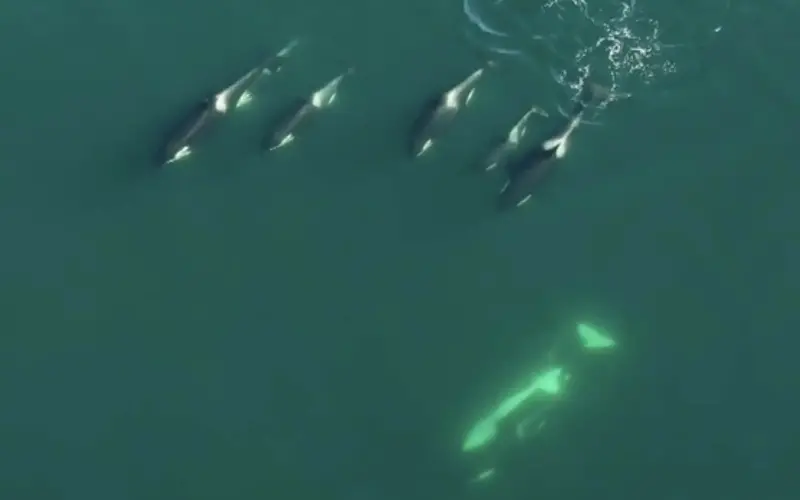
Killer whales and dolphins have been found hunting together for the first time.
Canadian scientists said the two species had developed a “strategic allegiance” to hunt salmon in deep water.
A study in the journal Scientific Reports found the dolphins were adept at finding large Chinook salmon but were unable to swallow them whole.
The orcas were then observed following the dolphins to their prey and would leave “scraps” for dolphins to feed on.
The scientists used drones and miniature cameras to record footage of the collaborations and recorded 258 different occasions where dolphins travelled near killer whales in waters off Vancouver Island in 2020.
It is the first evidence of the two species hunting together. Dr Sarah Fortune, of Dalhousie University in Nova Scotia, said: “We were all just like, ‘What?’
“It was incredibly exciting because killer whales are very well-studied — their diet is well-known, their foraging areas, their population — but the exciting thing is whenever we can apply new technologies that can push the limits of available data, inevitably we end up with new insights that show us the lack of understanding we previously had.”
She added: “We’ve long known that resident killer whales interact with Pacific white-sided dolphins, but seeing them dive and hunt in sync with dolphins completely changes our understanding of what those encounters mean.
“Our footage shows that killer whales and dolphins may actually be co-operating to find and share prey, something never before documented in this population.”
‘Strategic alliance’ formed in pursuit of prey
Dr Andrew Trites, of the University of British Columbia, said the killer whales were using the dolphins as “radar-equipped scouts”.
“The strategic alliance we observed between the dolphins and killer whales is extraordinary,” he said.
“By working together, killer whales can conserve energy and use the dolphins as radar-equipped scouts to increase their chances of finding large Chinook salmon at deeper depths. In return, the dolphins gain predator protection and access to scraps from one of the ocean’s most prized fish. It’s a win-win for everyone involved.”
The species were first observed working together by Keith Holmes, a drone pilot at the Hakai Institute, a scientific research institution.
“From above, you could see this incredible amount of activity,” he said. “It was clear that there was some sort of communication happening and they were actively foraging together.”
Earlier this year the BBC’s Parenthood documentary found that orcas practise drowning their friends as a way to learn how to hunt large prey like blue whales.
Footage captured by film crews off the coast of Australia showed a pod of killer whales honing their hunting skills in a world first.