



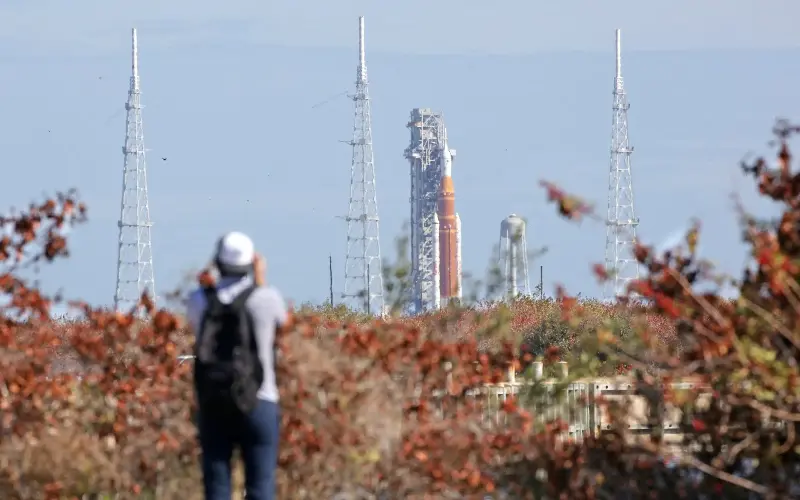
Nasa has delayed returning humans to the Moon after its Artemis II mission was beset with further problems.
The US space agency had originally planned to blast off this month, but the launch was cancelled when a hydrogen leak was discovered in one of the rocket’s umbilicals, which connect the launch pad to the vehicle.
It was hoped the rocket could get away in a second launch window, which was scheduled to open on March 6, but Nasa confirmed on Monday that new problems with the flow of helium to the Space Launch System (SLS) rocket had ruled out a lift-off next month.
The space agency said it was now “hoping for April”.
It is the first time that humans have tried to return to the Moon since the final Apollo mission in 1972, and the Artemis II mission will take astronauts further into space than ever attempted.
During the 10-day round-trip astronauts will orbit the Moon but not land. The crew is composed of three Nasa astronauts: Reid Wiseman, the commander, Victor Glover, the pilot, and Christina Koch, the mission specialist, along with Jeremy Hansen of the Canadian Space Agency.
The mission can only launch on a few days each month when the Moon is in correct alignment with the Earth.
Nasa may be forced to take the unwelcome step of moving the spacecraft back to the Vehicle Assembly Building – the huge hangar at the Kennedy Space Center in Florida – so that engineers can fully assess the latest problem.
The issue was detected during a test known as a wet dress rehearsal, in which the rocket is fuelled to check that everything is ready to go.
The upper section of the giant rocket uses helium to pressurise the liquid hydrogen and oxygen tanks, and maintain proper environmental conditions for the engine.
But the team saw that helium was not flowing correctly, forcing them to switch to a backup method to keep the engines and tanks operating safely.
Launch issues
Nasa is still working on the issue at the launch pad, but has removed access platforms around the rocket so that it can be moved back to the assembly building, which is now likely.
A rollback is laborious and would signal a significant setback for the project. Moving the huge rocket may also be scuppered by strong winds which are expected to hit Florida this week.
Jared Isaacman, the Nasa administrator, said: “Teams are troubleshooting and preparing for a likely rollback of Artemis II to the Vehicle Assembly Building.
“This will almost assuredly impact the March launch window. Nasa will continue to provide updates as they become available.”
Nasa said even if it was forced to roll back the spacecraft, an April launch could still go ahead, although the timeline may now slip to May.
During testing this month, Nasa also identified problems with the communications systems and with securing the hatch on the Orion capsule, which will peel off and take astronauts to the Moon.
It is the latest problem to befall the Artemis mission, which has suffered years of delays and setbacks. Artemis I was a year late in taking off, after suffering a crack in the thermal casing, a hydrogen leak and, finally, a fatal engine cooling problem.
The uncrewed Artemis mission eventually launched in 2022, to test navigation, propulsion and life support systems.
The propulsion system is being provided by the European Service Module, built in Germany by Airbus, which also supplies air and water to the crew and controls temperature.
For the final stage of the mission, Artemis III will see astronauts land on the Moon and is scheduled for 2028 at the earliest.