



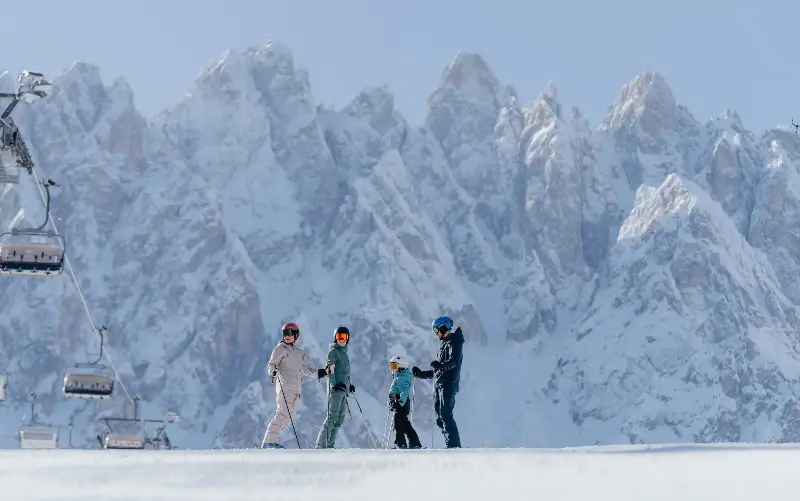
Italy is the buzzword among skiers and snowboarders this season. The 2026 Winter Olympic Games are heading for hosts Milan and Cortina d’Ampezzo, and the nation’s ski resorts are preparing for their moment in the global spotlight.
With such hype around the destination – data from the Mountain Trade Network reveals 34 per cent of Britons are considering Italy for a ski holiday this season, an annual increase of over 10 per cent on actual visits – imagine my surprise when I learnt the nation’s “best” ski resort was a place I had never heard of.
Introducing 3 Zinnen Dolomites, named the top resort in Italy for the second year running by the World Ski Awards 2025, leaving the likes of Cervinia, Cortina d’Ampezzo and Courmayeur in its wake. Intrigued, I set out for Italy’s Sud Tirol, the border region between Italy and Austria, to discover what defines podium-worthy skiing in il bel paese.
An unassuming confidence
Hotel Alpenblick in Sesto (known in local dialect as Sexten) was my base camp. The hamlet, which stretches along a mountain road at the foot of the area’s slopes, is one of 3 Zinnen’s five villages. Completing the line-up are Dobbiaco (Toblach), at the entrance to the area; the larger San Candido (Innichen); and Braies (Prags) and Villabassa (Niederdorf), smaller outposts that move at a slower pace. Beyond the cluster of traditional villages, the Ski Pustertal Express train links the area with better-known Kronplatz in 35 minutes, providing access to 100km (62 miles) of slopes covered by the wider Dolomiti Superski pass.
Visiting for a long weekend, I focused my attention on the 115km (71 miles) of local slopes, which I soon found connected smoothly between numerous valleys. Arriving last spring, I was also reassured by a giant network of snow-making facilities, which provided a 100 per cent snow guarantee. The lift system was impressive for such an under-the-radar area too: 31 lifts operating entirely off renewable energy, including the six-seater chairlift in the Croda Rossa area, designed to carry over 2,000 skiers an hour.
Untaxing skiing and smooth connections
This is where I started my tour of the piste map. Croda Rossa is home to Italy’s steepest groomed slope, the Holzriese (71 per cent gradient) and part of the Giro delle Cime, an all-day 43km (27 miles) circuit through the Dolomites, covering 5,600m elevation. Despite the slopes being shrouded in stubborn cloud, it was a delight to lap the wide, untaxing red and blue pistes before returning to the valley at Signaue (stopping for hot chocolate and strudel at the slopeside Henn-Stoll) and segueing smoothly onto the gondola up to Stiergarten (2,100m).
The skiing continued for much of the day on similarly pleasing slopes, crossing through forests and traversing along the valley back to my base in Sesto. I was (almost) able to ski to the door of the Alpenblick before an evening of welcoming Sud Tirolean hospitality, including Hugo Spritz cocktails and an indulgent, six-course dinner.
The following day dawned brighter, and I continued in the same direction, following the slopes down into Sesto proper before catching the Helmjet gondola towards the top of the ski area at Monte Elmo (2,250m). Here the slopes were much busier – again a combination of red and blue, with the occasional test of black. Run 13, which travelled the distance down into the valley at Vierschach Versciaco (1,131m) was a delight.
From here, free buses could have taken me onto the ski areas at San Candido, Braies and Villabassa, but with temperatures threatening rain at low altitude, I opted to stick to the highest slopes and enjoy the well-connected runs back from Monte Elmo towards my base. I wanted to preserve energy for the pinnacle of my Dolomites skiing experience the following day.
The ultimate Dolomites ski experience
The weather improved further over my final breakfast and I was relieved to see blue skies and sunshine as I travelled to Signaue to meet guide Micro Dell’Osta from Alpinschule Drei Zinnen. We were setting out on a day’s ski touring, with hopes of revelling in the views that entice millions of people to visit the Dolomites each year.
The route we’d set our sights on began at the top of the gondola at Stiergarten. As I applied sun cream and removed layers, Micro pointed out a cross on a peak in the distance above us, the summit of Mount Arnese (2,550m) on the geographical Austria-Italy border. He set it as our target as we attached skins to the bottom of our skis and pushed away from the pistes.
It was, as promised, a gentle climb and I was glad – moving slowly allowed the chance to marvel at the surroundings. Finally, I saw the iconic Tre Cime di Lavaredo, the world-famous symbol of the Unesco-listed Dolomites. The three spires of rock stood proud in the distance across the valley, and the surrounding massifs were equally impressive, showcasing exposed rocky ridges and skyscraper-shaped towers of granite.
We weaved our way slowly up the mountainside, practising kick turns on steeper sections and monitoring the snow conditions to choose our line of descent. Two hours later, as we neared the summit, we passed old military bunkers buried in the snow and eventually reached our target. As I stood – one ski in Italy, one in Austria – it felt like a suitably impressive trophy for my first time in the Dolomites.
Our descent took us to the Klammbachalm (1,950m) for a lunch of traditional knödeltris (a trio of bread dumplings) a short hop from the pistes. It hadn’t been the most challenging day I’ve ever spent on skis and hadn’t taken Olympian-level technique or grit, but I was far from disappointed – my first foray in the Dolomites had revealed a lot about skiing in Italy and I was hooked by its modesty.
Despite the mountains’ Unesco-recognition, the impending Olympic spotlight and best-in-class awards, the nation’s ski resorts remain unassuming and underrated – fittingly, 3 Zinnen is the perfect champion.
Lucy was a guest of 3 Zinnen Dolomites.
Essentials
Hotel Alpenblick in Sesto (0039 047471 0379) offers rooms from €142 (£123) per person per night. easyJet flies to Venice Marco Polo from £19 in winter, one-way. The Cortina Express operates daily transfers from Venice Marco Polo airport via Cortina to the 3 Zinnen Dolomites ski area. An adult six-day 3 Zinnen lift pass costs from €364 (£315). A private ski touring with Alpinschule Drei Zinnen costs from €135pp (£117pp).
About our expert
Lucy Aspden-Kean
Lucy Aspden-Kean is The Telegraph’s ski editor. She has been writing about ski holidays for The Telegraph for more than a decade, during which time skiing has provided her the opportunity to travel the globe, from heli-skiing in Patagonia and powder in Japan to ski touring the Dolomites and enjoying après in St Anton. After learning to ski on a family holiday to Austria aged 13, she has developed a life-long passion for the mountains, and loves nothing more than helping others find the perfect resort, holiday and experience on the slopes.