



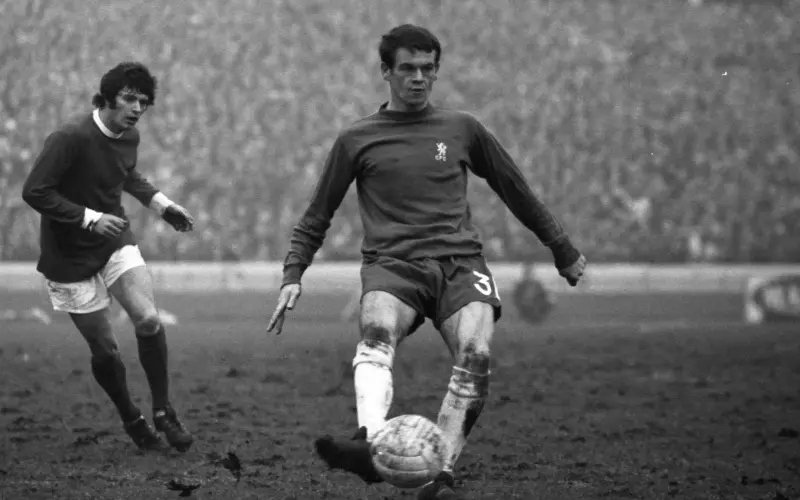
Eddie McCreadie, who has died aged 85, was a footballer and one of the unsung heroes of the great Chelsea side who won the FA Cup in 1970 in a brutal clash with their bitter rivals, Leeds United; a take-no-prisoners but talented left-back who would have made a terrific wing-back in the modern game, he later managed the Blues, rebuilding the side and taking them back up into the First Division after a period of decline.
In 1970, in a replay at Old Trafford that lives on in football’s collective memory as one of the greatest (if dirtiest) Cup finals, McCreadie all but decapitated his Leeds opponent Billy Bremner – a great friend and his Scotland teammate – in an aerial assault which would be a straight red card today but was not even a foul on the day. “I enjoyed that side of the game,” he admitted in later years, “but I wasn’t dirty, I didn’t think.”
Edward Graham McCreadie was born on April 15 1940 in Cowcaddens, Glasgow, and supported Partick Thistle as a boy. He played for the amateur side Drumchapel, then Clydebank Juniors. Thistle did not rate him, but East Stirlingshire signed him in 1959.
In 1962 the Chelsea manager Tommy Docherty was up from London to watch another East Stirling player, but was impressed by McCreadie – “I thought, ‘why the hell are you playing here?’” – and signed him for a fee of £5,000 and a promise to play two friendlies.
He was soon established in the Chelsea side, who were promoted to the First Division in his first season at Stamford Bridge and went on to play some of the most attractive football of the decade under the attack-minded Docherty.
In the first leg of the 1965 League Cup final McCreadie scored a remarkable winner, dribbling 80 yards up the pitch before coolly slotting the ball past the Leicester City keeper Gordon Banks – one of only five goals he scored for the club. He was solid in defence as a goalless draw in the second leg secured the trophy. That year he won the first of his 23 Scotland caps in a 2-2 draw against England.
The FA Cup final followed in 1967, a 2-1 defeat to Tottenham Hotspur. But a few weeks before that McCreadie had one of the most enjoyable experiences of his career, in his 10th international, when World Cup winners England were beaten 3-2 at Wembley – leading Scots fans to label their side the new “world champions”.
While Chelsea were generally there or thereabouts in the First Division, they were at their best in knock-out football, and in 1970 they reached another FA Cup final. The first match against Leeds, at Wembley, was a 2-2 draw, while the Old Trafford replay was an epic which the Blues won in extra time. McCreadie won a throw-in on the left. It was taken by the long-throw specialist Ian Hutchinson, and McCreadie’s defensive colleague David Webb bundled the ball over the line for a memorable victory.
McCreadie missed the following season’s European Cup-Winners’ Cup final win against Real Madrid with an injury, and two years later he retired, having played 410 games for Chelsea. He was immediately taken on to the coaching staff, but Chelsea’s first golden era was done: they were on the verge of bankruptcy, and in 1975, a month after McCreadie had been given the top job, they were relegated.
He set about reviving the Blues’ fortunes with a judicious mixture of young talent and old hands, taking the captaincy away from the veteran John Hollins and giving it to the 18-year-old Ray Wilkins (“everyone thought I was a nutcase”) – and in 1977 he led Chelsea back into the First Division.
But he immediately resigned after a disagreement with the directors – some sources claim that it was over a company car, though McCreadie denied this. He joined the stream of Brits crossing the Atlantic and joined Memphis Rogues of the North American Soccer League as manager (he also played one game for them).
He later managed the indoor side Cleveland Force, then retired from football in 1985. He spent the rest of his life in the US, later living on a farm in Tennessee owned by the brother of his American wife, Linda, and becoming a Christian. He did not visit Chelsea until 2015 and a plaintive chant was still sometimes heard at Stamford Bridge (to the tune of “Jimmy Mack” by Martha and the Vandellas): “Eddie Mac, when are you coming back?”
Eddie McCreadie, born April 15 1940, died January 12 2026