



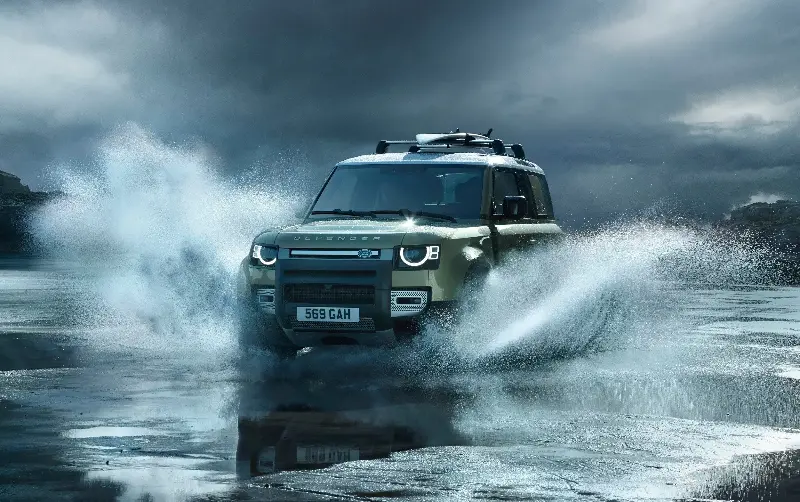
Join the conversation and let us know what you think about Land Rover in the comments section below.
The iconic Land Rover first hit Britain’s roads in 1948 with the Series I, emerging from Solihull as a rugged workhorse and a champion of post war British engineering.
Inspired by the Willys Jeep used throughout the war, the first edition of the famous vehicle was aimed at the agricultural and industrial sectors and was an instant success.
Admired by both the Duke of Edinburgh and the late Queen, the Land Rover went on to cement its place in the upper echelons of British society, becoming inextricably linked with the Royal family.
Fast forward to the present day, the modern Land Rover offering has focused more on luxury and cutting edge technology over the dependability and versatility of old.
No longer a tractor’s companion but now accused of being a ‘Chelsea tractor’ after multiple takeovers in the 21st century. Has the Land Rover lost its way for the many enthusiasts who so enjoyed the durable, reliable and roaring combustion engined models of old?
At Land Rover’s sister brand Jaguar, internal combustion engines will be a thing of the past. An astonishing move for a manufacturer so famous for the V12 that powered to two Le Mans victories and made the E-type into one of the finest grand tourers, amongst many other legendary machines.
Offerings such as the £170,000 Range Rover Electric show the direction of travel at Land Rover too, further away from the diesel and petrol powered machines of yesteryear.
‘Looked great anywhere and everywhere’
Stephen Bedder, 64, grew up in Solihull and was totally immersed in the world of Land Rover with both parents working for ‘The Rover’ factory as it was at that time.
The primary source of employment in the midlands town, the Land Rover was the first vehicle he “became aware of as a child”.
But it wasn’t until the 1969 revelatory release of the Ranger Rover, with its 3.5L V8 engine, 4-speed gearbox and stunning new look that he was first blown away.
“They were like nothing else on the road. Still go anywhere like a Land Rover but faster, quieter, stylish, bigger. Just drop dead desirable,” Stephen said.
“Land Rover Defenders looked like they should be in the desert or on a farm, and maybe chugging along A or B roads. But the Range Rover looked great anywhere and everywhere.
“At home on the M5, city centre, towing a boat, on the beach, in the jungle, driven by the SAS and the Royal family. How could you not want one?”
Whilst Stephen wasn’t quite able to achieve the dream of owning a classic Range Rover, he was finally able to scratch the Land Rover itch with a couple of Discovery 1s in the early 1990s - first a diesel and then 3.9L V8 petrol.
“The original Discovery was pretty much a Range Rover mechanically but with a modern family friendly seven seat body sitting on that versatile ladder chassis. The kids loved clambering into the back of the Discovery, and claiming the fold down seats.”
In total Stephen has owned four models of Land Rover, enjoying jaunts across Europe with the family in the Discoveries and now keeping entertained in retirement with a 1999 P38 which “you will find my legs sticking out from under it most Sunday mornings,” he says.
‘There is nothing in the current range which attracts me’
Despite a life engrossed in Land Rover, it was price that ensured the dream of owning a Range Rover eluded him, as practicality trumped luxury whilst bringing up a family.
Even with the clamour for a classic model however, Stephen says that “[if] money [were] no object there is nothing in the current JLR range which attracts me. They need to toughen up and simplify.”
With new Range Rovers starting around £92,000, they are certainly a world away from the originals in terms of affordability. Upon its release in 1970, the original Range Rover retailed at £1,998, which using the Bank of England’s inflation calculator would be £27,752 today.
Price is not the only put off for prospective buyers of the new fleet however. Recently our writer Clare Mcnaughton detailed how her £96,000 Land Rover Discovery was defeated by a Surrey car park upon returning from holiday.
Reliability, it seems, is one of the major bugbears of this generation of Land and Range Rovers, with plenty of readers sharing their own experience of JLR vehicular travails.
Nick Beart, 60, a company director detailed his exasperation with Range Rover: “I have a Range Rover PHEV. Endless electrical faults and it took two months to get back on the road after a battery failure, even though it was under warranty.
“When Land Rover products work they are wonderful but they don’t do that often, in my experience anyway.”
Electrical gremlins seem to be commonplace and with modern systems customers are often at the mercy of the local dealer as the days of do it yourself dwindle.
‘Within a month, it packed up’
Matthew, 65, a company director from Oxfordshire is a long-term sufferer of Land Rover issues.
In April 2025 he purchased a Land Rover Defender and was almost immediately met with serious issues.
“Within a month, it packed up at night on the side of a busy road,” he explained. “Even the emergency lights would not turn on.”
Land Rover outsourced the recovery of the vehicle to the AA and Matthew was stranded roadside for two and a half hours.
When the car was eventually recovered, it was diagnosed that the ACDC converter had malfunctioned - an issue Land Rover were aware of but still sold him the vehicle with the faulty component.
It is not just electronics causing shocking experiences that have turned people away from the current generation of Land Rover offerings.
As Stephen says “these modern ones have just silly levels of luxury upholstery and technical complexity. I wouldn’t trust myself with a coffee while driving.”
Gone are the days where you might associate a Range Rover with the late Queen Elizabeth II peering over the wheel driving through a country estate, but now more on the school run in the leafy suburbs of south west London - earning the moniker of the Chelsea tractor.
This too has turned enthusiasts of the traditional models off of the modern generation.
Christopher Pike bemoaned that “they’ve ruined Land Rover, the loyal base of which are reduced to buying and repairing old models. The new Defender is a Chelsea tractor, not the utilitarian work vehicle we all loved.”
Alec Jordan shared similar views: “I have had three Defenders and a Range Rover. I would not touch the current versions with a bargepole – they are not serious off-roaders.
“With the new Defender, instead of providing a proper capable and comfortable utility vehicle to challenge the Land Cruiser, they have ignored their farming and real off-road customers.”
A huge cyber attack last year saw Jaguar Land Rover’s car production plummet by 45,000 and a 25pc drop in retail sales for the final quarter of 2025.
So, despite strong performances before that unfortunate event, perhaps it is time to listen to admirers of their historical cars to draw them back in.
‘Cars need an emotional connection with the owner’
But what could the company do to convince devotees of the brand like Stephen that they could still provide a joyful driving experience?
One way would be to move back to the internal combustion engine and away from fully electric cars, which Stephen feels are “as soulless as a washing machine”.
“Keep the internal combustion engine. It’s what gives a car a soul and a jerry can of diesel is a lot easier to find in the Welsh hills than a charging point.
“[Fully electric] without even the choice of a dependable river wading diesel or a lovely petrol V8? Self harm and vandalism. Surely cars still need to have an emotional connection with the owner.”
Customer service has also been an issue for some customers with a less than satisfactory experience, something that Matthew said he ran into with his various Land Rover issues.
“You spend all this time getting fancy coffees and biscuits to be sold the expensive car, and the second you buy it, they lose all customer service.”
He believes the disconnect between private dealerships and Land Rover means that the customer service is having a deeply detrimental effect on the brand that served him so well during his days in the military.
He went on to say that “The salesman sometimes doesn’t understand how these cars work and what they do. The salesmen are not taught about the cars. They are just told to sell and not about the cars.
“Back in the day, the salesmen used to eat, sleep, and breathe Land Rovers and knew everything.
“They are selling this brilliant brand, but the quality is declining.”
Whilst Matthew soldiers on with his Range Rover and Land Rover Discovery, plenty of long-term aficionados of the famous brand have sworn never to return due to the various issues they face.
Jaguar Land Rover under the ownership of TATA have pursued more upmarket styles and have seen great exporting success. But perhaps a warning is to be heeded domestically, that they risk alienating enduring customers without a return to its famous routes.