



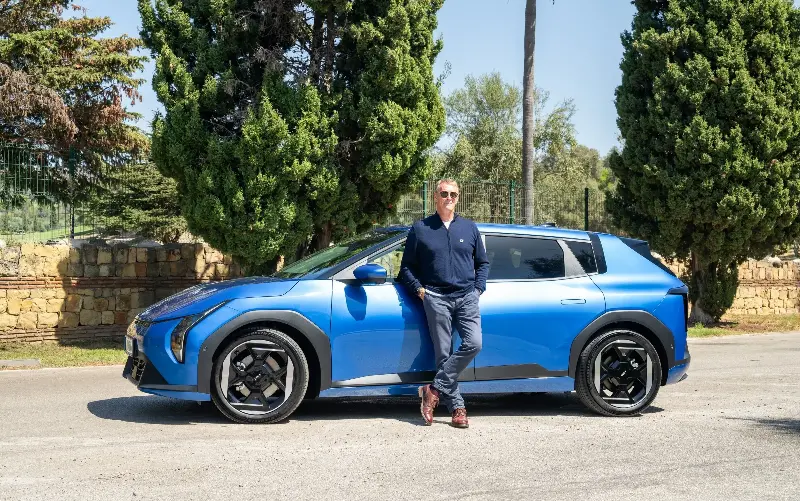
If most of us remember the saloon versions of successful hatchbacks, it’s with seat-squirming embarrassment (remember the Ford Escort-based Orion or the Vauxhall Astra-based Belmont?). Kia is hedging its bets with this EV4 hatchback. Perhaps mindful that one of its most successful rivals, the Tesla Model 3, is a saloon, there is also a booted version called the EV4 Fastback.
Much of Tesla’s success is due to a well-spread series of fast chargers linked to the car’s navigation system, so long journeys can be planned and charging takes place relatively quickly. And while the rest of us are coping with an often overcrowded, sometimes unreliable and hideously overpriced roadside charging network (up to 85 pence per kW), Tesla Superchargers cost about 36ppkW. Charging at home can cost as little as 8ppkW, but if you travel far and wide in your EV you’ll pay for it.
Faced with this, the public vote with their feet. Even with the Government’s recent EV incentive to private buyers, the more fiscally-advantageous deal offered to fleet buyers means sales there are by far the greater. Kia, for example, reckons that more than three quarters of its projected 3,000 annual sales of EV4s will be to fleets.
Looking good
That seems a bit of a shame, because what a looker this car is in hatchback form, as good in the metal as it is in photos. The Fastback version isn’t so convincing and is going to sell a small percentage. Paint colour matters; the deep metallic blue shown here looks a darn sight better than the grey option.
The hatchback is 4,450mm long, and with the bigger battery option it weighs 1.91 tonnes. Suspension is all-independent via a MacPherson strut front and a five-link rear, with frequency-selective damping all round. The hatch is made in Europe, the Fastback in South Korea.
The range starts with the £34,695 Air, with a 58.3kWh lithium-ion battery and a range of 273 miles. The same trim with the larger 81.3kWh battery costs £37,695 and has a class-leading range of 391 miles.
At the top end are well-specified GT Line and GT Line S models, with the top S version tested here at £43,895 with an 81.4kWh battery and a range of 362 miles.
The Fastback is only available in the two big-battery GT Line trim levels, both with a range of 380 miles and costing £40,895 and £45,395 respectively.
The electric bits
The EV4 is based on last year’s EV3 SUV and it feels similar. All EV4s have the same front-drive, 201bhp/209lb ft AC permanent magnet, synchronous electric motor, and the top speed of the GT is 105mph, with 0-62mph in 7.9sec. A heat pump, for improved cold-weather performance, is only an option on the top GT-Line S model.
Efficiency is quoted at 4.46 miles per kWh. On a medium-speed climb in the Andalusian mountain in hot conditions, I achieved an efficiency of 4.16 miles per kWh, which equates to a range of 321 miles.
Inside job
With smart, smooth plastics, and with the same three-screen facia under a single piece of glass as the EV3, the interior feels quite luxurious and comfortable. The seats are wide and supportive, and in the back there’s plenty of head and leg room and just enough width for three adults across the rear bench (although mind your head, as the top of the door frame tapers significantly). The rear seat back is also heavily raked, a position which some might find unnatural.
The seat backs fold 60/40 per cent to give an almost flat load bed if the boot floor is in its upper position. There’s space underneath for the charging cables but not for the hard load cover. The boot capacity is 450 litres with the rear seats up and 1,415 litres with them folded.
Equipment levels are quite good, but there are a lot of options. Standard on our car were charge points for phones as well as an inductive charger, Wireless Apple CarPlay and Android Auto, rear privacy glass, rain-sensing wipers and heated front seats and steering wheel. Options were the horribly slow powered tailgate, remote parking assistant, 360-degree surround view monitor and blind-spot monitor, along with LED headlights, rear parking avoidance system and a vehicle-to-load connector.
That screen system is something of a curate’s egg, too. The 5.3-inch middle screen for the heating and ventilation is entirely obscured by your hand on the steering wheel so it’s not much cop. The touchscreen isn’t particularly intuitive and the graphics are not the easiest to read. Nor are the functions of the 13 buttons on the steering wheel particularly clear. Some of them are multifunction, and if you tarry while looking at them the driver monitoring system gets very cross. What’s worse (and this was an issue with the EV3), if you switch off the annoying lane-keeping assistant, it mysteriously turns itself back on 10 minutes later.
On the road
It’s brisk, but not as crazy fast as some rivals. All the same, there’s a fair bit of scrabbling from the front tyres as you turn out of a T- junction. The accelerator feels well modulated though, and in Sport mode there’s a more eager response to the pedal.
The brakes are powerful and provide a progressive mix of regeneration and friction slowing, but the pedal feels over-assisted on initial application. The steering wheel paddles provide progressively more regenerative braking, and in their most extreme setting make the EV4 practically a one-pedal driving machine (the electric motor slowing the car without recourse to the brake pedal).
On 19-inch wheels and tyres, and with well-engineered suspension, you’d expect good dynamics, yet this top model somehow falls short. The ride is far from hopeless on a smooth road and it’s quiet and smooth on a motorway, but the rear end never quite settles. Watch from the passenger seat and the driver is negotiating a straight road in a series of very slight curves. Drive hard and the back end feels out of sync with the front, heaving on long undulations and never quite able to deal with broken road edges. It also feels really heavy and reluctant to turn into corners at times.
In addition, the steering feels completely inert and stodgy off the dead-ahead position with little indication of the road surface, particularly if the lane centring has switched itself back on.
The Telegraph verdict
An upmarket interior, lots of space, good looking and with an excellent range, the EV4 gives a good account of itself on paper. It’s a serious contender, and its European production will please many, yet there are still issues. It’s much better than some of its Chinese counterparts, but its unsettled ride and inert handling, along with the intrusive Advanced Driver Assistance Systems, belie the fact that this vehicle has been given its engineering and dynamic polish in Europe.
Kia always seems anxious to mention all the advanced bits that go into its cars, yet somehow, despite its impressive roster of parts, the EV4 seems somehow less than the sum of them.
As a footnote, I drove the cheaper version on 17-inch wheels, which provided a busier and noisier straight-line ride and less overall grip, but was much more rounded and communicative to drive.
As they say, less can often be more, and it’s often the case with EVs that the more basic models are the best.
The facts
On test: Kia EV4 GT Line-S
Body style: Five-door family hatchback
How much?: From £34,695 (Air trim with 58.3kWh battery) to £42,895 (GT Line S as tested)
How fast?: 105mph, 0-62mph 7.9sec
How efficient?: 4.6 miles per kWh (GT Line-S) 4.16m/kWh on test
Range: 362 miles (WLTP Combined), 321 miles on test
Drivetrain: 81.4kWh gross (about 78kWh useable) lithium-ion NMC battery, with 201bhp AC synchronous permanent-magnet motor, front-wheel drive via a step-down gear
Charging: Up to 350kW DC 10-80 per cent in 31min, AC charging up to 11kW with 10-80 per cent in 5hr 20min
Maximum power/torque: 201bhp/209lb ft of torque
CO2 emissions: Zero at tailpipe, 24g/km well-to-wheels
VED: £10 first year, then £190
Warranty: 7 years/100,000 miles; 8 years/100,000 miles on battery
The rivals
Volkswagen ID.3 Pro S Essential, from £36,995
One of the first non-crossover SUV family EVs and still decent to drive, if a bit soft and a tiny bit dated to look at. The centre console touchscreen is much improved, but still has too many sub-menus. In this top spec form the 79kWh lithium-ion battery gives a range of 352 miles.
Renault Scenic, from £35,495
This crossover/MPV-shape EV has had a low profile since it won the European Car of the Year award in 2024, which is a shame as it’s a good-to-drive and spacious family car. The 220bhp long range version has an 87kWh lithium-ion battery which charges at 150kW DC and provides a range of 381 miles.