



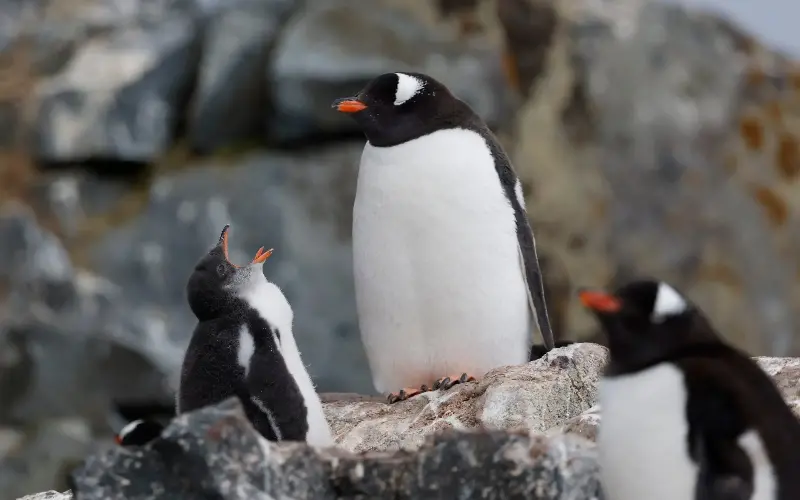
The penguins were intrigued, perhaps for good reason. Dressed head to toe in sterile personal protective gear, three scientists were scouring their Antarctic habitat on the hunt for penguin poo, or “guano”.
“They were very curious, they wanted to see what we were doing,” said Dr Roseanna Mayfield, assistant professor of environmental sciences at the University of Nottingham. “Some of them were also quite cheeky. I’m sure they wondered why we were there.”
It was late December and the British team had swapped Christmas festivities for a frosty field trip with an ambitious goal: to uncover traces of microbial threats in ancient guano deposits.
Their project, called PathoPast, aims to build the first historic archive of avian pathogens in Antarctica, based on the secrets preserved in sediment under the region’s lakes.
“These lakes offer a fantastic opportunity to look at the undisturbed chronology of sediments impacted by bird colonies, mainly penguins,” said Dr Alex Williams, a postdoctoral fellow in the School of Public Health at the University of Hong Kong. “The hope is that we collect these cores, then look inside for traces of ancient genetic material.”
He added: “Having a better understanding of past pathogen exposure can provide valuable context about the resilience of present-day penguin populations. With growing concerns about the spread of H5N1 in Antarctic ecosystems, this has never been more important.”
In the last five years, a highly pathogenic strain of bird flu has lapped the globe with increasing intensity, killing an unprecedented number of wild birds and jumping into mammals – including red foxes in the Netherlands, cattle in the United States and sea lions in Peru.
Antarctica has not emerged unscathed: the virus was first spotted in the region in late 2023. Since then, researchers have sporadically found H5N1 in dead birds, but a paper published last month in Scientific Reports documented a mass die-off for the first time – multi-organ necrosis killed at least 50 skuas after they contracted avian flu. The birds are considered a “sentinel species” for the health of the ecosystem overall.
“It’s very worrisome – the thing about avian influenza is that the virus changes so rapidly,” said Dr Michelle Wille, a senior researcher in the department of microbiology and immunology at the University of Melbourne, who works on pathogens in Antarctic wildlife. “We haven’t seen mass mortality in Antarctic penguins on the peninsula. That doesn’t mean it can’t happen.”
But tracking H5N1 and other diseases in the region’s avian population is no easy task. Dr Wille said researchers know “embarrassingly little” about the pathogens which affect birds – both from the past and the present.
In 2020, she co-authored a study that sequenced the RNA viromes of three penguin species and their ticks, and identified more than 100 viruses. It was a small study, but it “more than doubled” the number of known viruses found in Antarctic penguins, and countered the idea that birds in the freezing region are exposed to fewer pathogens than populations elsewhere.
“One of the things it elucidated for me is how we actually have almost no baseline data, in regards to the viruses that circulate in Antarctic animals,” said Dr Wille. “If we find something new, we literally have no idea whether it’s just new to science but has always been there, or if it’s new to the region. There’s abysmally little information.”
Dr Wille said PathoPast, a project she is not involved in, is therefore a “really cool idea” which could provide a desperately needed “view of the past”.
Dr Colin Butter, an associate Professor in bioveterinary science at the University of Lincoln, who is also not involved in the work, added that the team is likely to have more success tracing bacterial pathogens than viruses like bird flu, as DNA is far less delicate than RNA.
“The ability to look at ancient DNA is astonishing now,” said Dr Butter. “I think this will give, for the first time, a really good idea of the problems in these populations historically, and how they coped with infections.”
The research, funded by the Polar Research Infrastructure Network (POLARIN), is a collaboration between specialists at a network of institutions, including expedition team members based at the University of Hong Kong and University of Nottingham.
After months of careful planning and trying logistics, the three scientists travelled to the southern tip of Chile in mid-December. From there they flew 2.5 hours over the notorious Drake Passage to the rugged King George Island. Known as ‘gateway to Antarctica’, it hosts research outposts operated by countries including China, Russia and Uruguay.
“As we descended through a thick layer of cloud, I remember being really excited and thinking it was unlike anything I’ve ever seen,” said Dr Martha Ledger, a postdoctoral fellow in biological sciences at the University of Hong Kong. “Looking at the snowy, barren landscape, I also realised we were pretty much guaranteed to get a white Christmas.”
The PathoPast team spent 18 days over the festive period at a research station called Professor Julio Escudero Base, a complex of low-rise modules operated by Chile’s Instituto Antártico Chileno (INACH). Christmas featured a Secret Santa and big dinner with white tablecloths, while New Year’s Eve saw a round of cheers each time the clock struck midnight in a researchers’ home town – roughly two dozen people were on base at the time.
To collect their samples, the three British scientists travelled by boat and foot from the base to two lakes – Ardley and Yannae – nestled in the “beautiful and stark” landscape dominated by white and grey.
Getting there was a slog: winds speeds as high as 30km per hour made the zero degrees celsius temperature feel as cold as -17, and the kit they were carrying – including an inflatable dinghy and steel coring equipment – weighed some 70kg.
Challenges continued on the water, which had not thawed as much as expected – thick sheets of ice complicated efforts to get to deepest parts of the lakes. Once in place, the researchers used a hammer-weight system to drill the coring equipment down into the lakebed below, and the organic matter preserved by the cold over centuries.
“The lakes we cored on King George and Ardley Island offered different challenges than I’d experienced before, due to the unseasonably late melting of the lakes,” said Dr Mayfield.
“There’s a huge sense of achievement when we bring the sediment up onto the boat. It is always exciting to see what samples we will retrieve from the lake bed, what colour the sediment will be, if there’s any plants, or small invertebrate insects swimming around in the water.”
As well as six cores of lakebed sediment, the researchers took water samples for chemical and microbial analysis and – overseen by the colonies of Chinstrap, Gentoo and Adélie penguins – samples of fresh guano, to compare genome sequences from the past and the present. Some of the cores are protruded, which allows for chronological analysis.
But it will be some time before results are available – the samples have now made it off King George Island to the Chilean city Punta Arenas, but have some way to go (and many more complicated logistics) before they reach the labs in Nottingham and Hong Kong for analysis.
Dr Williams stressed the risks involved in this research are relatively low, because the team are not dealing with frozen material.
Last year, in a pandemic scenario exercise, the World Health Organization gamed an outbreak of a fictional disease called “mammothpox”, which emerged from the permafrost and infected researchers on a palaeontological dig.
“We don’t know what we’re going to find, but the most likely scenario is that we only recover the traces of non-viable penguin microbes, because most of these organisms will quickly succumb when exposed to harsh Antarctic conditions,” said Dr Williams.
“Plus, the lakebed is not frozen. It’s a stable low temperature, which does aid preservation, but it does not compare to the frozen conditions of Northern Siberian permafrost, for example.”
He added that, once in the lab, they are “not trying to grow anything, we’re simply extracting the genetic traces, so the biological risks are minimal.”
Instead, the riskier element was collecting the fresh guano needed to contextualise the historic analysis – hence the personal protective equipment. The team and their collaborators will also inactivate any viruses found inside these samples, and hope to have early results within a year.
Though they said it’s “highly unlikely” they’ll be able to produce a complete record of penguin microbes, they hope their archive will show which pathogens have affected the birds over time, and how the population adapted. This could be critical to protect the penguin species that watched over the festive field trip.
“Learning how things have changed over time, and the different drivers, is really interesting,” said Dr Ledger. “But it can also help us understand the present and predict the future, and the impact an emerging disease may have on Antarctica. This is critical.”
Protect yourself and your family by learning more about Global Health Security