



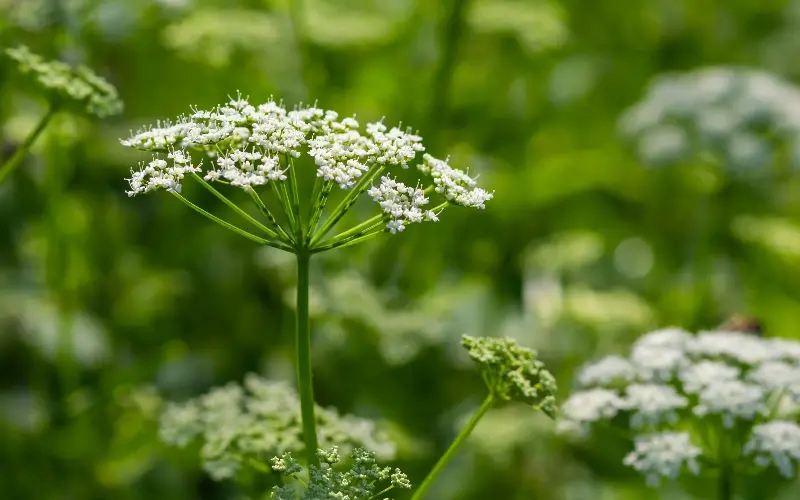
Whether it rains or shines this Easter, the long weekend will find me crouching in the garden, grimly excavating the ground elder with which my patch is infested.
The Royal Horticultural Society (RHS) website notes the redeeming qualities of this maddening weed: foragers apparently love its leaves, which have a “tangy flavour with a hint of parsley”. It is also a favoured food of the frosted orange moth and swallowtail butterfly.
There are medicinal benefits as well. Its botanical name, Aegopodium podagraria, is a combination of the Greek for goat’s foot and the Latin for gout, for which it was thought to be a remedy – hence its common names of goutweed and Bishop’s weed. (The reason why bishops were thought to be prone to gout is probably to be found in Anthony Trollope’s Barsetshire novels. But I don’t suppose the newly enthroned Archbishop of Canterbury will find herself in need of a tincture of ground elder.)
At any rate, I am beginning to wonder whether I should pause the struggle against my uninvited garden flora (bindweed and herb-robert are also on the list) and take a botanical interest instead.
At the University of Cambridge, botany is back on the curriculum. In 1827, Prof John Stevens Henslow, an Anglican clergyman and Cambridge professor of botany, devised a pioneering five-week botany course. Charles Darwin, to whom Prof Henslow became a friend and mentor, was one of his first students.
Two hundred years later, the archive of Henslow’s fragile preserved specimens and detailed ink and watercolour drawings, as well as his passion for fieldwork, are the inspiration for the University of Cambridge Botanic Garden’s four-week summer course, designed to offer plant scientists a broader understanding of their subject.
Botany has lately suffered something of an image problem: less a rigorous science, more a genteel pursuit for Victorian ladies with paintboxes and flower presses. But that is far from the historical reality. From its earliest days, plant exploration was an occupation for the intrepid, who endured the loss of everything from their hard-won specimens to their own lives in pursuit of their passion.
Peter Parker’s engaging guide, A Little Book of Latin for Gardeners, chronicles the many disasters that befell early plant hunters: Joseph de Jussieu went mad after his collection of South American plants was stolen; the Scottish botanist David Douglas trekked across North America in appalling conditions and eventually fell into a wild-cattle pit in Hawaii, where he was killed by a bull (the Douglas fir is named after him).
Reginald Farrer, whose high romantic soul was trapped in a small, ugly body, devoted his life to seeking and writing exquisitely about alpine flora. He died, aged 40, on the mountainous China-Burma border. (His life is recorded in Nicola Shulman’s biography, A Rage for Rock Gardening.)
In the early stages of remaking a neglected garden, I am a beneficiary of those brave botanists. Of the plants I have inherited or introduced – magnolia, camellia, mimosa, jasmine, tulips, hyacinths and peonies – almost none are native. (In Bloom, a current exhibition at the Ashmolean Museum in Oxford, celebrates the exotic origins of our favourite garden plants.)
Even the ground elder was brought here by the Romans, according to the RHS, which says there’s little point in digging it out, as it simply regenerates. Perhaps better, then, to stop digging and enjoy the horticultural trip around the world encompassed by my weed-infested borders.