



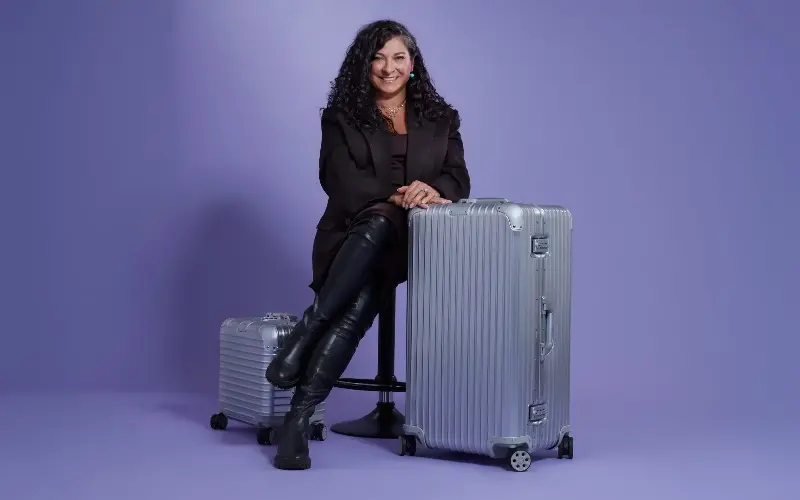
I’ve spent 30 years styling countless shoots and fashion shows, and even music videos, including one for the Spice Girls. I have done everything from magazine cover stories with Gisele Bündchen and Victoria Beckham to Victoria’s Secret’s runway spectaculars. When I arrive on set, I never know what surprises might await, what state the samples might be in, or how they will fit the models. From couture looks with broken zips to make-up-stained shirts or falling-down hems, I’m always abracadabra-ing the looks with whatever quick fix will work. It’s my job to make everything look its very best and here are the tricks of my trade.
Be prepared
My number one tip is to always have a mini sewing kit in my bag. I’m a bit of a klepto, so I take them from any hotel I find them in, and add them to my kit that I take with me everywhere. My kit contains threads of a thousand colours, so that if I ever get to a job and the zip has broken or the strap has snapped, I can just fix it. I’ve stitched people into dresses many times. There are always safety pins in my bag too, because you can fix things in a hurry with them. I’ve also got a miniature Swiss army knife that has little scissors and a screwdriver and a knife. It’s so useful – I take it everywhere.
Stain busters
My son, Zac, found this incredible specialist dry-cleaning fluid on TikTok called Miss Mouth’s Messy Eater Stain Treater, which is now an essential part of my kit. It’s designed for parents of toddlers, but I take it everywhere. It will remove any food stain, any red colour, even on white things. It’s changed my life!
For foundation stains, I use a basic make-up remover, and the golden rule here is dab, never rub. But you can’t use it on silk, because it will stain the fabric. If there’s an oil stain on a silk garment, you just dust on a little baking soda or talc. Lay a piece of paper over the area – it could even be a sheet of newspaper – and then you sweep a heated iron over it, remove the paper, apply more heat and remove the paper again. It acts rather like blotting paper and lifts the grease out of the material and onto the paper.
If it’s a protein food stain, such as egg, simply use cold water to blot it. Don’t put hot water on it, because it makes the protein in the stain coagulate and become solid and it gets into the fabrics. For chewing gum, put the garment in the freezer. It makes the gum hard and you can flick it off. For powders, like face powder, dust and some deodorants, you just need to rub the fabric against itself – that is a better way to get it off than using water. It sounds mad, but it works.
Soak it up
If you have time, I’m a real believer in pre-soaking, like my mum taught me to do. My dad’s white shirts always looked pristine because she would do all this pre-preparation. For whites that had yellowed, she would first use just a tiny smidgen of bleach with a little bicarbonate of soda or white wine vinegar, and then soak them, ideally overnight, before washing. I don’t think many people do that any more, it’s become a lost art.
Working uniform
That sense of being prepared for anything extends to my personal style. Often, I’m arriving from the plane and haven’t got the luxury of going to a hotel and getting changed before we start working, so I’ve honed my uniform. My go-to is Alaïa for stretch-knit dresses that never crease. I also go to Rick Owens or The Row for beautifully cut jackets and chic-but-comfortable bias-cut dresses.
Whether you are backstage at a Victoria’s Secret show, or on any fashion shoot, you are going to be scrabbling around on your hands and knees, doing up a shoe or generally running around. What I wear has to work really hard for me. My worry can’t be about me and how I look. It’s got to be about the show – and the girls – so this ‘uniform’ is my version of a house decorator’s boiler suit.
Packing tips
I travel so much that I’ve got packing down to a fine art. My big tip is to put everything into the case on a thin lightweight hanger and in a sleeve (I reuse the plastic ones that come back from the dry cleaners), or a garment bag. Keep it as flat as possible (I never roll items), so that when you pull it out, you never need to worry about looking for a hanger and the creases will be minimal.
It’s the speed at which you can unpack that makes the difference. I don’t want to spend time steaming my clothes when I arrive and then hanging them up, so I do the work before it goes in the suitcase. Talking of which, I’m a Rimowa girl because the design keeps me independent. The wheel mechanism on its cases is so good I never have to use a trolley.
Steam Queen
I do, however, always take a travel steamer with me – it’s the best investment you’ll make. It doesn’t have to be a fandango one. I got mine from Amazon and it’s lightweight and brilliant.
Get organised
I compartmentalise when packing so I know where everything is and I never waste time scrambling around to find stuff. Every shoe is in a shoe bag – I don’t understand people who throw their shoes into the suitcase with everything else – and I’ve little pouches for swimwear, lingerie and all the toiletries. I also make sure they are in their own waterproof containers, and then I wrap them again so that even if something does explode, it won’t ever get on my clothes.
More is more
I never travel light. My friend, the art director Ronnie Cooke Newhouse, once said: “No one ever built a monument to people that underpack”. People take such pride in packing one small bag, but I’m not interested. I care that I’ve got choices; I always pack for any eventuality. I’ll check in the big bags but, because I’m so paranoid about losing luggage, I’ll always have a small wheelie case with my jewellery and handbags and emergency clothes.
Moth patrol
Moths are my biggest fear. Everything at home is hung and wrapped in a garment bag or sleeve (again, I reuse the ones from the dry cleaners). That way, if a moth does get in, it’s contained and can’t contaminate the rest of your wardrobe. The scent of lavender can be a moth deterrent – I use lavender spray from Neal’s Yard and every piece is hung with lavender patches. I get mine online and I’ll take them with me when I travel, so I don’t pick up moths on the way. If you have an infestation, the only thing to do is dry-clean everything and fumigate. There are no quick fixes.
When in doubt, dye it
My husband, who ran a dry-cleaning business for many years before he retrained as an acupuncturist, taught me that dyeing silk and cotton garments that have faded in the washing machine is an excellent way to refresh your clothes. I’ve got a favourite Balenciaga shirt that a dry cleaner destroyed – we popped it on a cold-wash cycle with a washing-machine dye (Dylon is the best known) and it came out like new.
Sophia Neophitou-Apostolou is global editor-in-chief of 10 Magazine