



I always imagined Liechtenstein to be a lot like Aldovia, the fictional kingdom in the schmaltzy Netflix movie franchise A Christmas Prince. Following the escapades of an inordinately wealthy heir to the throne who falls in love with a journalist, the films feature a turreted, semi-timbered castle bedecked in lavish Persian carpets, women draped in pearls at every opportunity, and Christmas bonuses awarded to all Aldovian citizens funded by the Royal purse.
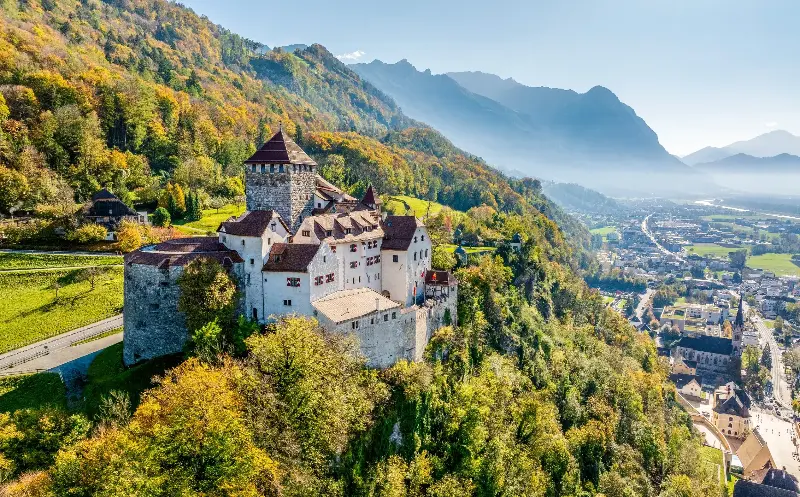
Disappointingly, it turns out that Romania’s Peleș Castle was a stand-in for Aldovia’s – Liechtenstein’s princely palace, in its capital Vaduz, looks more like a medieval fortress than a crenellated dwelling from a Christmas flick. Meanwhile, rather than being a Disney-esque paternal figure, its prince (57 year-old Alois, who acts as Regent on behalf of his ageing Head of State dad, Hans-Adam II) has threatened to leave the country on more than one occasion when things haven’t gone his way in Parliament. So far, so un-fairytale.
The country has typically been low on most traveller’s lists, receiving fewer than 120,000 tourist arrivals each year – the lowest of any country in Western Europe. Would-be visitors are, presumably, put off by its lack of airport (tourists must fly or take the train to Switzerland or Austria then transfer to a bus), and by the assumption that such a miniscule place can’t realistically have much to offer (at just 160 square kilometres, it’s just a shade smaller than Sheffield).
What it lacks in size, however, it makes up for in novelty value – a major selling point in an age when seeking out under-the-radar destinations is harder than ever, and one which has led to a recent surge in interest (Liechtenstein was even ranked one of 2026’s five “hottest destinations” for British travellers by TikTok). First-time visitors are in for a pleasant surprise: Liechtenstein may be lacking in fairytale credentials, but there its shortcomings end.
Its capital Vaduz, for example, is a bijou delight, so tiny that it has only one main thoroughfare and less than 6,000 inhabitants. It’s a place to get a novelty passport stamp at the tourist office, wander across the Old Rhine Bridge (to pop one foot into Switzerland), check out the crowns in The Treasure Chamber, or explore the excellent Postal, National and art museums. As the Royal Family still lives in its castle, the building is closed to the public – though you can clamber up the hill to its rather foreboding exterior for fantastic views over town.
But that’s just the start – it’s when you bike or hike away from Vaduz that things really get interesting. A 75km Liechtenstein Trail crosses the country, weaving past old smuggling routes, hidden hamlets and castle ruins (don’t miss 12th-century Gutenberg, dominating a vineyarded hill above the town of Balzars that’s been inhabited since prehistoric times). The route is easiest in summer, but most stretches are also workable in winter for seasoned hikers (for more information and detailed routes, see).
Then there are the challenging, rocky inclines of the Fürstensteig Trail (only doable from late-June to September), a mountain-edging track which winds its way above the tree line, culminating in views that stretch as far as Lake Constance. During the coldest months, visitors can even trek from a mountain village with a llama as a companion, stopping among the trees for warming, al fresco fondue.
The starting point for these hikes is Treisenberg, where immaculate wooden chalets look out over spectacular vistas. It was to this lovely spot that settlers from the Swiss Valais brought their farming skills in the Middle Ages, together with an impenetrable Walser German dialect that’s still used today (learn more about them at the town’s Walser Museum).
Another worthy winter destination is Malbun, Liechtenstein’s only ski area, where the slopes wind through the village centre and, in some cases, right up to the hotels. If you don’t ski, hop onto the Sareis chairlift for views far into the valley from the Sareisjoch ridge.
All of this makes for an old-fashioned, wholesome holiday, reflective of the country’s past. Before the reigns of Prince Hans-Adam II (who was responsible for the country joining the United Nations, EEA and WTO) and his father Franz Joseph II (the first modern prince to actually live in the country – and the man who turned it into a tax haven), Liechtenstein was a quiet backwater. Originally part of the Holy Roman Empire and owned by the upwardly mobile Liechtenstein family, it became independent of the German Confederation in 1866 and, like neighbouring Switzerland, remained neutral in both world wars.
It now has the second highest GDP per capita in Europe (after Monaco) – and yet, on the ground, its extreme wealth remains less obvious than its pastoral roots. The country has recently been trying to shed its tax-haven image, and though there are six casinos, there are no five-star hotels, and you’ll see few supercars or trophy wives.
In fact, the biggest giveaway to the country’s wealth is its immaculate cleanliness: if so inclined, you could eat your Käsknöpfle (a local dish of pasta-like dumplings, cheese, onion and apple sauce) off Vaduz’s pavements. If you happen to prefer your meals served on crockery, however, opt instead for one of the country’s excellent restaurants: Treisenberg’s Berggasthaus Masescha or the exquisite Torkel are both enduringly popular for good reason.
If you fancy a glimpse of Prince Alois, time your visit to coincide with the country’s National Day on August 15, when he nips out into the city to greet residents against a backdrop of parades, national costume and marching bands. And if you can’t make it then? Not to worry – head for the Old Cinema in Vaduz instead, where a 20-minute “Princely Moments” film plays daily at 2pm, taking viewers inside the castle for a glimpse into royal life.
It turns out that, behind those rather drab, fortressy walls, there are indeed chandeliers, flowered courtyards and some exceptionally snazzy carpets after all. Like its holiday appeal, it seems little Liechtenstein’s fairytale factor was hiding in plain sight all along.
Essentials
The easiest way to get to Liechtenstein from the UK is to fly to Zurich and hire a car for the one-hour drive. Alternatively, take a train from Zurich’s main train station to the border town of Sargans (around an hour and 15 minutes) and then a number 11 bus to Vaduz (30 minutes).
For the poshest stay in the capital, check in at Park Hotel Sonnenhof (doubles from £500). Or, to embrace mountain life, try Malbun’s cosy Hotel Turna (doubles from £225).