



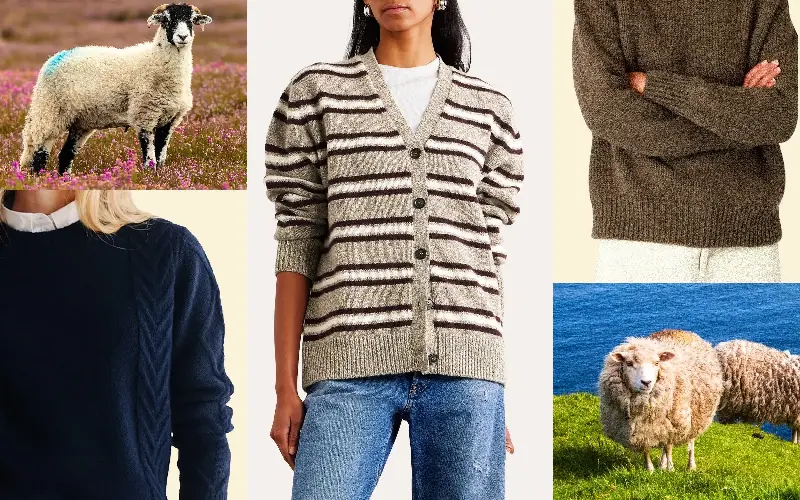
While field-to-fork eating has staked a claim on our collective consciousness, the concept of farm-to-wardrobe has been slower to gain ground. Fashion’s production chain is certainly more complicated to unravel. Compared to the relatively pared-back process of producing a pork chop, garments can take over 30 stages of manufacture, which criss-cross the globe. However, a slew of stylish knitwear brands are cutting back on fashion miles and backing British wool by using breed-specific clip to design luxurious and nostalgic knitwear.
Ruth Rands is the founder of luxury knitwear brand Herd, but she originally worked in the food industry. “Traceability and accountability around food are obviously very strict [but] when I started exploring the world of wool, I was blown away by the lack of information. ‘Lambswool’ is on the label… it doesn’t say where it’s from, how it’s made or what the breed of sheep is.” Rands uses the wool of the bluefaced leicester breed, specifically, for her label, believing it to be “finer and superior to Merino”. Herd’s processes remove toxic detergents in the scouring too, and only use plant dyes, which are kinder to the planet than conventional methods. The resulting designs are delicate and unique.
“Nobody was using bluefaced leicester [when Herd launched in 2020]. The reputation for British wool was in the gutter,” she notes. “People had this idea that it was scratchy and only good for carpet.” The feather-light knits now in the shops surely disprove that notion. As do rising fleece prices. British Wool, the not-for-profit organisation supporting the industry, has reported prices “at the highest level for almost a decade”. Shopping British wool brings a host of benefits to the environment and to the style credentials of the wearer – and the new knitwear brands are on a mission to support UK manufacturing and farmers too.
Rachel Carvell-Spedding founded Navygrey to quench her quest for the “perfect” jumper. She acknowledges the inequality of the farming system right now. “People are beginning to understand that farmers need to be paid more. The big challenge is processing British wool. Processing within Britain is more expensive than China. Wool is not a cheap fibre and our products end up not cheap, yet farmers aren’t paid enough, because the actual costs come from processing.”
Despite cost implications, niche brands are focusing on breed-specific wool, which adds provenance and heritage to their collections. While the majority of sheep in the UK are Texel or Mule breeds, and their fleece is a byproduct of the meat, bluefaced leicester, shetland, cheviot and masham are highly prized for their clip. As single-origin, extra-virgin, organic olive oil is viewed as elite among condiments, a jumper knitted from these breeds now has similar status.
Roger Shepley, the managing director of Shepley Yarns, supplies Barbour and Next with the best British spun wool. “Ten years ago no-one was asking for breed-specific wool. Now that’s a question we get asked every week,” he says. Shepley believes there’s “nothing negative about British wool. It’s a good product. It keeps things local. It keeps farms in business. It keeps sheep in fields… Perhaps it’s slightly more expensive than synthetic fibres, which come out of a chemical plant, but you get what you pay for.”
Indeed, British wool trounces sweat-inducing polyester and acrylic knits every time (and biodegrades quickly at end of life) and while wool from our isles will never be as smooth as cashmere (typically top of the flocks), it has its own brilliance. “The crimp within British wool gives it a lofty bounce,” explains Shepley. “So effectively, it gives you volume without weight.”
As with avoiding, say, ultra-processed foods in your fridge, reading the label is now key to decoding your jumper’s origin. Beyond generic “lambswool” labels, many brands cite British-spun wool as British, when it might have come from Australian sheep and was simply finished in the UK. Avoiding huge carbon footprints from shipping wool across the globe is a bonus, but any chance to bring the spotlight back onto “made in Britain” garments is a welcome addition.
Frankie Davies worked as a knitwear designer for Burberry before founding Charl knits. “I want to celebrate that sense of pride in what Britain can produce,” she says. The English textile industry took a dive in the 1990s, believes Davies, but it’s bouncing back. Davies is inspired by traditional ganseys, worn by Norfolk fishermen, and her knits go some way to helping rebuild a forgotten industry. “Certain parts of the coast are struggling with unemployment,” she continues. “It’s important for creative industries to manufacture in the UK. Apart from valuing our heritage, it’s about getting people to have pride in where they come from and what we can produce.”
Hot herds: The best breeds in Britain
Bluefaced leicester
“The holy grail of softness,” according to Carvell-Spedding. The bluefaced leicester is a lustre breed, known for long fibres with a sheeny look. The sheep have wool that is easy to spin into strong yarn, but it’s also light. Ruth Rands of Herd says: “There are other breeds you can wear next to the skin, but none of them are as soft as the bluefaced leicester’s cosy, inner layer feel.”
Fleetwood cardigan in plum, £595, Herd
Also try: The Hand-Me-Down, £315, Navygrey (mixed with 30 per cent Cheviot wool)
Shetland
“Shetland has amazing gradations of colour,” raves Davies. She describes shetland wool as dry and crisp, due to the sheep’s diet of seaweed and bracken, resulting in firmer knits. Carvell-Spedding is also a shetland fan, although she notes, “it now has to be called real shetland, because (other) brands say something is shetland wool and it’s not from Shetland (just spun there). It’s totally confusing… but there’s no regulation.” Navygrey’s real shetland wool jumper is a star piece – its last batch sold out in just four hours last month.
Striped wool cardigan, £385, & Daughter
Also try: Jumper in real Shetland wool, £295, Charl
Masham
A modern British sheep breed, masham are bred from Teeswater rams crossed with Dalesbred or Swaledale ewes. Their fleece is particularly long and semi-lustrous, giving it a subtle shine. Carvell-Spedding describes her masham jumpers as “proper” and the results have “more structure than super softness – this knit will have a bit more of a kick”. If you ever wanted your cardigan to be cool, this is the wool to pick.
Bluefaced Leicester and Masham mix knit, £285, Charl
Also try: Masham Crew, £295, Navygrey