



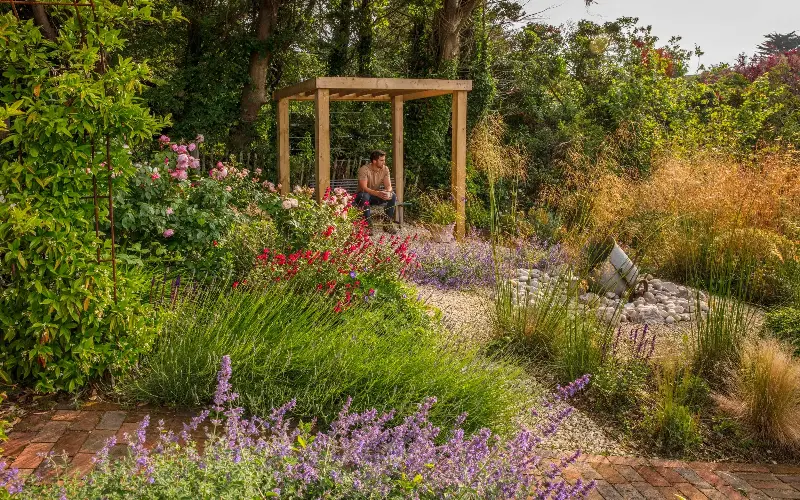
Henry Agg enjoyed gardening as a child, but lost interest as he got older. The spark was reignited, however, when he and his wife Allie bought their first house in Brighton almost 10 years ago.
“When we moved in I came out of dormancy and started to find that gardening passion again,” he says. The garden urgently needed work, but after the couple received “astronomical” quotes to landscape and redesign it, Agg, 35, decided to do it himself. Working long hours at that time in executive recruitment for Hewlett Packard, he allocated his weekends to his garden. With a knowledge of plants but no landscaping or design skills, he researched both by reading books and watching YouTube videos. As he progressed, he sent WhatsApp clips to his family.
“My family got fed up with me posting six-minute videos of me doing some brickwork,” he says, “so my brother suggested that I post to people who actually have a similar passion and who might like it.”
Agg took the hint and soon built up a social media following. Deciding that if he was advising viewers, he ought to know more about what he was doing, he gained RHS Level 2 qualifications and took a course in design at the English Gardening School. In 2023, he founded a garden design company as a “side hustle” to his corporate job. In January 2025, he went full-time with his garden design business, which now also offers a full landscaping service.
He has now written a book, The Weekend Gardener, using his own experience to give anyone who is determined and keen the confidence to build a garden from scratch in their spare time. Here, he shares his advice for gardening when you’re time-poor.
Time management is key
“You can create something lovely without dedicating five days a week to doing it. You can just do a few hours at the weekend if you manage your time effectively,” says Agg, who adds that you need to be honest with yourself about how much time you can spare and when, and also how long a task is likely to take you. Create a project plan, drawing up a methodical list of when you will build your patio, borders and beds, paths, and any features such as pagodas, and when you will lay a lawn or plant a hedge or trees.
Jobs for the weekend
How long each job will take obviously depends on what time you have to spare, your personal fitness, the weather and daylight hours, the size of the project and the materials used: making a gravel path will be quicker than laying a brick one, for example. Some tasks, such as laying a patio, installing a slatted fence or building a pagoda, could be done in one to two weekends if you want to crack on and get it done. You do not have to devote every or all weekend to projects; pace yourself to avoid things left half-finished after a burst of excitement.
Working with shorter time slots
When it comes to planting and maintaining your garden, breaking time down into small slots can work better than prolonged periods of activity. It keeps you focused and avoids the danger of feeling so overwhelmed or bored with jobs you dislike that you give up altogether.
Bookending
Agg finds completing a short task at the beginning and at the end of a day enhances his sense of accomplishment and boosts his mood. In a short stint of 20 to 30 minutes you can cover basic tasks in the summer such as watering, weeding, pruning and deadheading. In the autumn and winter it could be sweeping paths, mulching a bed, or tidying a greenhouse and checking on overwintering plants, or just planning your garden. If time allows, this can be done on a work day, too. “Breaking it down into two stints makes it feel less labour intensive and helps me keep on top of routine garden tasks,” he says.
The 20-minute slot
This is an intense session to squeeze in if you are busy. Divide your garden into little sections of tasks and select one that needs doing. Ascertain what you want to accomplish before you start and concentrate solely on that one job.
“Then put your gardening gear on, set a timer and go for it,” says Agg. “Whether it’s weeding, checking tree stakes and plant supports or pruning shrubs, I don’t think about anything except what I’m doing in that moment, which keeps me grounded. Weeding’s the biggest thing in the summer. People find it overwhelming, especially when you have bindweed and ground elder taking over, so that’s where it’s important to break down your garden into sections and just weed one area every time you go out there, rather than trying to do everything at once.”
Alternate jobs you see as a chore with ones you like doing. For Agg, making his own compost is more enjoyable than weeding.
A quick session is handy for shorter days in cooler months: planting a bare-root shrub, for example. “The job list changes, but I wouldn’t do any less gardening in winter, I’d just do shorter stints,” says Agg. “I think 20 to 40 minutes each day at the weekend is perfect. Just get out there, whether it’s pruning roses or whatever.”
If you’re stuck indoors, it is an ideal time to work on your planting plan, whether you want hot beds, gentle pastels, or as in Agg’s case, naturalistic swathes of perennials and grasses that “die gracefully” and retain winter appeal.
‘Power-hour’ slots
Again, if you have an hour to spare, set yourself one task or a selection of short jobs. In one hour you can plant a tree, or divide it up into planting three bare-root shrubs; or in warmer seasons, put in perennials and bulbs.
“More often than not, people walk into the garden and they see one thing to do, and then they start another,” says Agg. “Have one job in mind and one purpose. Set yourself a timer: it’s amazing to see just how much you can get done in one hour.”
He views it as a useful alternative to the gym: “I’ve always used gardening as a form of exercise. I’d do a power hour and see if I could get a sweat on. If you get in the garden and do a good session of weeding and put some energy into it, you’d be surprised how many calories you burn.”
Two-to-four hours
In slightly longer sessions, take the opportunity to do something a bit more time-consuming, such as building a raised bed or lattice plant supports, or planting a hedge.
Take time to enjoy yourself
“I didn’t want to write a book that says “go go go, get designing, get planning, get building”, and doesn’t encourage people to think about how they will do that while balancing everyday life,” says Agg. “You need to consider how you can create something without getting completely burnt out, so it doesn’t become a pain, as opposed to a pleasure.”
It’s also important to enjoy the fruits of your hard work. “In the summer I’ll make sure I have time to sit in the garden,” he says. “If you’re a keen gardener you always find something to do when you’re out there, instead of sitting and appreciating it. One day I’ll go out there to do a job, and the next time I’ll sit with a cup of tea and admire the work I’ve done. It’s important to find that balance.”
The Weekend Gardener by Henry Agg (DK Publishing) is out on February 12; £22