



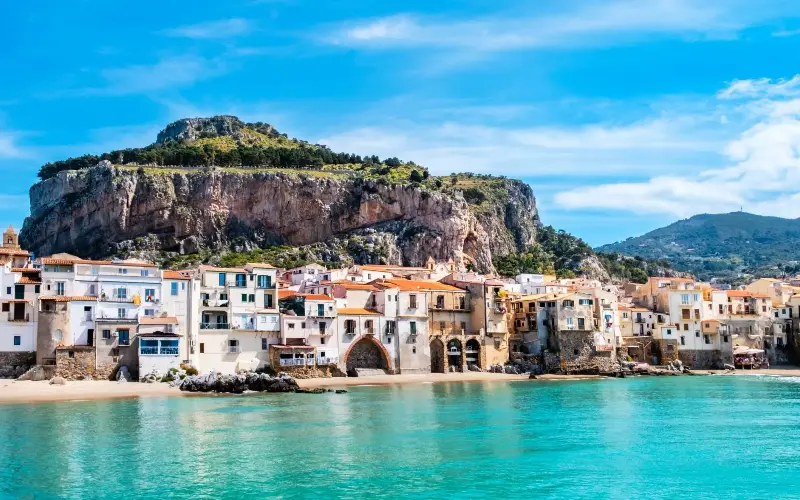
Through the ages Sicily has been a crossroads and crucible of Mediterranean culture. The island today is a fascinating palimpsest, its history and abundant natural wonders ensuring that there’s something for everyone: the historic cities of Palermo, Catania and Siracusa; the Etna region with its volcanic landscapes, fertile wine country and picture-perfect Taormina; Ragusa, Modica and the other honey-hued baroque towns of the south; the Greek temples of Agrigento, Selinunte and Segesta; Roman sites like Piazza Armerina; miles of sandy beaches and secret rocky coves. And don’t get us started on the food – from the couscous of Trapani to the pastries of Noto, it’s a reason to visit in itself.
With parts of the island on the same latitude as the north African coast, Sicily has a mild climate that makes it an attractive destination for much of the year: spring and autumn are a sheer delight and though in high summer (July and August) temperatures really do soar, sea breezes in coastal areas take the edge off the heat.
In this guide:
How to spend the perfect day
Spend your first day in Sicily in its capital, Palermo. This marvellous, chaotic, theatrical city was passed through and ruled over by many and diverse peoples – Greeks, Romans, Normans, Arabs – all of whom left their very strong marks on its architecture, cuisine and culture. Today the city exudes its own very powerful cultural energy in contemporary galleries and urban renewal.
Morning
Start your day at the bustling Vucciria produce market. Purists say it caters rather too much for tourists these days, but the atmosphere remains loudly, aromatically and colourfully Mediterranean. Twelfth-century churches such as La Martorana, or Roger II’s private chapel the Cappella Palatina are perfect distillations of the multiple cultural influences on the city, with their Arabic domes, squat Norman towers and florid baroque portals. The acres of gleaming Byzantine mosaics are quite breath-taking. You can visit them with the “Circuito del Sacro” ticket, which gives reduced price access to fee-charging areas of many of the city’s major places of worship.
Street food is in Palermo’s DNA: frequent snacking is part and parcel of the daily routine. When hunger strikes you can experience it inside too, for example at the historic Antica Focacceria San Francesco. The chickpea panelle fritters are divine.
Afternoon
Palazzo Butera is a good introduction to the city’s contemporary side: a freshly restored baroque palazzo houses the extensive contemporary art collection of the Valsecchi family. The website gives details of presentations and special events. The extraordinary tiled terrace (with café) is a mass of bougainvillaea, jacaranda and other semi-tropical greenery; there’s a fantastic view over Palermo and its glimmering harbour from the rooftop.
If the sun is shining, hop on the 806 bus in piazza Sturzo and join bronzed palermitani on Mondello beach, the closest to the city centre and a lovely – if often crowded – place for a swim. Alternatively, the pretty park at the Villa Tasca is a leafy place to rest after sightseeing. Book ahead for guided visits to the more formal part of the gardens, and to the palazzo itself.
Evening
Back in the city, Nautoscopio serves up aperitivi, food, live music and dancing on the sand along the city’s harbour front. For something more gourmet, opt for Michelin-starred MEC, the cutting-edge restaurant of a museum of digital technology housed in a 16th-century palazzo.
How to spend a week
At nearly 10,000 square miles, Sicily is the Mediterranean’s largest island. To enjoy a week getting to grips with it, private transport is a must. There’s a definite difference in feel between the west, which historically faced towards north Africa, and the east, which came heavily under the influence of the ancient Greeks. But in every corner of the island you’ll find the same overwhelming energy, fantastic cuisine and over-abundance of fascinating sights.
West from Palermo just off the A23 motorway, a splendid, unfinished Doric temple stands in glorious seclusion at Segesta: a magical place, an ideal fusion of architecture and nature. Forty-five minutes further south, dominating the island’s south-west coast, lie the tumbled ruins of Selinunte (the only standing temple is a reconstruction). A guide will help you get the most out of this site: Passage to Sicily provides highly qualified art historians. It’s not far from Selinunte to the marvellously atmospheric Cava di Cusa – an abruptly abandoned ancient quarry, where part-hewn and carved column sections stand in a romantic flower-strewn landscape.
The ancient world is bound to loom large during your Sicilian week, and nowhere more so than in the Agrigento-Piazza Armerina zone to the east of Selinunte. Beat the crowds at Agrigento’s Valle dei Templi by taking advantage of the 8.30am opening, and parking at the Temple of Juno entrance at the top. To bring the site to life, I’d recommend reading the first chapter of John Julius Norwich’s erudite yet entertaining 2015 book Sicily ahead of your visit.
For a refreshing break, retire to the lush green of the Kolymbethra garden, adjacent to the ruins. The vast archaeological site of Villa Romana del Casale a few miles south is best known for its famous depictions of female gymnasts working out in their bikinis. Remember these sites are huge and largely shadeless: hats and lots of water are a must in warmer weather.
Continuing eastwards, the Baroque triangle is a succession of honey-coloured sandstone towns, made striking thanks to enlightened reconstruction by the island’s Spanish rulers after a devastating 1693 earthquake. Ragusa Ibla, Noto and Modica are each more beautiful than another – the last with the added (and unexpected) benefit of being a historical centre of chocolate making.
Swinging north along the island’s east coast brings you to Siracusa with its gorgeous centro storico on the island of Ortygia. It’s urbane and trendy, and full of bars and restaurants, but the whisper of its ancient origins clings on nonetheless in its picturesque streets leading down to the harbour.
There’s a string of inviting beaches along the Rivieri dei Ciclopi as you approach Europe’s most active volcano, Mount Etna. Whether you opt to hike across black lava fields, explore the excellent wines growing on its slopes, or simply wander the streets of pretty – though painfully crowded – Taormina on its northern flank, the volcano will undoubtedly exert its strong magnetic force on you.
When to go
Sicily has a mild climate that makes it an attractive destination for much of the year. Bear in mind that Sicily has a much longer warm-weather season than northern and central Italy. If you’re lucky, it’s possible to sunbathe and swim in the sea well into November, and spring starts early: in many areas, the ground is carpeted with wild flowers at the end of February.
Where to stay
Luxury living
The best spa in Sicily sprawls across 4,000 modernist metres in the swish Verdura Resort on the little-visited south coast. There are also two 18-hole golf courses. West of the charming baroque town of Sciacca, the hotel is ideally placed for visiting two of Sicily’s most impressive Greek temple complexes: Agrigento and Selinunte.
Boutique bolthole
Seven Rooms Villadorata is a devastatingly gorgeous feast for the senses housed in a wing of the most extravagant baroque palazzo in Sicily. Expect high ceilings, soaring windows with white shutter doors and heavy linen curtains, original encaustic tiled floors, and on your supremely comfortable beds, delicately puckered white silk quilts and blue alpaca throws.
Essential information
The basics
- British embassy in Rome: 00 39 06 4220 0001; ukinitaly.fco.gov.uk
- Tourist offices and information: The official Regione Sicilia tourism website is at visitsicily.info. Tourist information offices can be found at all three Sicilian airports, at ferry ports, and in the main towns. Three of the more useful are for Palermo, Catania, and Taormina.
- Emergency services: Dial 112 (Carabinieri); 113 (State Police)
- Currency: Euro
- Telephone codes: From the UK, dial 00 39 plus the area code with the zero
- Time difference: +1 hour
- Flight time: From London to all three Sicilian airports is just under three hours