



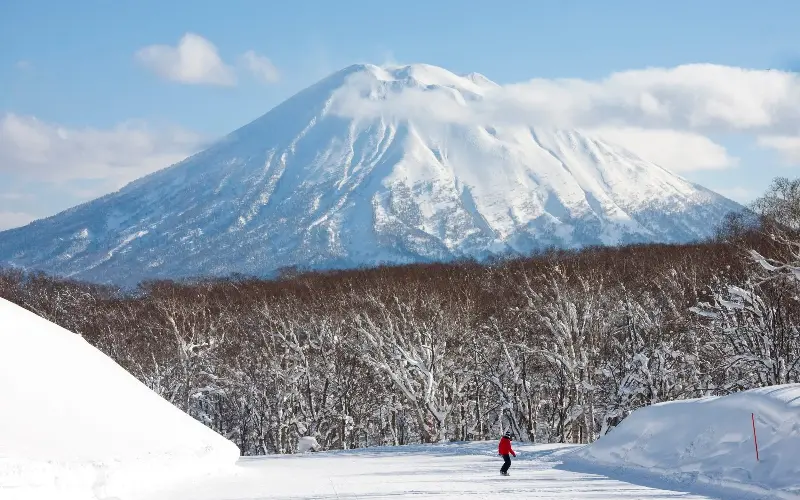
Japan enjoys mythical status among skiers and snowboarders. Its culture, excellent food, efficient transport and futuristic cities make it a remarkably straightforward place to visit, while the chance to unwind in an onsen or wander through lively streets after a day on the slopes adds a richness that keeps many skiers coming back.
Its geography is equally compelling, blessing the country with some of the deepest and most consistent snow in the world. Cold, westerly winds whipping across Siberia scoop up moisture from the Sea of Japan, and dump it when they hit the country’s mountains.
It’s not uncommon for resorts in Hokkaido, the northern island, to see snowfall in the double digits in a season – the kind of figures that make even snow-sure Alpine resorts look modest by comparison.
Visitor numbers have grown exponentially in recent years. Statistics from the Japan National Tourism Organisation show that foreign visits to Japan were up by a third for winter 2024/25 compared to 2018, the last full season before the pandemic. More than 22,000 Brits are estimated to have made the trip last winter.
Although skiing in Japan is now more popular than ever, it still feels more daunting than going to the French Alps. Here are a few basics to help you make the most of your first ski trip to Japan.
Gateway to ‘Japow’
Niseko & the surrounding area
Niseko is undoubtedly the easiest option for British skiers heading to Japan for the first time. It’s the largest resort on Hokkaido, the northern island that gets the best of the country’s famous powder, known as “Japow”. The snow is so constant here, we had to dig out our car and our chalet steps every single morning for a week the last time I visited.
It’s also Japan’s most international resort, with a strong contingent of Australian and American residents. It’s easy to get around as an English speaker and to find English-speaking ski instructors. Both Niseko village and the surrounding settlements at the base of the ski lifts have a range of accommodation to suit all budgets.
The lift-linked Niseko United ski area, which can be accessed from four different base stations, boasts 50km of pistes. That may not sound much by European standards, but it feels plenty when the bits between them are constantly refreshed by new snow.
There are several outlying resorts within a half-hour drive too, including Rusutsu, with its 42km of pistes, and the tiny three-lift operation at Moiwa – a favourite with local powder-lovers as it tends to be less crowded.
Book it
Ski Safari offers 10 nights B&B in the three-star Always Niseko Hotel, near the base of the slopes, from £2,800pp, including flights and transfers. Alternatively, the Pensione Uno just outside Niseko town has double rooms from £164 per night, including breakfast. You can fly from London Gatwick to Sapporo Chitose New Airport, with a layover in Hong Kong, with Cathay Pacific from £548 return.
Powderhounds’ paradise
Central and Northern Hokkaido
The ski resorts of Northern Hokkaido benefit from the same, insane amounts of snow as Niseko and the surrounding area, but tend to be smaller and quieter, with fewer foreign visitors. As such, they tend to feel a bit more authentically Japanese, both on the slopes, and in terms of après culture. Often the best way for Brits to visit these is to string a few together on a week or 10-day long snow safari.
Furano, in the centre of the island, is the largest of these resorts, with 32km of slopes, a modern lift system and kid-friendly skiing. Kamui Ski Links, an hour to the north, is another good option if you’re looking for beginner or intermediate slopes. More advanced skiers should head to Kurodake, a small operation with just two lifts, a gondola and a rope tow, that boasts steep, challenging back country terrain. Alternatively, Asahidake, where a single cable car offers access to a large, unpisted area inside Daisetsuzan National Park, is a great place to base yourself for ski touring.
If you’re feeling particularly adventurous, you could even head to Rishiri, a tiny island off the northwest coast of Hokkaido, accessible by ferry, where there are a handful of lifts and great ski touring on the flanks of a volcano.
Book it
Crystal Ski offers seven nights B&B in the Shin Furano Prince Hotel, from £3,137pp, including transfers and flights via Tokyo. Alternatively, book a multi-resort trip with Hokkaido Powder Guides or Rising Sun Guides. Prices available on request.
Cultural hotspots
The Japanese Alps
While there’s no doubt that Hokkaido gets the best of Japan’s legendary snow, the country’s biggest mountains, largest resorts and most challenging skiable terrain can be found on the main island of Honshu. Just a two-hour bullet train ride west of Tokyo, the city of Nagano offers a gateway to the Japanese Alps, where the highest peak, Mount Kita, is almost 1,000m taller than anything in Hokkaido.
As a general rule, the resorts of the Japanese Alps tend to be frequented by fewer foreigners than those up north. Even the most famous, the mountain town of Hakuba, attracts far fewer international visitors than Niseko. If your priority is exploring Japanese culture and skiing steep, high alpine terrain, your best bet may be to combine a stay in Tokyo with a visit to the Japanese Alps.
Shiga Kogen, to the north east of Nagano, claims to be the country’s biggest ski resort, with over 80km of pistes spread across 18 interconnected areas. Nozawa Onsen, named for its hot springs, is also relatively large by Japanese standards, with around 50km of pistes, but the town still retains a traditional feel. Madarao mountain resort is a good option, particularly for families.
If the skiing is less important than soaking up the culture you could even try a tiny two-lift operation like Hirayu Ski Resort, where your ski pass doubles as a ticket for the onsen, just a short walk from the base of the lifts.
Book it
Iglu Ski offers seven nights B&B at the four-star Hotel Abest Hakuba Resort for £831pp, excluding flights. For a ski-in, ski-out, the Shiga Swiss Hotel in Shiga Kogen has double rooms from £111 per night, including breakfast. You can fly from Manchester to Tokyo Narita Airport Tokyo via Abu Dhabi with Etihad from £703 return.
How to get there
Three airlines currently offer non-stop flights from London to Japan: British Airways, Japan Airlines (JAL) and All Nippon Airlines (ANA). However, you can fly for about half the price if you’re happy to do a layover in China, the UAE or Finland. Once you’re in Japan, bullet trains are the best way to get between cities.
Previously, flying was the best way from Tokyo to Hokkaido, but in 2016, a bullet train link opened up connecting the northern island. The journey now takes four hours. Trains may sell out, especially at peak times, but unlike UK trains, the ticket prices are set and don’t increase if you book late.
Japanese ski resort villages are often spread out, and you may find you save money by booking accommodation further away from the slopes and renting a car. A car also allows you to visit multiple resorts. Conveniently for Brits, Japan drives on the left-hand side of the road, but you will need an International Driving License, in addition to your photo card. These cost £5.50 from Post Offices and Paypoint newsagents. See gov.uk for details.
When to go
January is generally reckoned to be the best time to ski if you want to make the most of Hokkaido’s near-bottomless powder – so much so that pro skiers sometimes refer to the month as “Japanuary”. Having said that, conditions are frequently just as excellent in February, and even into March.
The Sapporo Snow Festival, where snow and ice sculptures take over the streets of Hokkaido’s main city, has taken place every February since 1950 and is worth a visit. The 2026 edition will take place on February 4-11, 2026. Elsewhere, the Snow Machine festival – Japan’s answer to Snowbombing, with big name DJs playing on the slopes – will take place in Hakuba on March 3-8, 2026.
Who to book with
Among UK operators, Ski Safari (01273 224060) has one of the widest selections of Japanese ski holiday packages. However, Japan is a country that really rewards independent travel – not least because of the savings you can get on flights. Booking.com has the widest range of options, but it is also worth checking local sites like Rakuten Travel for deals and off-the-beaten-track destinations.
How much does it cost?
Skiing in Japan isn’t cheap, but aside from the flights, the costs of food, accommodation and ski passes are comparable to major European destinations like France or Austria. For example, lift passes usually range between £45-£65 a day at major resorts. Likewise car rental is relatively inexpensive.
About our expert
Tristan Kennedy
Tristan is a British journalist who has been snowboarding for more than 25 years – including all over Japan. He lives in the Dolomites and specialises in covering adventure sports and the environment.