



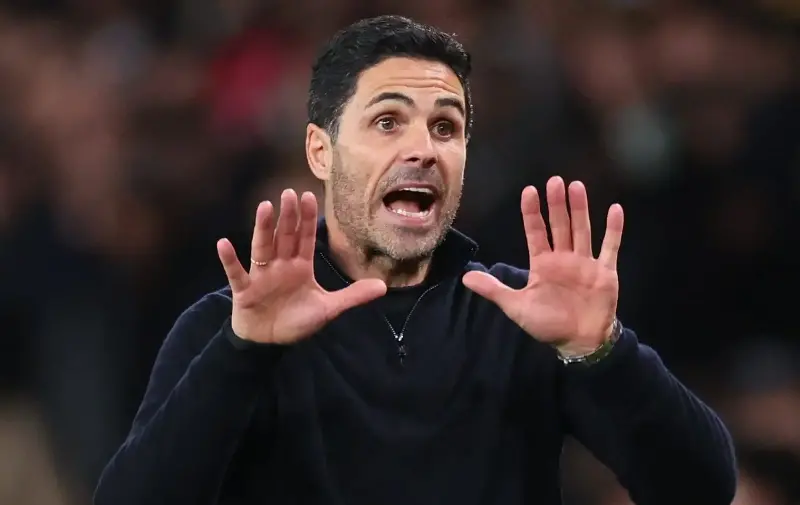
A title decider looms this weekend. Arsenal and Manchester City still have a handful of league games left but whoever is celebrating on Sunday will be visualising having their hands on the Premier League trophy.
An Arsenal win at the Etihad will allow them to ease over the finishing line. A draw means they can crawl across. Lose, and the momentum shift will be such that it would be a shock if Pep Guardiola is not wearing the crown again in May.
The stakes are high for both clubs and managers, but there is an inescapable sense that the pressure is even greater on the league leaders. For Mikel Arteta, the implications of falling short will be more serious; the validity of his approach hinges entirely on whether he is a Premier League or European champion over the next two months.
A triumph will render all criticism up to this point of his reign irrelevant and meaningless. Fall short, and the recovery period will be one of rancour and recrimination.
Arteta has led his team to the brink by sticking to a pragmatic, broadly defensive formula.
For seven months, Arsenal supporters have tolerated increasingly unconvincing victories more than they have embraced them. There has been an ‘end justifying the means’ mood at the Emirates ever since Arteta shifted strategy to follow a path to become more like Jose Mourinho’s Chelsea than Guardiola’s City, under whom he honed his craft as a coach.
Arteta’s vision is now one monumental win against a title rival from paying off. His problem is that failure will be received so unsympathetically, Arsenal’s supporters would make their team the most criticised runners-up in history.
The howls of discontent which followed last weekend’s home defeat to Bournemouth will grow because this has been Arteta’s title to lose since the early months of the season.
Rarely, if ever, has a side with a six-point lead so late in the season – while preparing for a Champions League semi-final – been perceived so negatively.
When the camera zoomed onto Declan Rice’s face after the 0-0 draw with Sporting Lisbon, you could be forgiven for thinking Arsenal had gone out.
It was a reflection that the performance levels have not been great for a while, and the fear expressed as far back as September that in such circumstances the Emirates would be suffocated by fear rather than energised with excitement is proving prophetically accurate.
Is such a reaction fair? To me, much of it is harsh as we must continue to put into context where Arsenal now stand, and how far they have come to get into this position.
We should remember that Arteta chose to redesign Arsenal because of a harrowing experience at the Etihad in 2023. Still in the title race, Arsenal travelled to Manchester and tried to go man-for-man with City, pressing high all over the pitch. The apprentice took on the master and was exposed, losing 4-1. Arteta was seen as naive and over-ambitious.
Those scars have been obvious in the way Arsenal have prioritised defence ever since.
A year later, Arteta returned to the Etihad with a vastly different approach, drawing 0-0 and standing accused of lacking courage as there was a feeling City were there for the taking. City still won the league, but Arteta was heartened enough by the performance that he has never veered away from this caution in the most consequential fixtures.
There will be those hoping he releases the handbrake this weekend. Having come so far, that is unlikely. Arsenal do not play with the same attacking swagger as three years ago. Amid all their positive results, Arteta has never been able to end the debate about whether this is because he has reined in his more adventurous players, or whether they truly lack the quality to hurt a team like City.
My worry for Arsenal throughout this season has been the lack of strike power. I cannot recall considering a Premier League team of the year which did not have a single attacker from the eventual title winners. If Arsenal are champions, none of their forwards will be under consideration above City’s.
Until recently, it did not feel that flaw would deny Arsenal the title because the other usual challengers have been well off the pace, and City are not the team they were. In his private moments, Guardiola knows that.
He may have even confided to colleagues that his side is not quite ready to repeat his previous successes. What must have renewed his optimism is Arsenal’s nervousness and fatigue.
Guardiola’s side reminds me of many Manchester United teams in the Sir Alex Ferguson era, when it seemed like their aura was worth 15 points in the run-in, regardless of form. Ferguson was the master at understanding that the months between August and March are all about getting the team into a position so that they are in contention in April and May. Then experience and know-how goes a long way.
Guardiola has that: the memories of previous title wins mean City head into the next six games with absolute conviction they can win, even though they are just as likely as their challengers to drop points. For Arsenal, it is the opposite. Their record of 12 losses in April under Arteta - the most in any month under his management - cannot be shrugged off as irrelevant. It suggests they are a team that wilts under pressure. Grinding out results mid-season is different because the consequences do not seem so black and white. By comparison, City have won just shy of 80 per cent of their April fixtures under Guardiola.
In other seasons, this would allow Arsenal to see themselves as underdogs taking on seasoned winners. Not this time.
Arsenal fans will not like to hear it, but finishing second for the last three years represented success. Arsenal were the second best in the country behind City and Liverpool. They finished where they deserved to be. When Arteta took over in the era of Guardiola versus Jurgen Klopp, it was correct he found a different way to win.
Finishing second in 2026 will undoubtedly be a failure. This is supposed to be Arsenal’s time, but the final push to win a major trophy is always the toughest. Football is full of examples of teams who suffered a near miss and put on a positive spin about the next season. More often than not, that next step is backwards.
Arsenal have managed to avoid that so far. Psychologically, it would be tougher to recover this summer and there is a greater chance of longer-term consequences if trust in the manager begins to evaporate.
Whether Arsenal get the job done this season or not, Arteta will be under the most severe pressure of his reign to have a tactical rethink over the summer.
As a winner, he can do that by design and with absolute authority. If he and his players are licking their wounds once more, changes in tactics and personnel will be due to public demand and from a position of weakness.