



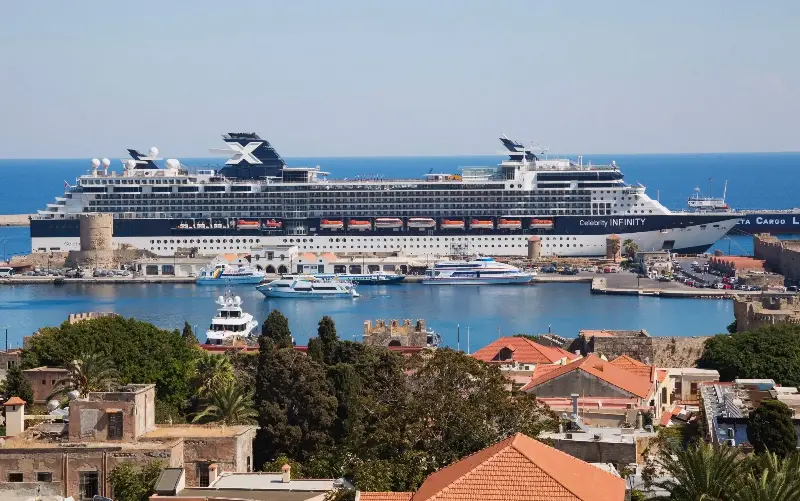
A Celebrity Cruises ship will set sail today for the first time since it suffered a major power failure on February 15.
Celebrity Infinity, which can carry up to 2,170 passengers, experienced a “loss of control… due to a malfunction in the electrical distribution panels”, a statement from Greece’s Hellenic Coast Guard said at the time. With no propulsion, air conditioning or flushing loos, the vast ship had to be towed into port.
It was the second such occurrence for the vessel in just a few months, after it lost power due to an electrical fire in July 2025. A “Bravo, Bravo, Bravo” alert (which typically indicates a fire emergency) was also reportedly sounded this time, though the cruise company did not confirm the cause of the outage.
Overflowing loos and emergency meals
Such problems are far from unheard of. The website CruiseMapper lists 57 cases since 2020 where these maritime behemoths have found themselves without power or propulsion, and other loss-of-control incidents aren’t even included in this category.
For example, MSC Opera’s crash with another ship after its engine got stuck in “on” mode in 2019 is classed by the website as a “collision”, while the famous five-day stranding of Carnival Triumph in 2013 – dubbed the “poop cruise” on account of its overflowing loos – is down as a “fire accident” despite the flame-damaged engines leaving the ship adrift.
Captain Gennaro Arma is a seasoned master mariner with 11 years’ experience in command of cruise vessels. He says: “Modern cruise ships rely on integrated electrical systems to power propulsion, steering controls, navigation equipment and thrusters. If a vessel suffers a full electrical blackout, propulsion and steering response can be temporarily lost.”
Carnival Triumph’s ill-fated sailing showed just how dramatic the results can be. “We’re talking about raw sewage,” passenger Bettina Rodriguez would tell CNN. Besides the unfortunate lavatory situation, food had to be provided by other ships while a new generator was flown in by helicopter in a bid to get the propellers working. By the time a decision was made to tow the ship to shore, it had floated 90 miles off course.
Luckily, power losses are rarely that extreme. Cruise liners are built with multiple safety nets so that critical systems should not be ground to a halt by a single failure; they can run on fewer than the four to eight engines on board if needed, and are able to operate at reduced speed with just one propeller unit should the other malfunction.
Last summer, MSC World Europa lost control and drifted after a power loss, but backup generators ensured that passenger services still had an electricity supply. Engineers were able to restore partial propulsion and the vessel docked in Naples eight hours behind schedule.
“Major losses of control are relatively rare when you consider the number of cruise voyages operating globally each year,” says Captain Arma (according to figures from the Cruise Lines International Association, there are around 24,000 annual sailings). “But from a captain’s perspective, it is something we train for regularly. One of the immediate priorities is maintaining navigational awareness.”
The days of the wooden helm are long gone – many vessels are fitted with pods under the hull which act as both a propeller and a rudder by rotating and directing thrust. Nevertheless, shipmasters can still switch to manual systems if this steering capability is lost. Captain Arma says: “People often think ships are completely automated, but ultimately it’s still a ship that can be controlled manually by trained officers on the bridge.”
All at sea
If attempts to restore power fail, the crew will usually request tug assistance via radio or satellite communications. The coastal authorities contacted will depend on which country’s waters the ship is in, and response times can be long.
For holidaymakers, being on board a drifting ship on the high seas and waiting hours for help might sound nightmarish, but the immediate threat is actually lower in the open ocean. “The main concerns are drifting toward land or shallow waters, or collision risks in busy shipping lanes,” says Captain Arma.
However, tempestuous waters can pose another problem. “In rough seas, power is crucial because it allows the ship to maintain the safest orientation to the waves, typically heading into them. Without propulsion and steering, the vessel can drift broadside to the sea, where rolling forces are strongest,” says Captain Arma. “For crew and passengers, this likely means strong side to side motion, difficulty walking or standing, loose objects shifting or falling, and worsening seasickness.”
The trend for power loss incidents does seem to be creeping downwards; there were only eight cases in 2025 compared with 33 in 2019. But the impact on the relatively small number of affected passengers is huge.
Malfunctions that occur early into a cruise can derail the itinerary or even result in the trip being cut short. Often, though, it is the people waiting to board the liner next who are most severely impacted.
In January, Royal Caribbean’s Anthem of the Seas had to return to Sydney for repairs to its propulsion pods, with the delay causing the cancellation of the next cruise. Passengers received full refunds, future cruise credit and a reimbursement for all travel costs, just not the 10-day voyage to New Zealand.
Similarly comprehensive compensation packages were offered to the cruisers booked onto Celebrity Infinity on February 16, as the ship’s subsequent sailing had to be completely called off.
“Cruise ships are essentially floating cities,” says Captain Arma. “When something goes wrong the protocol is very clear: stabilise the situation, restore power and secure the vessel.”