



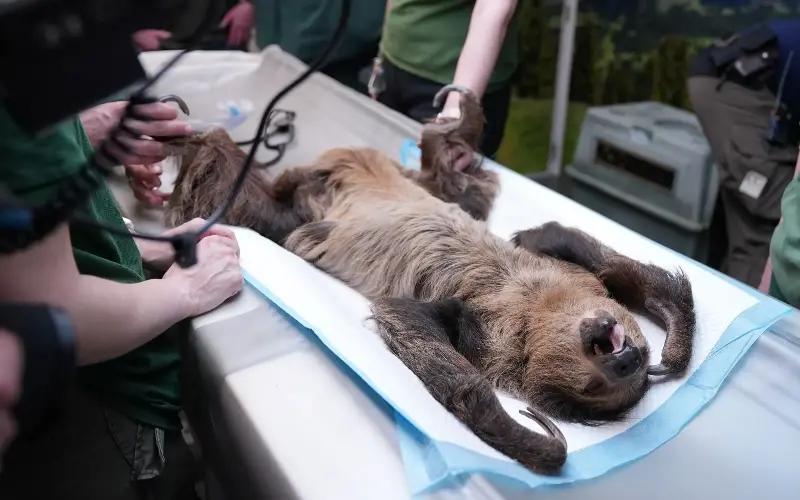
A sloth was given a CT scan after zookeepers raised concerns about it growing too lethargic.
Arlo the sloth went through the scanner at Banham Zoo, near Attleborough in Norfolk, as part of a day of testing to help vets gain a clearer picture of its animals’ complex or long-standing conditions.
Arlo was joined by two penguins, a vulture, a cheetah, a meerkat and a tiger in what is thought to be the widest range of animals to be scanned in a single day using computer tomography (CT), which produces detailed images of bones, organs and soft tissue.
Zookeepers first sounded the alarm after Arlo became even more sedentary than usual, spending hours every day beneath a sunlamp that had recently been installed in his enclosure, which he shares with his partner and their cub.
The scans were carried out with radiographers from Burgess Diagnostics, whose usual clientele is dogs.
‘Info it gives is exponential compared to X-rays’
Dr Elliott Simpson-Brown, a zoo vet with the International Zoo Veterinary Group, said being able to bring the CT scanner to the zoo meant the checks could be carried out in a safe and controlled environment that didn’t stress the animals.
Excessive lethargy in sloths can be caused by calcium deposits that build up in the joints and organs, causing long-term discomfort.
While their natural diet is low in calcium, the animals have historically been supplemented with the mineral in captivity, leading to health problems.
After an initial clinical exam showed no signs of illness, Arlo underwent a CT scan to ensure there was nothing more serious.
The full results are pending, but a preliminary review found nothing concerning.
Dr Simpson-Brown said: “If we get the all-clear on the CT, it means he’s just enjoying his new slower pace of life as a parent.”
While most zoos have on-site X-ray machines, these only give two or three views of an animal, whereas a CT scan provides a 360-degree view, allowing the vets to take a total of more than 43,000 images.
“The information it gives you for the time it takes is exponential compared to X-rays,” he said.
He added that the CT scanner was therefore able to identify underlying health issues quickly and non-invasively.
The other animals to go through the scanner included Bob, a one-eyed African black-footed penguin, Grub, a meerkat, and Mishka, a Siberian tiger whom vets were examining for any bone and spinal changes.
Dr Simpson-Brown said: “Looking at a sloth and trying to determine if they are lethargic or not cannot be the easiest. Luckily, the keepers here are incredibly diligent, so they are noticing the subtle changes in an animal.”