



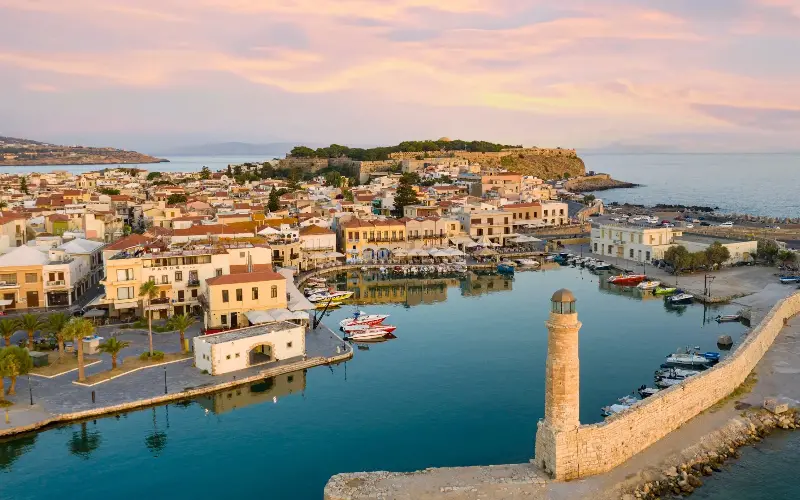
Variety is the spice of life on the largest Greek island. Crete, home of the Minotaur legend and birthplace of Europe’s first evolved society, is a vivid and sensual mosaic of contrasts: from lofty mountains and pink-sand beaches, to buzzing nightlife and traditional kafeneions (coffeehouses). Standing at the crossroads of three continents, the atoll described by Homer in his Odyssey as “a fair land ... in the midst of the wine-dark sea” has been invaded countless times over the centuries. The traces of successive invasions can be found in Turkish bathhouses, Venetian fortresses, and Byzantine architecture.
However, Cretans refuse to dwell on the past: any and every occasion is an excuse for a glendi (party), usually revolving round food: home-grown vegetables, locally produced olive oil, fat snails gleaned in the mountains, or raki brewed in the local still. And (as any Greek will proudly tell you) Crete is the country’s most hospitable island, so you can expect plenty of invitations to join in the fun.
In this guide:
How to spend the perfect day
Morning
It takes seven hours to drive from one end to the other of the megalo nisi, or big island, as Greeks know it, so your first day will only give you a small taste of the wonders of this storied island. Whether you stay for a weekend or a week, capital Heraklion makes a great base.
Grab a slice of custard-packed bougatsa pastry at Kirkor and, if you’re feeling brave, try the syrupy elliniko coffee heated on a bed of sand. Then spend an hour in the Heraklion Museum, where archaeological wonders include the intricate Malia bee pendant, Kamares tableware, and those legendary Minoan frescoes. From here it’s an easy stroll to 1866 Street Market, where you can see stivania (traditional Cretan boots) and knives inscribed with mantinades (traditional Cretan rhyming couplets).
This is also where you’ll find some excellent kafenions, including my favourite: Kafeneio O Lakkos, located in a leafy square in what was once the city’s red-light district. Fill up on meze snacks like plump stuffed courgette flowers and xochloi snails in a garlicky sauce, served with thimbles of raki.
Afternoon
Via car or the hop-on hop-off bus, follow the rutted road inland through silver-leaved olive groves to Knossos Palace. To get the best value from your visit, buy a combined museum/palace ticket, which costs €59 (£51), to explore this Minoan site where archaeologist Arthur Evans carried out his controversial but evocative restoration work.
I’d recommend renting a car, because if you have wheels, from here you have direct access to the Cretan wine roads. Stop off and sip some of the island’s award-winning wines in one of a dozen wineries, before making a beeline for Myrtia village’s Nikos Kazantzakis Museum (there’s also a new bus route direct from Heraklion) where the life of Crete’s literary giant is commemorated.
Night
Back in Heraklion, seek out Peskesi – my favourite farm-to-table restaurant in Crete – set above a Byzantine church. Expect to eat whatever’s currently being harvested on owner Panagiotis’s organic farm, like lightly steamed vlita (amaranth) drizzled with lemon, sea salt and olive oil; askolimbi (wild thistle roots) in a lemony sauce, and other traditional dishes.
Now follow hip Herakliotes to sip some of the city’s best raki-based cocktails at stylish hangout Stone Project. For a real dose of local lifestyle, end your evening at the warehouse-style music venue Nyn Kai Aei, where Cretan music stars come to strum and improvise rhyming mantinades folk songs.
How to spend a week
To explore this 260 km long island, I prefer to avoid the busy main road and follow the old national road which loops from village to village. Head along the coast to Rethymnon, stopping off at Bali beach for a quick dip. Then wander the jasmine-scented labyrinth of Rethymnon’s old streets, lined with mosques, mansions and Venetian fortifications topped by its 16th-century Fortezza (citadel). Stay at The Syntopia, a boho-chic haven complete with a lagoon-style pool just outside town.
Explore the cobbled alleys lined with clothes boutiques and traditional stores, and enjoy some baklava at Hatziparaschos bakery, home to Crete’s oldest phyllo pastry maker.You can also take a day trip to enjoy organic food at Agreco farm or visit Preveli beach.
Continue along the coast, past the coastal town of Georgioupoli and Lake Kournas, where rare striped terrapins bob on the water, to Chania. Stay at atmospheric boutique hotel Casa Delfino Hotel & Spa. Explore the city’s intricate network of shopping streets behind the Venetian harbour; be sure to seek out the leather-scented stores of the city’s two last traditional stivania boot makers. Restaurants near Chania’s harbour tend to be tourist traps, so it’s worth heading out of town to Leventis in Stalos.
Chania is a good base for activities close by: hike the Samaria Gorge; take a boat trip to Balos or Elafonissi pink beaches; visit Gramvousa island fortress or hike coastal trails in the region.
If you head for Crete’s far less crowded eastern side, you’ll discover a more traditional version of the island. Explore Lasithi’s capital Agios Nikolaos, overlooking Voulismeni, a circular lake where legend says the Goddess Athena once bathed, surrounded by tavernas. Karnagio is my local go-to when I have friends in town.
If you have kids, it’s well worth stopping off en route to visit the CretAquarium, a vast marine-themed space with 60 different tanks and its own shark tunnel.
It’s also worth planning time to explore traditional villages like Armeni and Ziros; swimming from the silky sands of Vai’s exotic palm-tree studded beach or the remote paradise of Xerokampos, and feeding on meze snacks in my favourite family-run tavernas Xatheri and Kaliotzina.
When to go
Temperatures are balmy all year round along Crete’s extensive coastline – although it will often rain from January to March, and sometimes there will be a few days of snow. Weather up in the mountains is colder: expect chilly weather from late December to early April. Conversely, in summer when temperatures along the coast climb to 30-35C, the mountain villages – which are often five degrees cooler – are ideal for escaping the heat.
Sea temperatures start to rise in late April and May, and you can often still swim in November. The island is crowded during July and August when Cretans from overseas come ‘home’ for the summer, but in late spring and early autumn the beaches and attractions are generally far less crowded – especially in the east of the island.
Where to stay
Luxury living
No expense has been spared in creating Abaton Island Resort & Spa, a sleek and classy Cycladic-style resort close to Hersonissos. Rocking chairs scattered around the property invite repose, and lighting is used to create ambiance: a forest of light bulbs dangles above comfortable sofas in reception, and the main bar glows with coloured lights.
Designer digs
Domes Noruz, a stylish design hotel modelled on the domes of nearby Chania’s Venetian shipyard, has two large pools (one of which has a swim-up bar) and a bijou spa. Public areas are immaculate, with scatter cushions and bean bags strewn over carefully tended strips of grass. Close by are some of Crete best beaches, including the pink sand beach of Elafonisi.
Budget beauty
The wonderfully friendly Casa Delfino Hotel & Spa in the high-ceilinged house of Genoa merchant Giovanni Delfino is an easy drive from the region’s main sights. It has striking original features, a bijou spa and some rooms have panoramic views over Chania’s lively cobbled harbour.
How to get there and how to get around
During the summer months Jet2, Tui, Wizzair and British Airways fly direct to island capital Heraklion from London Gatwick, London Stansted and from six other destinations, including Belfast. Ryanair, British Airways and Easyjet also fly to Chania in the west of the island. Although there are no direct flights, Sitia in the east of the island has its own small airport. Flights from Athens to Sitia with Olympic Air take 50 minutes.
Although KTEL buses link the island’s main towns and resorts, if you want to get off the beaten track and explore more remote areas, it’s best to hire a car – there are car hire companies at both Chania and Heraklion airports.
Essential information
- British Consulate: Heraklion: 00 30 28102 24012; gov.uk
- Tourist police: 171
- Ambulance: 166
- Fire: 199
- Tourism Office: 00 30 28134 09777; Nikiforou Foka Square (Lions Square), Heraklion
The basics
- Currency: Euro (€)
- Telephone code: 00 30
- Time difference: +2 hour
- Languages: Kritikoi (Cretan patois), Greek
- Flight time: Around four hours
Local laws and etiquette
- Cretans are relaxed about sartorial style, but they appreciate modest clothing (no shorts or crop tops) when visiting churches and other religious places – and you are expected to remove headgear when entering. Nude sunbathing near Cretan families is considered extremely rude, and is only acceptable on designated beaches.