



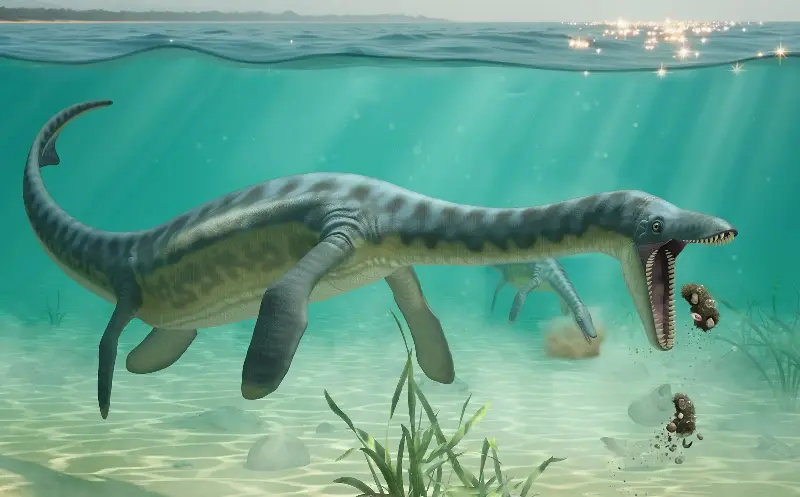
Newly discovered fossils suggest that plesiosaurs vomited in the shallower waters of coastlines, regurgitating undigested bones in pellets like owls, say scientists.
Dirk Knaust, a palaeontologist working with Equinor ASA, a Norwegian energy company, found 20 clumps of fossilised vomit from the reptiles about 30 miles off the coast of Norway.
In the Jurassic period – between 200 and 150 million years ago – the area where the pellets were found would have been a river delta, suggesting plesiosaurs hunted prey at sea then swam to shallower water to get rid of material they could not digest.
Mr Knaust believes plesiosaurs, which are classed as extinct marine reptiles rather than dinosaurs, could have displayed the same behaviour around Britain, because the fossils were found in what was a narrow sea that also covered the Jurassic Coast.
Although plesiosaur skeletons have been found all over the world, the UK is a particular hotspot. Previous research into plesiosaur anatomy and movement has suggested the marine reptiles angled their heads down to collect shellfish from the seafloor.
However, they could not crush shells or other skeletal material with their teeth, and it is believed their stomachs compacted the vomit into pellets, as happens in seals, crocodiles and owls.
‘So much more to learn’
Mr Knaust said: “Plesiosaurs may have come close to shore to relax or sleep after hunting and that’s likely when they vomited. We see fur seals and marine crocodiles doing something similar today, but while they go on to land, plesiosaurs probably remained submerged due to their weight and shape.
“This is still just the beginning. There’s so much more we can learn from picking through what extinct animals threw up after dinner.”
The chunks of fossilised vomit range in size from a walnut to a mango and contain mollusc shells and serpulid shells – hard, tube-dwellings built by filter-feeding worms.
There was also evidence of crinoids, invertebrates that attached themselves to the sea floor with a stalk, and belemnites, the hard parts of squid-like cephalopods.
Shellfish, such as the ones found, can only survive in the salty open ocean, so the remains must have been brought up by a creature that swam between the coast and the sea.
The mix suggested the animal responsible must have been specialised to eat hard-shelled and exoskeleton prey on the seafloor. It also had to be large enough to allow it to vomit 4in clumps.
‘Fascinating animal’
Mr Knaust ruled out sharks and crocodiles, because there was no evidence of fish bones.
He said: “The plesiosaur most closely matches the size and feeding profile of the vomit producer. [It] is such a fascinating animal and these findings add to other kinds of evidence that help us to understand their abilities and behaviour.”
Plesiosaurs could measure anything from 6m to 42m in length and were some of the most successful marine reptiles to have ever lived, surviving for more than 140 million years through multiple extinction events.
The cryptoclidid plesiosaurs, which Mr Knaust held responsible for the vomit, grew 4m to 26m long and lived between the Middle Jurassic and the Early Cretaceous – 174 to 100.5 million years ago.
The chunks of vomit were found in drill core samples taken from North Sea wells operated by Equinor ASA during the development of a subsea storage site for CO2 near the Troll gas and oil field.
Mr Knaust has previously found footprints in some of the extracted cores, including from land-based predators and herbivores that roamed the land surrounding the deltas.
The study was published in Geological Magazine.