



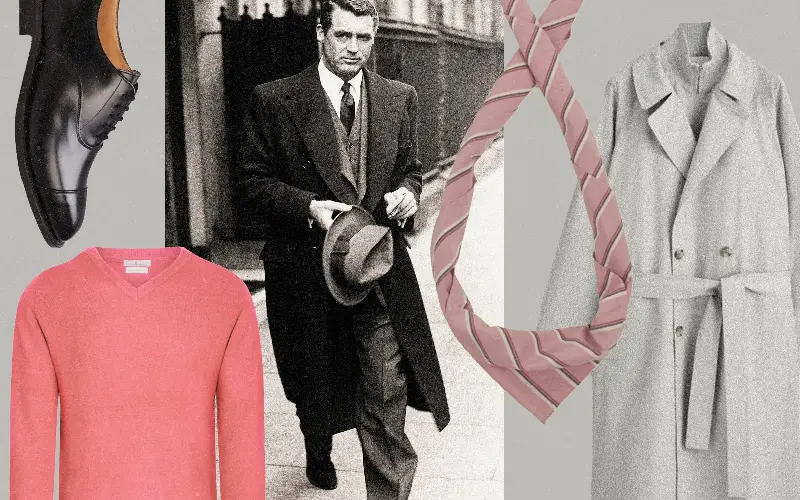
An esteemed reader of this parish got in touch recently in response to my equally esteemed colleague Lisa Armstrong’s piece on the art of looking expensive without spending a fortune. Said gentleman took to the comments section (yes, we do look – please be kind) to ruminate on what maketh a similarly elevated uniform for a man, listing a good single-breasted navy jacket, good shirts, well-maintained shoes and small accessories as starting points.
Well, Mr George Allen, I heartily agree with you on those points – and I have some of my own to add, too. Looking expensive obviously has nothing to do with how much money one splurges; witness the crass vulgarity of logomania and the toxic fashion endeavours of the Bezos-strata of billionaires (as Lisa pointed out). A male friend, who married just before lockdown, had one prerequisite for his outfit: he wanted to look expensive. To that end, he splashed out on a Prada suit (it was his wedding day, after all) in chestnut-hued silk, with a shirt and tie. Nothing overt – just a quietly luxurious suit that looked immaculate.
Not that you need to opt for Prada to look expensive. In fact, that great arbiter of taste, the wonderful charmer Nicky Haslam, prefers Primark over Prada, but mixes it with heritage items built to last: a track top from the fast-fashion retailer with a corduroy jacket, perhaps. Not that I’m particularly fond of mass-produced clothes pumped with plastics and oils, but the sentiment remains that money is no factor in looking elevated and considered.
So, with our reader’s musings as a starting point, here are some touches that men should consider.
Jump to:
Start with the shoes
“The first thing a woman notices about a man is his shoes”, “a good outfit starts with the shoes” – there are myriad variants of the same sentiment, but the unifying factor is that whatever you’re wearing becomes redundant if your shoes are scruffy. Yes, trainers have their place, but for gloss and elegance they should be properly made, preferably British in origin (check whether they’re made in Northampton, the benchmark of excellence in shoemaking) and in sturdy leather.
Oxfords are generally the smartest, Derbys next in the pecking order and brogues traditionally more countryfied. Look for pairs that are Goodyear welted, which means a rubber strip is stitched between the upper and sole for durability and to facilitate easy resoling. As with everything, spend the most you can afford. Then – here’s the crucial part – maintain them properly with shoe trees and resoling when the time comes. I don’t have time to polish the way my grandfather did on Sunday afternoons, so have that element done at Timpson if you can.
The power of proper tailoring
Yes, a single-breasted navy jacket is an excellent wardrobe stablemate, but the crucial thing with all tailoring is to go for the highest level of quality you can afford in terms of material, and to ensure it fits correctly. You don’t have to be bedecked in Savile Row’s finest (in fact, I’ve met CEOs from such venerable houses who look like Southend publicans); a good blazer or suit depends on fabric and fit.
Opt for natural materials – fabrics where synthetics are mixed in with wool and silk to a heavy percentage can look shiny – and, crucially, consider the fit. The general rule of thumb is that slender, more elongated frames can carry both single- and double-breasted shapes, whereas the latter can be tricky on shorter, fuller frames, owing to the extra buttoning and expanse of material across the torso.
If you’re remotely confused about fit, ask for advice – most high street retailers, such as Ted Baker or Reiss, have tailors on hand, for example, to make tweaks that will enhance your silhouette. And if you don’t have that option, do some local research into dressmakers or alteration services near you – it really makes the difference. Navy and black are perennial, and tend to look more patrician and elegant than the corporate feel of grey.
The case for a good coat
This is very much an extension of the first point, but as with tailoring you should opt for what my granny always termed “a good coat” – imbuing its solidity against the Scottish cold with a moral compass – one made in quality, natural materials and cut to fit well; leave the puffas for the football terraces and donkey jackets to Michael Foot.
Stick to a classic, longer version that falls below the thigh in wool or a subtle heritage weave such as herringbone or Prince of Wales check. Trench coats, too, can look smart as a lighter option for spring. As with suits, if in doubt look to Bill Nighy: a severe, sharp black coat in wool is a thing of quiet majesty.
Smart shirts need structure as well as style
One rule of thumb here: don’t go for grey or black. It’s rather Andy Burnham, and tends to sit at odds with a formal jacket. Casual shirts can look good with a blazer – likewise collarless styles – but be warned that the softer structure of their collars can mean a tie doesn’t sit correctly. They can also fray more easily. If you’re going for smart formal, stick to a proper shirt that fits the brief and opt for double cuffs to accommodate cufflinks.
On that note: no novelty cufflinks, ever. Discreet, subtle lustre in a semi-precious stone or a glint of silver is fine; Union Flags and comedy footballs are not.
The case for colour
A certain school of thought advises that soft, neutral colours look the most expensive, and that can be true – the kind of delicious caramels, fawns and oatmeals that call to mind a White Company catalogue. But colour can zhush up a look, too, in considered doses: a Fair Isle knit in rich, autumnal hues, or a pink cashmere sweater with camel trousers (those two shades look great together); see also red trousers. It’s not about slapping on Crayola brights like Timmy Mallett, but adding a nuanced touch of tonal colour that feels deliberate and refined.
Accessories maketh the man
It’s the little things that make an outfit, as with shoes. Accessories can transform your M&S suit into something more elevated, and add a touch of personality. It doesn’t have to be a handsome Turnbull & Asser tie (although those are always a welcome addition to formal shirting), but it can be as simple as a pocket square with a jacket, an excellent leather belt, a foulard or – if you’ve got the head for it – a great Panama hat.
While rucksacks are undoubtedly practical, they don’t exactly say “grown up”, so if you’re particularly wedded to yours, opt for a version in leather. Otherwise, an elegant pochette, leather briefcase or attaché case – softer, more structured varieties are less rigid than the “Captain of Industry” versions of old – are smart options.
Watches are their own category – some of the most expensive are the most repugnantly vulgar – so we’ll park that for another day. As for what your tie knot says about you, I’ll leave you to the esteemed Tom Chamberlin on that front. I prefer going tieless, which I realise makes me a heathen.
Good grooming goes a long way
An element that so many men don’t prioritise, yet is the easiest route to looking polished and put together. The 101, in fact: you can be bedecked in Savile Row, but if you look unkempt it’s of little use. It’s the small things – tending to unruly eyebrows, sticking to a simple moisturising routine, exfoliating once or twice a week to remove dead skin that can flake, and keeping your hair neatly trimmed.
One point on hair: being laden with product never looks “expensive”, if that’s the goal, but rather “regional high street on a Saturday night”. A little oil and a light pomade are generally best, and if you have the patience to blow-dry, it tends to look more considered. Add a scent that’s less astringent and chemical than your average Duty Free offering, perhaps from a heritage barbershop such as Truefitt & Hill, for a final touch.
Care makes the difference
As with shoes, clothes need to be kept in fine fettle, not just because it’s good form but because it’s also ecologically responsible; ensuring a long life for your clothes means you’re not adding to the constant churn of consumerism and the resulting waste. Look at King Charles: he’s had the same Anderson & Sheppard coat for almost 40 years, likewise with his patched-up suiting.
So, have frayed edges mended, moth holes repaired (I could write reams of seething prose about the evils of the dreaded moth) and your trousers fixed if certain – more intimate – areas begin to wear. Invest in a lint roller and a sweater comb. It doesn’t take much effort, and it’s a degree of self-respect and respect for your clothes that will set you apart.
Steer clear of sportswear
There’s a strata of quiet luxury focused on sports attire for men – see Succession’s silverback alpha Logan Roy in padded gilets and trainers – and it’s true that athleisurewear has become hugely elevated in recent years, and wildly expensive: a pair of cashmere sweatpants from Brunello Cucinelli retails at almost £3,000. But unless you’re part of the 0.001 per cent, it’s very hard to pull off without those exceptional fabrics. Yes, sportswear has its place – the tennis club, perhaps, or lazy weekend brunches – but if in doubt, steer clear.