



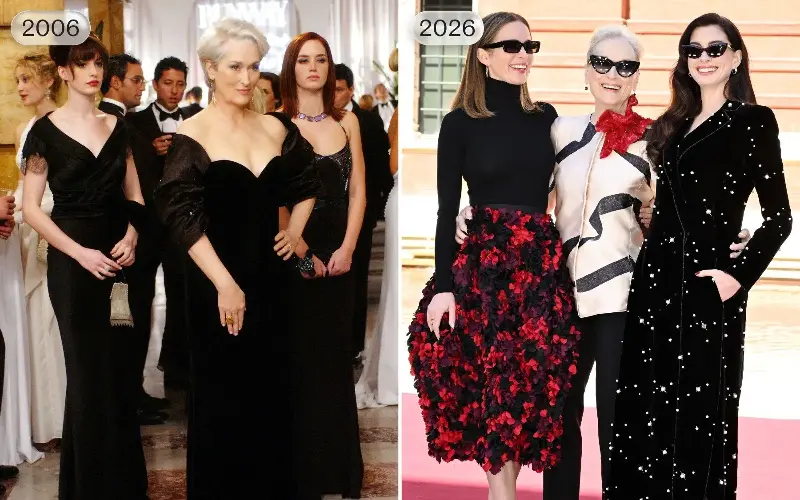
If 20 minutes is now a long time in politics, then 20 years in fashion – the gap between the first Devil Wears Prada film and the much-hyped sequel – is just long enough to take us in a big loop.
Looking at the one and only picture that exists of me at work around that time (the sole image I could uncover is from 2007), how times have – and haven’t – changed. I would probably still wear all the items (dark velvet jackets 4eva) but possibly not together, and the skirt would be longer. Also, since we’re being picky, not the necklace. God, not the necklace, which was by a brand called Raoul and fabulous in its way, although overscale for my frame. Statement necklaces were huge, in all senses, that year.
I’ve been asked by the editor of this feature for more details about what I wore back then. And more pictures. Er, pass. I know I loved and bought Marni. And filled the gaps with, yes, Gap, which was so good in that period that Phoebe Philo did a quiet stint there in 2006-07, between big designer gigs. And judging by the carrier bag I’m holding, possibly Banana Republic, which had a moment. But the bag could have been left on my chair – I was at an event for the brand in New York.
There’s scant further proof of what was in my wardrobe. This was pre-smartphone, so we weren’t taking pictures of ourselves incessantly and poring obsessively over the results – lovely for the soul, but also why many outfits back then looked like a game of three or more halves.
What else was hot? Boho, logos, hipster jeans, the red carpet, skinny models, naked dresses, Birkin bags, celebrity as aspiration, Sienna Miller as style inspiration, the Beckhams, Jeff Bezos and his current wife, Chanel jackets and flap bags – they were with us then and they’re with us now.
Other things have faded. The high street struggled. Topshop’s bricks-and-mortar form expired (though it has slightly risen again recently). Matchesfashion.com and much of the luxury online shopping caboodle came and, in some cases, went.
M&S revived, improbably replacing Topshop. Mother-daughter shopping went from media fantasy to a genuine demographic. A surprising number of female faces have outlasted the naysayers – witness Anna Wintour and Meryl Streep together on the May cover of US Vogue to publicise, guess what?
Once upon a time, Wintour wouldn’t have dreamed of plastering her own image on the front of her magazine, let alone at the grand age of 76. Her power resided in her being the puppet master, not the puppet. As for Streep, also 76, she always positioned herself slightly beyond the fashion fray, until recently. Now, like other 70- and 80-somethings (Glenn Close, Prue Leith, Helen Mirren, Jane Fonda, Martha Stewart), she seems to have discovered that the right clothes can be a joyful superpower.
While a cursory sweep of Devil one might seem filled with the familiar, the framing of almost everything has changed in ways we couldn’t have imagined. Body-shaming is a buzzword, and the new paradigm says all shapes and sizes are beautiful. Yet millions are on weight-loss drugs to get thin (they probably tell you it’s to lower their blood pressure).
Fashion trends might be cyclical, but beauty and wellness – a little-used word 20 years ago – are unrecognisable from their quaint 2006 versions. Back then, pillow faces and trout pouts were still something of a warning of what could happen if you hung out on Harley Street too long. Now, in some parts, they’re standard. Add filters and you can achieve a face akin to a Disney cartoon princess.
The Noughties had their share of enhanced imagery – in 2006, barely a single magazine image wasn’t airbrushed, and we knew it. In 2026, filters are ubiquitous, and many who don’t realise it compare their own faces with unreality and feel short-changed.
The mid-Noughties still pedalled the Hope in a Jar approach. Remember when, quaintly, Crème de la Mer was considered a wonder treatment? Now, if you’re not, at the very least, following a South Korean skinmaxxing and glass-hair regimen, mouth-taping at night to stop your jawline sagging, utilising at-home beauty tech in between professional tweakment appointments and keeping up with your Biab manicures, if you don’t have a confirmed date in Turkey for a complete dental overhaul or hair transplant, you’re made to feel as though you’ve given up.
Those with money can achieve a kind of agelessness that is more accurately an ageing-limbo – not old in the conventional sense but not youthful either.
Ageing has become a phobia. Bryan Johnson, the venture capitalist turned longevity evangelist, is just one of an increasing number of (usually) men who want to thwart the ultimate system and dodge the hereafter – though ironically their waxy skin and weird diets (bordering on eating disorders) signal a kind of living death. The freakish health regimens of the rich and famous fascinate us in the way that wild tales of drug abuse did in 2006. Clean living is pretty much a given. For It couples, substitute Kate Moss and Pete Doherty in 2006 with Zendaya and Tom Holland now.
In 2006, as Devil one illustrates, the gatekeepers to Good Taste were unquestionably the world’s glossy magazines, primarily Vogue, which determined what and who was in and out. No mercy and precious little diversity, be it in ethnicity, body shape or age.
Now, many of those magazines have been decimated or closed. Vogue itself wields a shadow of its former clout. It can still rack up hundreds of thousands of likes on Instagram – but only by posting about the kind of celebrities its narrow, 2006 self would have shunned.
The 2006 Miranda Priestly – Streep’s Wintour-like character in The Devil Wears Prada – would have dismissed the oncoming Kardashian tsunami as of no more relevance to her magazine than, well, a tsunami. But in 2013, Wintour, having steadfastly refused to invite the family to her Met Gala for years, finally capitulated to populism. Kim Kardashian attended with her soon-to-be-husband Kanye West, and the following year the couple appeared together on the cover of Vogue. It was as if Condé Nast’s cultural custodians had suddenly laid down their metaphorical spears and decided to get high instead. Andy Warhol’s prediction that one day everyone would be famous for 15 minutes was about to seem like an understatement.
In 2006, if you were famous, everyone knew who you were – but relatively few people truly were. Appointment viewing was just that. VHS recorders and DVD players existed, but the era of streaming-service dominance was yet to come, so everyone still watched the same programme at more or less the same time. The water-cooler effect was real.
Old-school magazines like Priestly’s fictional Runway were dictatorial, but offered a clear point of view. You knew where you stood. If Vogue wasn’t your “jam” (to quote Meghan, a figure whom no one had heard of in 2006), try Cosmopolitan or Good Housekeeping. A BlackBerry was the height of personal tech and meant adults could work on holiday – people joked about Crackberry addicts. Twenty years on, smartphone addiction affects seven-year-olds. Schools are tentatively banning them. Governments talk about them in the same language they once used for cigarettes.
In 2006, no one outside Silicon Valley knew an app from an apartment. Now those apps determine what we read, listen to, watch and believe. Politics – once a subject for the kind of people you might have avoided at parties – is now inescapable, including in fashion, which some time in the 2010s discovered its voice on subjects as wide-ranging as the environment and Gaza. We’re more tribal than ever.
But for all the anxieties, we’ve still got it pretty good. Emily Blunt, then a newcomer in her breakout role as one of Priestly’s assistants, remains at the top of her game in the new film, as does Anne Hathaway, each achieving longevity beyond the wildest dreams of most of 2006’s 40-something actresses. They may have to conform to draconian Hollywood expectations to game the system, but at least they have the tools to take part.
Meanwhile, the Kardashians’ extraordinary before-and-after surgery transformations showed millions that genes didn’t have to be destiny: with money you could play God.
If you can’t get a job because ChatGPT (or Anna Wintour, in her great 2021 clear-out of rival Vogue editors) has made you obsolete, you can take comfort from the fact that you no longer have to work for a snooty, mono-taste glossy magazine to make it big in fashion. You can become a self-employed digital content creator. You might have to develop a mercilessly mean streak because social media has normalised narcissism and the algorithm favours bullying over nuance and neutrality, but there are positive, genuinely thoughtful voices out there too, provided one can tame that algorithm.
Will 2026 Miranda Priestly attend the shows with the tech bros formerly seen as dowdy (as Wintour has this year, sitting across from Mark Zuckerberg and his wife Priscilla Chan at Prada, escorting Lauren Sánchez Bezos to couture)? Might she also address how power in fashion has shifted from the very few to the many? Her take-down of Andy Sachs, the morally supercilious assistant played by Hathaway, in Devil one, became so famous it’s still quoted today.
For clearance bin, substitute Vinted, the resale site where buyers and sellers trade second-hand clothes and, in the endless surplus, come face to face with the true cost of our fashion addiction. Vinted didn’t exist in 2006. Nor did Vestiaire Collective, and its various peers, all of which provide platforms for pre-loved designer pieces and offer a genuine alternative to the new, new, new culture that was firmly embedded in 2006. Back then, staggering out of Primark under a mountain of unfeasibly cheap clothes was considered smart shopping. Now it’s buying less, but better. It’s understanding cloth, how to style and how to maximise what’s already in your wardrobe. The modern sin isn’t being out; it’s having too much.