



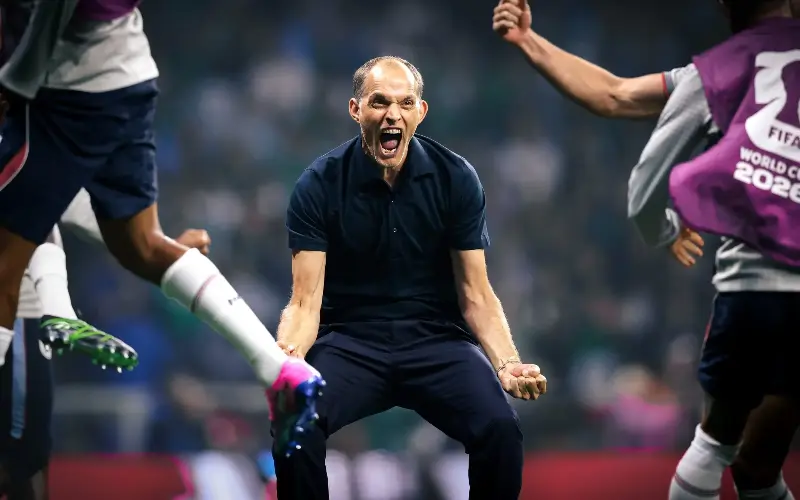
Rare indeed is the tournament where affection for an England team approaches unconditional love. But the class of 2026 are, if only for a precious, fleeting moment, the toast of a nation. That epochal victory over Mexico at the Azteca Stadium has cemented itself as one of those “Where were you?” occasions, with the BBC indicating that more people stayed awake for the match’s conclusion at 4.09am UK time than watched Neil Armstrong become the first man to walk on the Moon at 3.56am on July 21, 1969. In the days since, the public appetite for savouring the performance has remained insatiable, with more than 40 million views on social media for a video of John Stones pranking Thomas Tuchel by suggesting he had an injured shoulder.
Such popularity has been mirrored here in the United States, where England’s herculean defensive effort with 10 men captivated a combined TV audience of 45 million. Against all expectations, this team are becoming a sure bet for thrilling, twisting, draining theatre. The playing style has changed manifestly under Tuchel. Where once England would succumb to abject terror after going 1-0 up early, disappearing into their shells in both their 2018 World Cup semi-final and the 2020 European Championship final, their immediate instinct after Jude Bellingham’s first goal in Mexico City was to chase a second. That refusal to die wondering is refreshing.
For once, the attention is also firmly and squarely on the football. It is a novel sensation, given the tendency during the Gareth Southgate years for the manager’s earnest convictions to translate into distracting gesture politics. From championing Black Lives Matter and rainbow armbands to describing the Brexit vote as having “racial undertones”, Southgate, a naturally equable soul, plunged headfirst into a series of tinderbox issues.
At major tournaments, this approach did not earn him undiluted praise. While many lauded him for the sincerity of his “Dear England” letter in 2021, when he argued that he and his players had a “duty to interact with the public on matters such as equality, inclusivity and racial injustice”, others bristled at having the main meal of football served with a side order of a sociology lecture.
Similarly, England’s 2022 campaign in Qatar is remembered less for stellar displays on the pitch than for Southgate and the Football Association (FA) tying themselves in knots over how to protest against the Gulf state’s hardline laws on gay rights. No sooner did they adopt a noble stand, claiming that they would convey the message even in the face of Fifa punishment, than they buckled at the first sign of pressure, with captain Harry Kane wearing a bland “No discrimination” armband – for fear of incurring a yellow card for anything more pointed. Even Euro 2024 was not immune to political interventions, with a general election falling directly in the middle of it.
Happily, this World Cup feels detached from any achingly worthy England pronouncements. Credit for the shift belongs to Tuchel, who has explicitly defined himself as a “head coach” rather than a manager, removing the need for political forays. “I think we have the best chance when you allow the head coach to focus on football,” he said upon his appointment, with a knowing smile. “Maybe I can hide a little bit behind being not English, and not talk to everything that happens in your country, out of respect.”
Tuchel’s reticence is not purely a reflection of being German. He followed the same rule at Chelsea, even when he was bombarded in March 2022 with questions about Russia’s invasion of Ukraine and the ramifications of Roman Abramovich’s decision to sell the club. “You have to stop,” he snapped. “I am not a politician. I’m not so sure if I am the person who should give messages to the fans about anything other than sports.” But set against this rigid delineation of his duties is a playful sense of humour, already expressed in the US through his urging of parents to write excuses to schools so that their children could pull the odd World Cup all-nighter.
To see him leaping up and down for joy in England’s dressing room at the Azteca, having initially fallen for Stones’s highjinks, was to witness the return of some much-needed irreverence. A feeling had crept in under Southgate that everything was becoming too po-faced and corporate, with players under greater pressure to be social justice warriors than world-beating footballers. Not that the effects of his cultural transformation should be discarded. In the end, he took England to two finals, one semi-final and one quarter-final in the eight years after England bombed out of Euro 2016 against Iceland. What was missing was the fun, the amusement to sit alongside all the bleeding-heart advocacy.
In part, Southgate was a product of a curious historical juncture. In 2020, the discourse was centred on BLM, taking the knee, and the infernal tokenism of identity politics. He believed passionately in it all, later writing in his book Lessons in Leadership that his views had been shaped by reading Reni Eddo-Lodge’s 2017 tome Why I’m No Longer Talking to White People About Race.
For a while, he was celebrated as a thought leader, a paragon of virtue, although those who supported him inveighing on politics tended to do so because his views corresponded with their own. But the FA’s subsequent determination to move away from the gospel according to Gareth indicated that it all went too far. As Tuchel has shown, fostering team unity matters far more than trying to be the great healer across an ideological divide. If the public connection to his players seems stronger today, then that is because he has allowed support to develop organically, as opposed to politicising his team at every turn.