



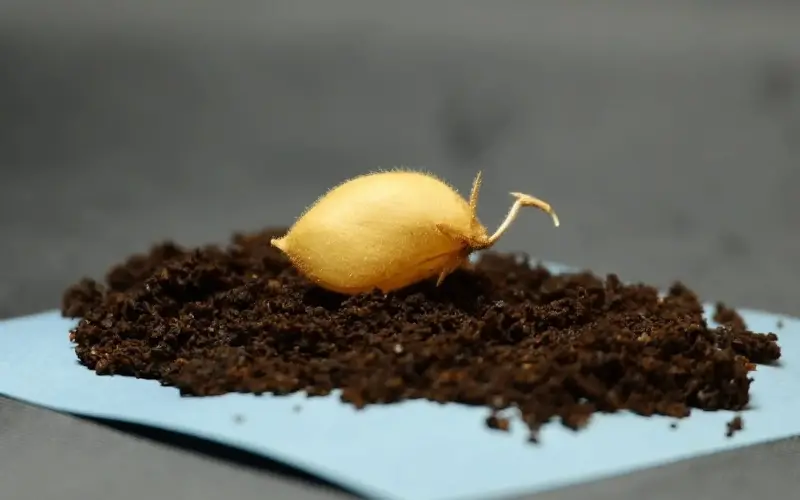
Moon hummus could be on the horizon after scientists grew chickpeas in lunar dust for the first time.
The Myles variety of the legume was planted in simulated moon soil based on samples brought back by Apollo astronauts in experiments conducted at the University of Austin, Texas.
Moon dust, also known as regolith, is dramatically different from that on Earth, containing rock, mineral fragments and tiny pieces of abrasive glass. It crucially lacks water, nitrogen and phosphorus to help plants thrive and contains heavy metals that could be toxic.
But against the odds, the team was able to grow harvestable chickpeas.
“The research is about understanding the viability of growing crops on the Moon,” said Sara Santos, the project’s principal investigator at the university’s Institute for Geophysics.
“How do we transform this regolith into soil?”
Nasa and the European Space Agency are hoping to establish a permanent base on the Moon within the next decade but it is still not clear how astronauts will survive long-term.
Scientists had doubts that anything could grow in the hostile lunar soil, until 2022, when a team at the University of Florida grew cress in soil brought back from Apollo missions.
Genetic studies on the lunar cress showed that the plants had changed their biology to cope with the harsh conditions and had switched on dormant genes that are typically deployed to fight soils which contain high levels of salt or metal.
Moon dust is powdery, and so sharp and angular that it started to wear away the space suits of the Apollo astronauts.
Knowing that the chickpeas might struggle in the lunar soil, researchers mixed in vermicompost – a nutrient-rich, organic fertiliser and soil conditioner produced by earthworms.
Scientists believe the compost could be created on missions by taking earthworms that would feed on organic waste material such as food scraps or cotton-based clothes and hygiene products that would otherwise be thrown away.
The chickpeas were also coated with the fungus arbuscular mycorrhizae before planting. The substance penetrates root cells, trading soil nutrients for the plant’s carbon.
The study showed that mixtures of up to 75 per cent moon dust successfully produced harvestable chickpeas – any higher and the plants displayed signs of stress and early death.
Testing for toxins
Researchers also found the fungi were able to colonise and survive in the simulant, suggesting they would only need to be introduced once in a real-world growing setting.
Researchers now plan to test the nutritional content of the chickpeas and find out whether they contain any poisonous substances.
“We want to understand their feasibility as a food source,” said Jessica Atkin, a doctoral candidate in the Department of Soil and Crop Sciences at Texas A&M University in Brazos County.
“How healthy are they? Do they have the nutrients astronauts need? If they aren’t safe to eat, how many generations until they are?”
The experiments also have implications closer to home, showing how plants can adapt to survive harsh environments and poor soils – traits which could become vital if the planet continues to warm.
The research was published in the journal Scientific Reports.