



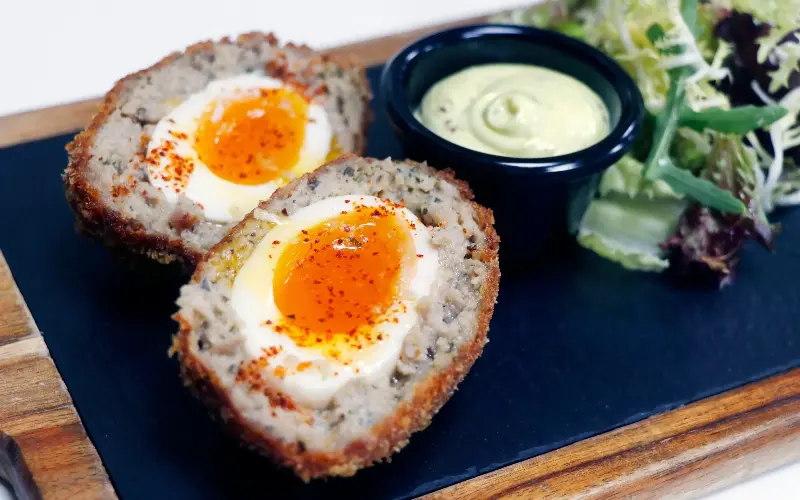
There was a time, not long ago, when most of us were as well acquainted with the ingredients that went into pub snacks as we were with asbestos factories. In other words, we knew they worked, after a fashion, but we didn’t want to get too close.
Now, of course, we want to know the provenance of everything on a gastro-pub menu. It often goes too far, but our revived gourmet interest in “authenticity” is, at its root, one of the few happy narratives to have occurred in Britain in the 21st century.
Thanks mainly to rationing and its cultural aftermath, we spent decades eating British dishes that didn’t so much pinch as commit a mendacious Chinese burn on the ingredients that went into things like Scotch eggs, turning them from being a luxury snack of the Bertie Wooster class, into a rubbery punchline to half a dozen pints of kegged Watney’s.
The Oxford Companion to Food states that the origin of the Scotch egg may lie in Indian koftas. Perhaps half remembered by a colonial back on home shores after a long stint working for the East India Company. Fortnum and Mason lay claim to inventing the first Scotch egg in 1738, using a punnet’s egg, with the “Scotch” prefix stemming from the use of anchovies to liven up the meat.
It had found its way into cookbooks for the prosperous middle classes by the 19th century. Mrs Beeton took the credit but, in actual fact, a recipe for “Forced Eggs”, which is pretty much the same, was printed by Maria Rundell in her A New System of Domestic Cookery in 1809; the “forced” referring to the seasoned minced meat.
The name may have changed, but the forced element was relevant by the 1970s and 80s. Inferior ingredients had relegated the Scotch egg to a snack that required coercion (or desperation) before eating.
It wasn’t alone – the same could be said for white bread, the Cornish pasty and curry. While it’s hard to forget the adoration of Martin Amis’ ferociously feral Keith Talent in London Fields for one malodorous pub standby. “Taking my life in my hands, I ate a pork pie” Amis’ dying narrator Samson Young recalls, as he samples Keith’s go-to pub snack.
The road back for these British classics turned into car wrecks was a long one. And while it’s easy to look at the opening of the Eagle gastropub in Clerkenwell in 1991, and Fergus Henderson’s St. John in 1994, as game-changers, the reality is that they weren’t really known outside London’s chattering gourmand classes and those who read the magazines and weekend supplements they wrote for.
Step forward Marks and Spencer. It was their repackaging of these unfashionable products as something approaching a middle-class snack rather than a working-class mistake during the late 1990s and early Noughties that really put pies, trifle, crisps and pasties away from the pub hot plate and into the Le Creuset bowls and the middle shelf of the Aga to be warmed up.
Fortnum and Mason weren’t about to be undone by the high street, however. These days, their delicious Scotch eggs come in at a weighty £25 for four. But they’re the size of a baseball and created with Suffolk Red eggs and pork from the Dingly Dell farm in Suffolk.
And yet, and yet… Our collective foodie memories are just not myopic enough to forget the era when a Scotch egg was mostly seen festering in an Esso garage, tasting like a golf ball covered in sawdust.
This status-lurching means we’re now eating British comfort grub in an era where our taste buds are both jaundiced and newly jejune. We’ve been schooled to think that Scotch eggs are supposed to be naff. Yet, when we now eat a half-decent version of one, we’re full of slightly innocent wonder at how a food that we associated with gallows humour and bachelor-diet tragedy for so long, is capable of greatness.
The suite of foods that lost then regained their original class status is still relatively exclusive though. Like being blackballed from Bertie Wooster’s Drones Club, there’s currently no sign of re-admittance for salad cream; considered refined in Victorian society but now in the squeezy-bottle doldrums. Corned beef has never recovered from the industrialising process that saw it move into tins. If a chef wants to serve it these days, they need to call it pastrami or salt beef.
Perhaps, with good behaviour, some kind of parole period into the gourmet world may still beckon for those left behind. Because if the Scotch egg can travel from aristocrat picnic to petrol station and back again, then almost any food can smash through the class barrier ceiling. Though, in all fairness, that could get a bit messy with tapioca.