



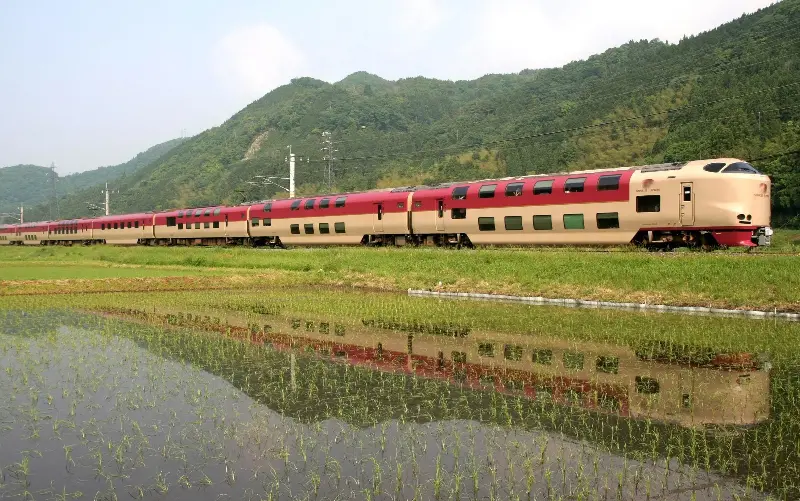
Never have I experienced the nerve-jangling, high-stakes terror which gripped me aboard the Sunrise Express.
It was nothing to do with speed: as Japan’s last remaining sleeper service, it’s a slow and gentle alternative to the country’s racing bullet trains. Equally, it was nothing to do with running late and missing my connection in Tokyo: Japan is known for the extreme punctuality of its trains, and this one was no different, running on time almost to the second.
No. Instead, it was 6am, and I was staring at big red numbers counting down to zero while I showered.
I was travelling on the Sunrise Seto, which runs between the coastal city of Takamatsu and Tokyo in 9.5 hours – sister service of the Sunrise Izumo (12 hours), which begins in Izumoshi on main island Honshu’s northern coast, and joins the Seto at Okayama for the remaining 400 mile stretch along the south coast to the capital.
Shortly after I boarded the night before, a friendly passenger had advised me to purchase a shower card immediately, as they are – with a grand total of two showers serving the entire eight-coach train – like gold dust. I dutifully obliged, and was feeling very pleased with myself when I noticed the duration marked on my ticket: six minutes.
“What happens if I go over that?” I had asked Kevin, my new Japanese rail enthusiast friend. “You won’t – it cuts off when the clock strikes zero,” he replied, matter-of-factly.
I’d been expecting the shower – like every shower on every train I’ve ever experienced anywhere in the world – to be next to useless, a mere dribble of tepid water. To my surprise and delight, however, I was greeted the following morning by a steady and reliable gush – well worth the 330 yen (£1.60) I’d paid for the privilege. And then I noticed the timer, huge and red and right in my eyeline, counting down. Oh, and they don’t provide towels, it turns out.
I should somewhat attribute the blind panic which ensued to the fact that my nerves were not at their best. I’d already had a fairly rough night’s sleep on board the strangest overnight train I’d ever travelled on. This was somewhat my own fault, however: while the service does offer traditional berths, they are few and far between, and tickets are snapped up pretty much immediately when they go on sale a month in advance.
Had I known this, I would have been online the second the bookings opened – but as I hadn’t done this, I’d ended up purchasing a ticket for one of the Nobi Nobi sleeping areas instead: best described as a very hard bit of carpet, a sort of capsule pod without walls, separated (barely) from those on either side by a partial wooden partition. I’d slept on tatami mats and found them surprisingly comfortable; by comparison, this felt like concrete.
At one end of the bunk was a window, and at the other a curtain, offering a degree of privacy from those walking along the corridor. I arrived to find a light duvet and a pillow case… but no pillow. I quickly realised my error, noting the seasoned pros around me laying out their blow-up pillows and sleeping bags, then grudgingly folding up my jacket and shoving it under my head, spending the night in a ball to accommodate my suitcase and laptop bag, owing to the lack of space for luggage storage.
And yet – despite a night of tossing and turning, then hurriedly pulling on my clothes in the tiny shower cubicle while I was still dripping wet – I couldn’t help ultimately being swayed by the charms of the Sunrise Express. It was, as everywhere in Japan seems to be, spotlessly clean onboard, and gorgeous to look at from the outside with its head-turning red and cream livery. And there is something very pleasing about walking down the aisle to see everyone’s shoes so neatly tucked away.
There is no dining car but, as is common in Japan, numerous vending machines sell all sorts of drinks and snacks, as well as (as is the case across east Asia) a hot water dispenser at the end of each carriage, for tea and cup noodles. There are also a few small seating areas scattered throughout the train, providing a few communal spaces where passengers can chat and eat together.
I was charmed, too, by the enthusiasm and affection the Japanese people have for their railways. My empty train was greeted at its origin in Takamatsu by a platform filled with eager passengers, all poised – phone in hand – to photograph it. Rather than being a scrum, as you would expect in Europe, everyone was respectful and waited their turn. In a similar vein, at Okayama – an hour or so into the journey – there was a polite scramble to take videos and pictures as the Sunrise Seto joined on to the Sunrise Izumo, with staff relaxed and amiable and helping to make sure everyone got their snap.
But the best thing about the Sunrise Express – and where, for me at least, it really has the edge on the Shinkansen – is the opportunity it offers to go to sleep in one place and wake up in another, with the whole day ahead of you to explore. This is the beauty of the sleeper train, and something that’s lost in the Shinkansen’s ability to cover great distances up and down the country in mere hours. I arrived in the capital just after 7am (10 minutes early, I should add), strolled off the train, out of the station and around the corner, straight into the impressive Imperial Palace East Gardens.
It was my first time in Tokyo, and with a full day at my disposal, I was able to tick off a whole roster of first-time experiences – among them walking across the famous Shibuya Crossing, grabbing lunch at Curry Station Niagara (a delightful restaurant where food and drink are delivered via model railway, and you even order via an old-school ticket machine), and seeing the city from 450m above ground at Skytree Tokyo.
Yes, the Shinkansen is impressive, rightly a source of great Japanese pride, and an essential part of any trip to Japan. But, I’d argue that the same should be said of the Sunrise Express, the country’s last bastion of overnight train travel in this justifiably rail-obsessed country.
Just don’t do as I did and forget to bring a pillow. Or a towel.
Essentials
Daniel Puddicombe was a guest of the Japan National Tourism Organisation.
Park Hotel Tokyo has doubles from £260; JR Hotel Clement Takamatsu, next to the station, has doubles from £72.
Sunrise Seto tickets go on sale a month before the train runs; Nobi Nobi seats cost around £75 one-way; berths (first- and second-class) cost from around £105 one-way. Reservations are free if you have a JR Pass. Book via JR-West.
Finnair operates daily flights from London Heathrow to Tokyo, via Helsinki, from £776 return.