



Despite the many architectural achievements of the human race, none – no matter how big or how high – can incite the raw awe of a mountain. These behemoths of rock and ice seem so wise, solid and ancient; reassuringly immutable presences in a fast-changing world. They can be calming, soul-lifting, stimulating or terrifying, but never fail to impress.
And while all mountains deserve respect, some have a tendency to move you more than others, perhaps due to their spiritual significance, spectacular shape or sheer, brute size. Here are a few of the world’s finest, with ideas for the best ways to see – or stand atop – them.
1. Kilimanjaro, Tanzania

At 19,341ft (5,895m), Kilimanjaro is the biggest, beefiest, most tantalising peak on the entire African continent. What makes it so striking is that it stands alone, rising friendless, monstrous and snow-capped from the flat, equatorial savannah.
Climbing it is that most wondrous thing: a manageable challenge – tough but not technical. The trek entails breath-thieving altitudes and limited comforts (think camping or basic huts, questionable long-drop loos), but delivers – if successful – immense satisfaction and views from the roof of Africa.
If that sounds too much effort, appreciate it from the ground instead: the classic view is from Kenya’s Amboseli National Park, where you can watch huge elephant herds parade before the mountain. Or, if flying south into Kilimanjaro International Airport, simply book a window seat on the left and hope for clear weather.
How to do it
Exodus (020 3993 2193) has an eight-day small-group Kilimanjaro Climb from £2,399pp excluding flights.
2. Mount Fuji, Japan

At 12,389ft (3,776m), perfectly conical Mount Fuji is Japan’s highest peak. But it’s also so much more, an icon deeply woven into Japanese culture. Worshipped from afar since ancient times, and a religious centre since becoming less volcanically active, its flanks are dotted with shrines and pilgrim trails. Fujisan is also an artistic muse, most notably inspiring many Ukiyo-e woodblock prints in the 19th century.
It’s a shy mountain, often cloaked in clouds. Winter is the best time to get a clear view, perhaps from the 2,080 ft (634m)-high deck of the Tokyo Skytree or by a lake in Hakone National Park, to see the peak prettily reflected. Alternatively, hike up. Climbing season is July to mid-September; most split the trek over two days, spending a night mid-way to make the final ascent for sunrise.
How to do it
Inside Japan (0117 244 3470) offers a ten-day small-group Discover Japan trip, visiting Hakone, from £2,465pp excluding flights.
3. Tre Cime di Lavaredo, Italy

The Dolomites could justifiably claim to be the most beautiful range in the world. There’s just something about this cluster of pale peaks, pinnacles and steeples, the plunging green valleys below them, and the sunset phenomenon of the enrosadira, which makes them blush pink.
The three jagged limestone spires of Tre Cime di Lavaredo, which top out at 9,839ft (2,999m), are some of the handsomest of all. You can see them from the scenic, summer-only toll road to Rifugio Auronzo. However, the best views are reserved for those on foot. The easy walk from Auronzo to Rifugio Lavaredo is good; better is a seven-ish mile loop of the peaks, via Lake Misurina, the Lavaredo pass, Rifugio Locatelli and the Col di Mezzo, with detours to First World War relics en route.
How to do it
Much Better Adventures (020 3966 7597) offers a eight-day small-group Hike the Italian Dolomites trip from £2,176pp excluding flights.
4. Mount Everest, Nepal

The funny thing about the world’s highest mountain is that it doesn’t immediately stand out. Everest might be 29,032ft (8,849m) but it lives in a world of giants and is often obscured by its enormous neighbours, or hidden in cloud. But still, who doesn’t want to try to catch a glimpse?
On a clear, haze-free day, it’s possible to see Everest from Kathmandu, though the nearby hill station of Nagarkot is a better bet. Or opt for an hour-long scenic flight from the capital, to get right in among the Himalayas. However, for the most breathtaking close-ups, hike to Everest Base Camp, adding on Kala Patar, a 18,370ft (5,600m) trekking peak that affords astonishing views of the mountain and the Khumbu Icefall; make the ascent for sunrise, to watch the day’s first rays hit the earth’s highest point.
How to do it
KE Adventure (01768 773966) offers a 20-day Ultimate Everest Trek, including Kala Patar, from £2,495pp excluding flights.
5. Suilven, Scotland

Suilven only measures 2,398ft (731m) – not even a munro. But it’s a cracker, rising formidably from Assynt’s ancient lochan landscapes. The mountain is made of layered Torridonian sandstone and sits amongst three-billion-year-old Lewisian gneiss, some of the world’s oldest rocks. It’s a wild place, for a wildly imposing peak.
Suilven can be seen from the fishing village of Lochinver, on the NC500. Ideally, though, view it from different angles, to fully appreciate its grandeur. To do this, trek beneath it: the moderate 11.75-mile route from Elphin to Lochinver approaches from the east, Suilven morphing with every footstep, looking variously like a giant rhinoceros, a hefty sugarloaf or a mini-Matterhorn.
Alternatively, follow the strenuous trail up and along Suilven’s craggy ridge to reach Caisteal Liath, the mountain’s true summit, to look out across Britain’s least-tamed lands.
How to do it
Waterloo House in Lochinver (07595 727355) offers the Suilven View Pod, sleeping two, from £145 per night.
6. Half Dome, USA

Half Dome is technically an igneous batholith, not a proper mountain, but as arguably the USA’s most iconic lump of rock aside from (underwhelming) Mount Rushmore, it qualifies here. Rising like a cowled giant from California’s majestic Yosemite Valley, it’s arresting both in shape and location – the king of the best-looking court.
Long deemed “perfectly inaccessible”, Half Dome was first climbed in 1875. Now, anyone with a permit, good fitness and no fear of heights can stand on the 8,846ft (2,696m) summit – it’s a strenuous day hike, culminating in a cable-assisted ascent. Only problem is, if you do that, you can’t admire the mountain itself. Instead, hike, drive or tour-bus to Glacier Point for unobstructed vistas. Or pause at Tunnel View on the drive into the park, for the valley panorama made famous by Ansel Adams.
How to do it
Intrepid (0808 274 5111) offers a six-day small-group Hiking in Yosemite trip from £2,280pp excluding flights.
7. Kirkjufell, Iceland

Kirkjufell – aka Church Mountain (for its steeple-like form), aka Arrowhead Mountain (its name in Game of Thrones) – is Iceland’s most photogenic peak, despite being only 1,519ft (463m) tall. It’s actually a nunatak, the rocky summit of a mountain that once protruded through the ice cap, shaped by millennia of volcanic rumblings and glacial erosion. Now it stands sculptural and solitary on the coast of the Snaefellsnes Peninsula, the otherworldly setting for Jules Verne’s Journey to the Centre of the Earth.
Kirkjufell can be climbed, but probably shouldn’t be, unless you’re OK with heights, scrambling and danger. Better to appreciate it from below. The classic viewpoint is by Kirkjufellsfoss, to see the mountain soar behind the three-tiered waterfall, possibly with a backdrop of northern lights. Also try Grundarfjörður harbour, for a foreground of colourful fishing boats.
How to do it
Regent Holidays (01174 530059) offers a five-day West Iceland Fly-Drive, encompassing Snaefellsnes, from £1,035pp including flights.
8. Fitz Roy, Argentina/Chile

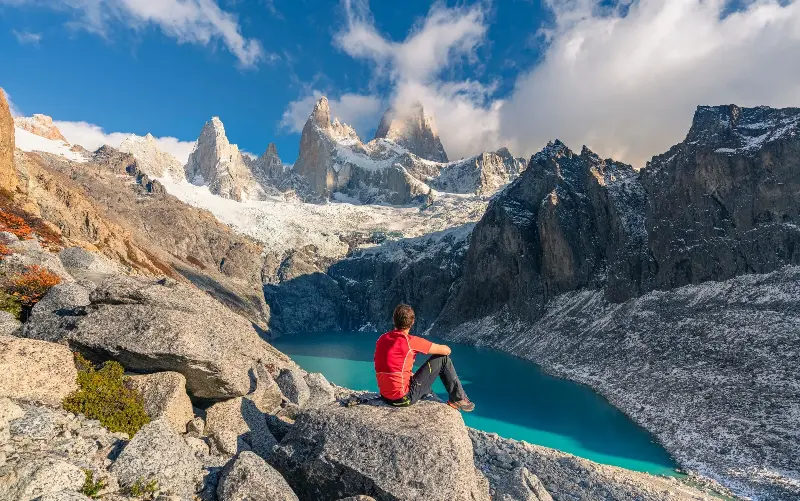
Patagonia isn’t short of striking summits, but 11,171ft (3,405m) Mount Fitz Roy is most striking of all. It’s the highest point of the border-straddling Fitz Roy massif, a forbidding chain of granite spires, spikes and needles, cut with glaciers. It’s named in honour of the captain of the HMS Beagle, though the local Tehuelche call it chaltén – smoking mountain – on account of the clouds that often swirl about its summit.
It’s an extremely tough, technical climb, but there are plenty of lovely, easier day walks in its environs, starting from El Chaltén, the trekking capital of Argentina. The classic route is through the native forests of Los Glaciares National Park to Laguna de Los Tres, to see Fitz Roy loom above the dazzling turquoise lake.
How to do it
Swoop Patagonia (0117 244 4227) offers a five-day Explore Fitz Roy from a Luxury Lodge trip from £3,795pp excluding flights.
9. Tongariro, New Zealand

When the Lord of the Rings film crew were looking for their Mount Doom, they came to Tongariro. Dominating the centre of North Island, this volcanic massif includes muscular 9,177ft (2,797m)-high Ruapehu and sprawling Tongariro, with its many cones – the most active of which is superbly symmetrical Ngauruhoe (aka Doom).
These peaks, with their puffing craters, sulphurous vents, vivid lakes and alpine meadows below, have long been culturally significant to the Maori; in 1887, this landscape became the country’s first national park. Wildfires in late 2025 have ravaged 3,000 hectares, but the volcanoes remain an extraordinary sight.
See them from the Desert Road (State Highway 1) or the historic tracks of the Northern Explorer train. To get closer, tackle the Tongariro Alpine Crossing – often called “the world’s best day walk” – which climbs over the massif’s lunar-like plateau.
How to do it
Great Rail Journeys (01904 734154) offers a 21-day escorted Grand Tour of New Zealand from £6,499pp including flights.
10. The Matterhorn, Switzerland

The Swiss feel strongly about the Matterhorn. When Toblerone moved some production abroad, strict rules about “Swissness” meant its packaging was no longer allowed to feature an image of the country’s de facto national mountain. However, the chocolate bar’s pyramidal shape remains, aping the angular form of this 14,692ft (4,478m) peak, surely the most distinctive in the Alps.
Climbing the Matterhorn is a serious business – the first ascent, in 1865, resulted in the deaths of four of the seven-strong team. But enjoying it from afar is easy enough. Car-free Zermatt luxuriates in its shadow – there are good views from the town’s Kirchbrücke bridge.
Alternatively, ride up to the Blauherd summit station and walk to Stellisee, to see the peak reflected in the lake, or ride up to 12,740ft (3,883m) Matterhorn Glacier Paradise via the world’s highest cable car.
How to do it
The mountain-view Matterhorn Focus (0041 27 966 2424) has B&B doubles from £575 for two nights.