



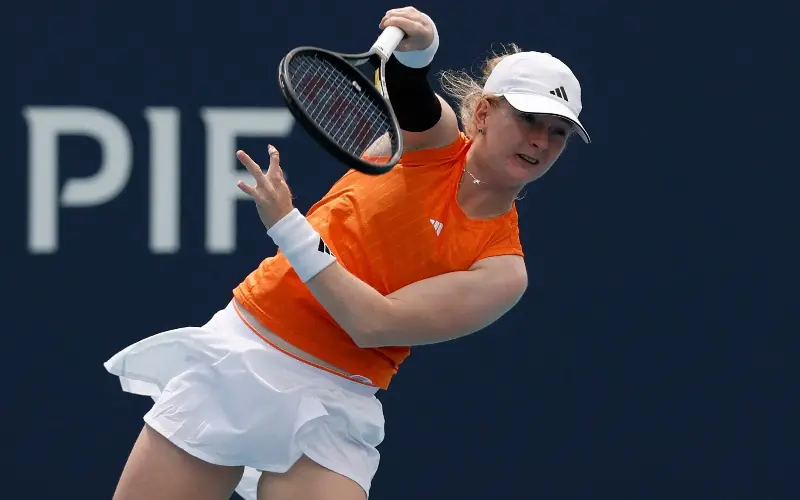
“I still have [a poster of] you in my room.” Those were the words Francesca Jones said to Venus Williams after beating her 7-5, 7-5 in the Miami Open.
Williams was the reigning Wimbledon champion when Jones was born, and had played 1,000 career matches before the Briton turned 18.
But after a washout that delayed their match by a day, Jones claimed what might yet be the most memorable victory of her career, if in status not in rankings.
There is no denying the standing that Williams still holds on the tour. She walked out to a mostly full Grandstand wearing a jacket that said “Gamechanger” on the back, and left to a standing ovation.
“That’s exactly what Venus and Serena are, they’re game-changers and they’re the reason that we have such big events like this now. They grow the sport so much and we have so much to thank them for,” Jones said.
Jones’ adoration might have been memorialised on the wall of her childhood bedroom in Barcelona, but it started many years before.
“With my backstory, when I was younger I was told I wasn’t going to play tennis and then having my dad take me to Wimbledon, I saw both Williams sisters on Centre Court and I told her at the net she’s still on the wall.”
Jones was born with ectrodactyly-ectodermal dysplasia-cleft syndrome (EEC), a rare genetic condition that means she has three fingers and a thumb on each hand and only seven toes. After being told by doctors she would not make it as a professional tennis player, she moved to Barcelona before the age of 10 to pursue the sport.
The pair had come across each other before, in a training session in Austin just a few months ago in what Jones describes as a “full-circle moment”, but meeting on the court was something else.
Williams played from a strong base and at 45 years old has little option but to try and dictate play from the middle of the baseline. Jones on the other hand, makes up for what she lacks in power – she uses a light racket and modified grip because of her disability – with nimbleness and determination.
The first four games of the match were exchanges of breaks before Williams was able to hold to the delight of the patriotic fans on Grandstand court in the shadow of the main stadium, but it was Jones who won enough of the important points to take the straight-sets win.
Williams can hardly be considered a regular on the tennis tour at this stage of her career, and is ranked 517th in the world. After 14 months away when most people considered her retired, she made a surprise return last July, receiving a wildcard to the Washington Open. There have been critics of her continued, but intermittent, presence which is only possible through receiving wildcards to every tournament.
After Indian Wells, former men’s No 1 Yevgeny Kafelnikov, criticised her for receiving the direct entries, despite a losing streak that was then only eight matches.
There were glimpses of what Williams, a former world No 1 with a title count that few can match, used to be able to offer. Her serves kicked up and there was no lack of power, including a forehand winner at 79mph. But the consistency and agility is not up there with the current crop of players, although Jones believes that should not make a difference.
“She’s amazing,” Jones said. “It’s phenomenal. People might focus on the fact that she’s lost consecutive matches but I think we have to recognise she’s playing three sets against [some of the best players on the tour].
“She doesn’t lose a serve, and it’s a vital part of the game. Of course her movement isn’t what it used to be, but I think there’s no reason she can’t win matches and I fully believe she’s at a level where she can compete.”