



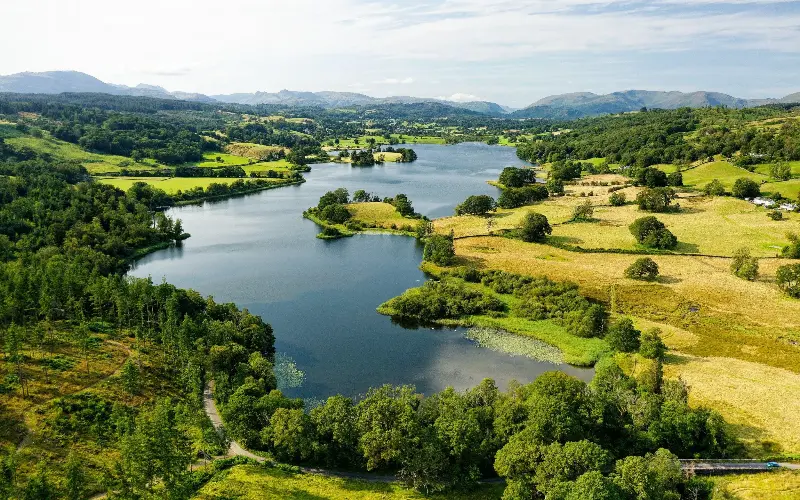
“One problem with the Lake District is that, once you’ve come here, everywhere else is a bit disappointing.”
The local boatman was giving me his opinion as he zipped me across Windermere. The other problem, he continued, is traffic: “The roads are built for horses and carts. Tourists get distracted, go: ‘Ooooh, there’s a sheep!’ and drive into drystone walls. It’s a nightmare.”
This is the perennial issue facing Britain’s most-visited national park. It’s gorgeous almost beyond description – those Romantic poets had a pretty good stab at it – but ugly as hell on a hot summer weekend when the whole country and its many dogs seem to descend.
However, even in peak season it’s possible to find less-frequented corners, if you’re willing to venture a little off-piste. But where? After scouring the region armed with tips from local insiders, I believe these are the best options.
1. Instead of Windermere, try. . . Ravenglass & the Esk Valley
Wonderful Windermere is England’s biggest lake but also its busiest, not least because it’s accessible by train. Well, so is Ravenglass, the national park’s only seaside village. It’s on the main Cumbrian Coast Line, and it’s the terminus of the narrow-gauge Ravenglass Railway, which has puffed up the Esk Valley to Dalegarth for more than 150 years. Carriages range from bracingly open-top to posher Pullman; scenery ranges from sweeping estuary to towering Scafell range.
One reason this corner of the park is quieter is that, if you don’t go by train, the shortest drive into Eskdale from the east involves two squeaky-bum mountain passes (Wrynose and Hardknott). Instead, I opted to drive via the dramatic Birker Fell road, one of the park’s wildest reaches – and where I was astonished to find, mid-nowhere, the Crosby Snack Shed.
The lady who served my sticky-toffee flapjack was unequivocal about the western Lakes: “Far less commercialised, every bit as pretty.” She recommended the 8.5-mile Eskdale Trail, which weaves via woods, riverbanks and railway stations between Ravenglass and Dalegarth. For the time-poor I’d add a shorter alternative stroll, from Dalegarth to the translucent waters of Gill Force.
Where to stay
The Woolpack Inn (01946 723 230) has doubles from £115 per night B&B.
2. Instead of Buttermere, try. . . Ennerdale
Beautiful Buttermere, hugged by striking peaks and looped by a spectacular low-level walk, is the third most-searched-for lake according to Ordnance Survey data (search volume: 49,500 per month). However, Ennerdale, tucked over the other side of the High Stile ridge, offers similarly impressive fell-scapes and an equally satisfying 6.5-mile circuit hike, but is far less visited (4,400 monthly searches). It’s also the focus of a major rewilding project that’s replacing conifer forest, re-wiggling the River Liza and letting nature take charge.
Ennerdale isn’t easy to reach. Out in the far west, it’s the only major lake in the park not flanked by roads – there are two car parks at the valley’s western edge, but further exploring must be done by canoe, bike or on foot. The last of these is a particular joy, as I found walking through here on Wainwright’s Coast to Coast. The new National Trail takes you around the lake edge, with two options for exiting the valley: along the Liza, via isolated Black Sail Youth Hostel and up to Honister Pass, or the even steeper route to Honister from the lakeshore via Red Pike and Haystacks, Wainwright’s favourite fell.
Where to stay
The Shepherds Arms (01946 861249) has doubles from £118 per night B&B.
3. Instead of Ullswater, try. . . Thirlmere
Thirlmere is a bit of an oddity. It’s in the thick of things – just north of Grasmere, just east of Derwentwater – but is more often driven past than explored (search volume: 8,100 per month). So I was surprised when the guide showing me around Wray Castle said it was one of his favourites: he liked its tight hug of fells.
Thirlmere was originally two smaller lakes, but was dammed in 1879 to create a reservoir, sinking the village of Wythburn in the process and leading to one of the first (albeit unsuccessful) environmental campaigns. An exhibition inside lonely Wythburn Church tells this story, while the church car park is a start-point for summitting Helvellyn.
Most hikers head up this iconic 3,117ft peak from the Ullswater side, a longer, busier, dizzier route via notorious Striding Edge. The routes from Thirlmere are still relentlessly upward, but not so vertiginous. Alternatively, climb Raven Crag, a fine lookout with views over the reservoir and along the Helvellyn ridge (and where I saw my first weasel). If you’re in a car, don’t miss the skinny forest road along Thirlmere’s western shore – an extremely scenic drive.
Where to stay
Dale Head Hall (01768 772478) has doubles from £140 per night B&B.
4. Instead of Ambleside, try. . . Kirkby Lonsdale
When I asked the lady on reception at Lindeth Howe hotel where she goes on her days off, her answer was telling: not nearby Windermere or honeypot Ambleside, but Kirkby Lonsdale. This old market town is just outside both the Lake District and the Yorkshire Dales, and is less busy because of it.
She liked to go for the shopping: the high street is healthy and non-touristy, with plenty of local indies, from Dales Traditional Butchers to Abrahams clothes store. Eating options include the Michelin-listed Sun Inn, which does pub classics and fancier dishes, and the Milking Parlour, for ice cream churned at the owner’s nearby farm.
For an insider take on the town, join a guided Vault Walks (first and third Friday and Saturday every month). And enjoy the super scenery: from St Mary’s churchyard, a trail leads to a panoramic viewpoint over the Lune Valley. The vista was painted by JMW Turner in 1822, moving writer and art critic John Ruskin to state: “I do not know in all my country, still less in France or Italy, a place more naturally divine”.
Where to stay
The Sun Inn (015242 71965) has doubles from £134 per night B&B.
5. Instead of Grasmere, try. . . Esthwaite and Moss Eccles Tarn
According to the OS, Esthwaite is the least-searched-for lake (1,900 searches per month). But this lovely little water is a good alternative to crowded Grasmere if you want a literary fix. Indeed, Wordsworth used to ice skate here while studying in nearby Hawkshead. Esthwaite was also Beatrix Potter’s favourite. She based illustrations for The Tale of Mr Jeremy Fisher on its wildlife, and bought Hill Top, a beautiful cottage in adjacent Near Sawrey, which is now run by the National Trust.
Esthwaite is excellent for fishing; you can also hire electric boats for osprey cruises – the raptors are in residence spring to autumn.
However, the lady in Hill Top’s gift shop recommended not Esthwaite but Moss Eccles Tarn – where Potter kept a boat – and the surrounding Claife Heights, the forested uplands flanking Windermere’s undeveloped eastern edge: “Nobody goes up there,” she said.
I’m not sure that’s entirely true, but it was certainly peaceful. I bought a cake from an honesty box on the short walk to Potter’s beloved tarn, picnicked on its shores and later topped 800ft Latterbarrow, delighted to find quiet trails so close to the park’s busiest lake.
Where to stay
The Cuckoo Brow Inn (015394 43425) has doubles from £161 per night B&B.
For more info, see visitlakedistrict.com