



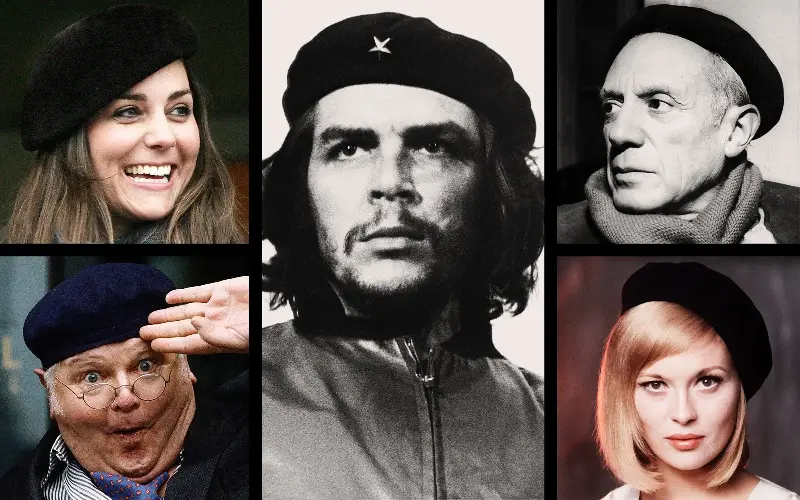
As Gwyneth Paltrow, Winona Ryder and Naomi Campbell would no doubt attest, chronicling the clothes worn by high-profile people in court has become something of an international sport. Whether defendant or plaintiff, it’s fair to say that a certain degree of thought tends to go into the wardrobe one wears on the witness stand. Appearances matter – particularly when your livelihood depends on them, and every public appearance is a PR opportunity.
The latest name to be critiqued isn’t an actress or a supermodel, however, but a former president of Sinn Féin. Appearing at the High Court in London on Tuesday to defend a civil claim that alleges he played a “pivotal role” in the Provisional IRA and orchestrated bombings during the Troubles – allegations he denies – Gerry Adams, 77, had clearly also dressed intentionally. Wearing a navy suit and green and white polka dot tie, he sported a “Save Gaza” wristband, a Palestine badge pinned to his suit lapel and a sprig of shamrock in his top pocket in honour of St Patrick’s Day.
But the most contentious element of Adams’ wardrobe – a black beret – wasn’t on display in court. During the proceedings, he was questioned about a number of historic occasions on which he’d worn the item at the funerals of IRA members, with Sir Max Hill KC, counsel for the claimants, arguing that the beret was a clear signal that Adams was also a member of the terror group. “I did on a number of occasions wear a black beret, but so did other people,” Adams responded. “Benny Hill wore a black beret, too.”
As did Frank Spencer (in the Seventies sitcom Some Mothers Do ‘Ave ‘Em), several characters in the Eighties BBC show ‘Allo ‘Allo! and Wolfie Smith (in the sitcom Citizen Smith – although perhaps this last wouldn’t best serve Adams’ argument). And let’s not forget Marge Simpson’s predilection for donning them in specific episodes of The Simpsons whenever either she or Homer explored their artsier sides.
On screen and off, if ever there was a titfer with a long and complicated history, it is surely the beret. Few hats can purport to be both symbols of the establishment and symbols of revolution. A simple, circular cap of felted wool, the style is thought to have been worn in northern Europe since the Bronze Age but its humble origins as a shepherds’ and fishermen’s hat belie its exalted status as battlefield essential and revolutionary emblem.
While Dutch painter Rembrandt is thought to have kicked off the trend for artists to wear them after depicting himself in one in a self-portrait in the middle of the 17th century, their mass production originated in the Basque region of Spain some 200 years later. Their transition from rural utility item to political and cultural symbol was gradual however. In France, where the trend spread next, the beret became shorthand for a certain type of Gallic chic, with painters, poets and intellectuals adopting it as an informal uniform in the early 20th century.
But it was the military that gave the beret its global reach. One of its earliest military usages was the Scottish Blue Bonnet, a Tam O’Shanter which became a symbol of Scottish Jacobite forces in the 16th and 17th centuries. While berets were used as military headdress in the 1830s during the First Carlist War in Spain, in the 1880s the French mountain corps the Chasseurs Alpins became the first regular unit to adopt them as standard headgear, since which time they have remained popular owing to being cheap and simple to manufacture in large numbers, as well as being warm and durable.
Throughout the First World War and its aftermath, European armies began experimenting with soft headgear that could be worn with ease in confined vehicles. The British Royal Tank Regiment adopted the black beret in the 1920s, its dark colour chosen to mask oil stains. Other units followed, each claiming distinctive hues. In 1941, the British Parachute Regiment was officially approved to wear maroon berets, with the commando forces being approved to wear green berets in 1942. A khaki beret was worn by the Reconnaissance Corps between 1941 and 1944, while the Royal Air Force adopted a blue-grey beret in 1943. These distinguishing colours transformed the beret into a language of rank, role and esprit de corps. What had once signified locality now denoted discipline and belonging on an international scale.
By the 1920s, Coco Chanel had exalted it into a high fashion status symbol, as one of the first designers to show berets on the catwalk. According to Chanel’s biographer, Justine Picardie, author of Coco Chanel: The Legend and the Life, the beret was integral to Chanel’s unique take on gamine chic. “In the same way that she popularised trousers, stripy tops and short hair for women in the 1920s, so, too, did her wearing of a beret express a certain kind of insouciance and sartorial ease.” The look found favour with a slew of gamine stars, including Greta Garbo and Marlene Dietrich.
The young Princess Elizabeth wore her beret as proudly as any civilian, most notably in a 1942 portrait taken by Cecil Beaton when she was 16, depicting her in one adorned with the badge of the Grenadier Guards. “For me, this is one of the most memorable royal images,” says Picardie, who encountered it while researching her new book, Fashioning the Crown. “She was too young to serve in the Armed Forces at this point – she joined the ATS when she was 18 – but her honorary role as colonel of the Grenadier Guards is signified in the soldierly cap and the regimental insignia, while her youth also shines through her smile. I think it would have been Beaton, by then an experienced fashion photographer, who arranged the princess’s beret at such a jaunty angle.”
Parallel to this institutional embrace ran a more subversive current. In the mid-20th century, the beret became a potent political symbol. Revolutionaries and radicals seized upon its visual simplicity and military associations, with images of guerrilla fighters in Latin America and elsewhere – most notably Che Guevara – fixing the black beret in the public imagination as an emblem of resistance. In the United States in the late 1960s, the Black Panther Party adopted it as part of a uniform that projected both militancy and unity, blending ideology and style.
Since then, its political edges have been softened, but its cachet remains. A staple of women’s wardrobes for decades, berets have fallen in and out of fashion, embraced as practical winter attire and worn as a symbol of bohemian nonchalance.
In the Eighties, rare was the British woman who didn’t own a wool-mix beret from C&A or Debenhams. While they’re not hugely in fashion now (that accolade belongs to the pillbox hat), that Kate Moss and Kendall Jenner have been spotted wearing black berets in recent times could mean that’s set to change. For those keen to channel Coco Chanel, luxury Italian label Loro Piana offers a washed silk “Anna” beret for £675, while Barbour’s knitted “Beldon” beret is a more affordable £29.95.
As for Gerry Adams, one would have thought that the public humiliation of having to liken his militant headgear to the beret donned by Benny Hill might be enough to put the former Sinn Féin leader off reprising the accessory any time soon, if ever.