



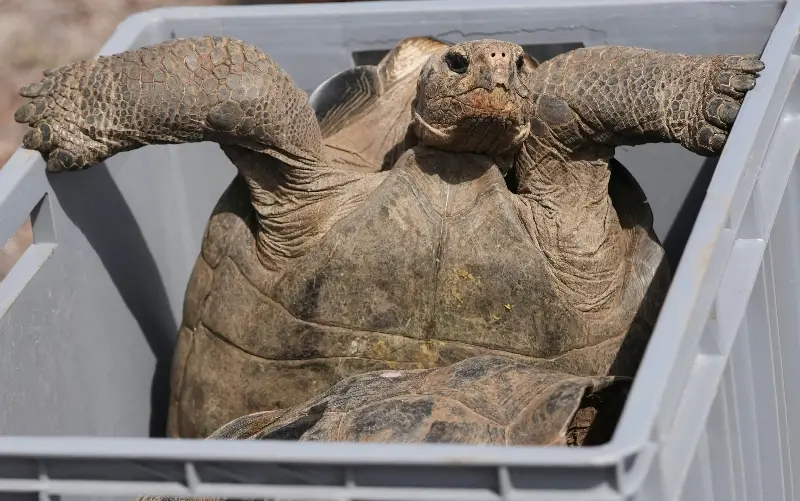
Giant tortoises have returned to the Galapagos island of Floreana for the first time nearly 150 years after they were driven to extinction.
A group of 158 juvenile giant tortoises, aged between eight and 13, have been released in an ambitious project to restore the exhausted ecosystem of the island in the south of the Galapagos archipelago.
Floreana was once home to tens of thousands of giant tortoises, but they were driven to extinction in the 19th century after sailors, whalers and settlers arrived with invasive mammals that degraded the local environment, wiping out native flora and fauna.
When Charles Darwin reached the island in 1835, its tortoise population was already at death’s door.
The tortoises released on the island are hybrids selectively bred for reintroduction using a relic population of giant tortoises with Floreana ancestry from Wolf Volcano in the north of Isabela, the largest island of the Galapagos.
The hybrids carry between 40 per cent and 80 per cent of the genetic make-up of the Chelonoidis niger, a species that has been extinct for 150 years, according to Christian Sevilla, the director of ecosystems of the Galapagos National Park.
The project selected the adults with the strongest genetic make-up in order to bring the extinct Floreana species back to its former purity, Mr Sevilla added.
The juvenile specimens, whose arrival was timed with the season’s first winter rains, make up the first tranche of a total of 700 tortoises which will be introduced gradually to Floreana.
“They are large enough to be released and can defend themselves against introduced animals such as rats and cats,” said Fredy Villalba, director of the Galapagos National Park breeding centre on the island of Santa Cruz.
An invasive species eradication programme that started in 2023 has already removed many of the rats and feral cats on the island.
Through grazing, giant tortoises promote the regeneration of native plants and help maintain habitats that support reptiles, invertebrates and birds. They also distribute native seeds across the island as they roam.
They will share their new home with a population of almost 200 people alongside flamingos, iguanas, penguins, seagulls and hawks.
Veronica Mora, a Floreana resident, told the Associated Press that the release of the tortoises – which have already begun to explore the habitat – had been the dream of the local community. “We are seeing the reality of a project that began several years ago,” she said.
In 1978, the United Nations recognised the Galapagos as a Natural World Heritage Site in recognition of their extraordinary concentration of terrestrial and marine species.