



The Italian Renaissance crawled to Britain. Tudor architecture is therefore the age of freestyle, of making it up as you go, of mixing known Gothic with semi-comprehended classical. What else to do? Tudor patrons coveted new buildings in “the antique taste” but homage to ancient Rome was to a myth, not to anything seen.
Only the tiniest trickle of English visitors had reached Italy. Architectural books were vanishingly rare. There is no evidence of any 16th-century Englishman owning engravings by the seminal Italian Renaissance architect, Andrea Palladio. The first volume of English-engraved classical architectural orders, a meagre tome by John Shute, was only published in 1563.
Even the concept of “architecture” was exotic. Shakespeare never used the word. The Tudor poet, Philip Sidney, used it once but italicised as a little-known affectation. Henry VIII and Elizabeth I are keystones in English history’s arch and yet very few of their buildings have endured for 450 years. The men responsible for them were not professional architects, for there were none, but surveyors, master masons and joiners.
This is the first great brick age. Fifteenth-century manufacturing improvements, introduced by Flemish brick-makers, permitted English clay to be moulded into architectural service for the first time since the Romans. Initially masons used bricks where flame-proof strength was required for vaults and fireplaces but increasingly they deployed them by choice.
These, then, are my ten favourite buildings from the Tudor period:
1. The Henry VII Chapel, Westminster Abbey (from 1503)
This is England’s most exquisite Gothic chapel, boasting one of Europe’s greatest ceilings: a fantastical fan vault with pendants and spandrels shaped with the seeming ease of lacework. An engineering masterpiece, the vault’s weight is borne by hidden arches and external piers disguised as ogee-domed turrets. Tudor masons had no time for architectural “honesty”.
This filagree chapel is bejewelled with royal tombs: Henry VII, Edward VI, Mary, Elizabeth I, James I, Charles II, Queen Anne, Mary Queen of Scots. Its design hugely influenced the Houses of Parliament opposite. Pray for the semi-forgotten master masons responsible, Robert Janyns and William Vertue.
St George’s Windsor and King’s College Cambridge also have angelic Tudor fan vaulting, though both buildings are medieval in origin.
2. St John’s College, Cambridge (Tudor sections, 1511-1602)
No British educational institution has more Tudor bricks. Calming and clean, the first two courts are predominantly Tudor. Black header bricks create diamond pattern effects. The Great Gate is gloriously crenellated. Look for the yales, mythical heraldic beasts with elephants’ tails, antelopes’ bodies and goats’ heads.
Trinity, Christ’s and Queens’ Colleges also gift Tudor gatehouses to their streets. At Caius in the 1560s Dr Caius designed an allegorical progress through three Renaissance gates of Humility, Virtue and Honour.
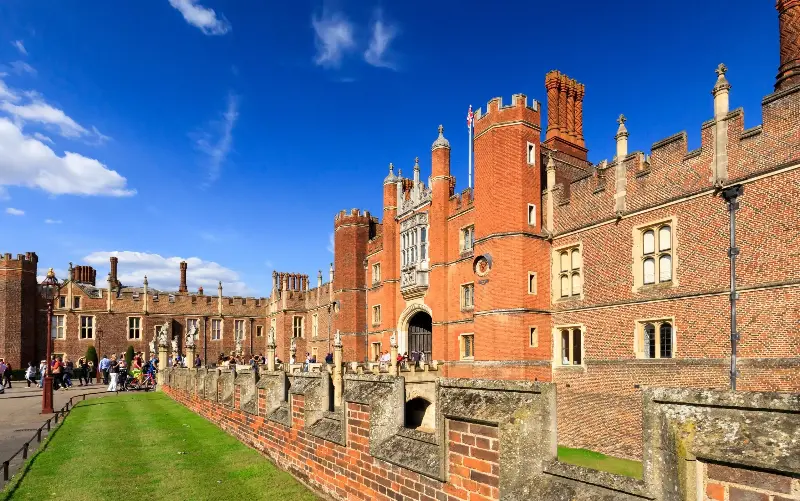
3. Hampton Court Palace, Richmond (Tudor sections mainly 1514-1547)
No Tudor building better captures the transition from English perpendicular Gothic to uncertain continental Renaissance than Hampton Court, created by Cardinal Wolsey and expanded by Henry VIII.
Wolsey desired a Renaissance palace, but it is full of Gothicisms because most craftsmen knew no other. Thus, England’s last royal great hall with a hammerbeam roof can be seen alongside Roman Emperors’ busts and a Renaissance astronomical clock. The palace is enormous. Frugal Elizabeth barely touched the place.
4. Lavenham Guildhall, Suffolk (c.1529)
Few “good ordinary” Tudor village buildings survive. One exception is beautiful Lavenham’s timber-framed Guildhall which packs a lot of history behind its jettied front and gabled porch. The Guildhall was built for the Guild of Corpus Christi and paid for by the wool trade, the 16th-century’s dot-com boom.
The Guildhall has served as a prison and a workhouse (though far kindlier than Dickensian clichés imply) before being used during the Second World War as an American troops’ social club and as a “British Restaurant” for those who had been bombed out or run out of ration coupons.
5. Tilbury Fort, Essex (from 1539)
No surviving Tudor structure transports you to English history’s maw so directly. Commissioned in consequence of the break with Rome which enraged Catherine of Aragon’s nephew, Charles V, Tilbury Fort was in military use from the 1530s until 1950. The Luftwaffe bombed it.
However, Tilbury Fort’s finest hour came in 1588 playing a pivotal role in England’s defences against the Spanish Armada. Queen Elizabeth visited troops here on August 9, delivering her immortal lines: “I know I have the body but of a weak, feeble woman; but I have the heart and stomach of a king, and of a king of England too.”
6. Middle House, Mayfield, East Sussex (c. 1575)
No era has one style. This magnificent timber-framed Elizabethan manor house on Mayfield’s high street is wholly Gothic save a few carvings. It follows what was once a typical half H-plan with gorgeous circular timbering, oversailing gable ends and bay windows.
Far more Tudor buildings would have followed medieval design and building patterns known for centuries, as here, than the fashionable strapwork and arcades of great Elizabethan palaces. Middle House is now a hotel.
7. Burghley House, Cambridgeshire (1577-1585)
Burghley House near Stamford was commissioned by one of the most effective and likeable English statesmen that has ever lived, William Cecil, chief advisor to Elizabeth I. Wise, learned and conscientious, Cecil was a loyal husband and a devoted father. He somehow found time to be an antiquarian as well as key advisor to the Queen.
Burghley House is the opposite of the blingy “new money” houses which typified the era. It is the last great house to have a traditional turreted gatehouse. The most striking feature, the Renaissance three-storey clock tower and obelisk, flanks the internal courtyard. Like Cecil, the real wonder lies within.
8. Wollaton Hall, Nottingham (1580-1588)
New money is always brash. None were brasher than the Elizabethan nouveaux riches combining pilfered monastic land, fashionable classical patterns and acres of glass. Thanks to a 1567 royal patent and French Calvinist workmen, glass was suddenly cheaper than ever.
Master mason, Robert Smythson, built three surviving Elizabethan houses: Longleat, Hardwick and Wollaton, the last for Francis Willoughby, a coal magnate. Wollaton, the most striking, is least known. Smythson was learning on the job at Longleat. The detailed carving at Hardwick is less good. But Wollaton has the best work and a unique raised banqueting hall over-topping the rest of the house.
9. Oakwell Hall, West Yorkshire (c. 1583)
There is something viscerally satisfying about this solid 1583 manor house. Built in millstone grit, it is low, strong and wide. It looks like it could withstand earthquakes even though the windows are enormous. One has 30 separate lights separated by nine mullions and two transoms.
Dark, brooding and romantic, unsurprisingly Charlotte Brontë transformed it into “Fieldhead” for her novel, Shirley.
10. Montacute House, Somerset (finished 1599)
If Longleat, Hardwick and Wollaton were self-consciously new and radical, Montacute House shouts less. The designer was probably a local man. Ill-proportioned Ionic columns suggest he may have been more comfortable with older Gothic patterns. The strapwork and chimneypieces inside are sumptuous. My personal favourite room is the Great Chamber. The breathtaking Long Gallery is England’s longest, with oriel windows and portraits on loan from the National Portrait Gallery.
Edward Phelips, who commissioned Montacute, went on to prosecute the Gunpowder Plotters. It was one of the first houses bought for the public by the National Trust.
Do you agree with our expert’s choices? Let us know in the comments below
Nicholas Boys Smith is the founder and chairman of Create Streets. His history of London’s streets No Free Parking is available from Bonnier books.