



You learn a lot about yourself while travelling. In Japan’s San’in region, for example, I discovered that I like sake, but not matcha; clams, but not goose barnacles. That I will never be an artisan potter. Nor, unsurprisingly, a samurai swordsman.
That last lesson came one January afternoon in the castle town of Hagi, western Honshu, when I found myself in the Yubikan (martial arts hall) of the former samurai school, uncertainly clutching a bamboo sword. Urged on by my sensei – ebullient guide, Aki – I leapt forward and back snarling “Meng! Meng!” (Face! Face!), wildly swinging my shoto.
“Remember, we’re practising kendo,” smiled Aki, adding with Yoda-like sagacity: “Ken is sword. Do is mindset.”
Or, in my case, do not. My efforts fell short of woeful.
But trying new things – and, often, failing – is one of the joys of travel. As is venturing off the beaten track. And Japan’s track is increasingly well-beaten, particularly Kyoto. Of the 40 million tourists predicted to visit Japan this year, likely a quarter will throng the “thousand-year capital”. Hence a recent hotel tax hike of up to 900 per cent.
How to dodge the selfie-centred hordes? Several dozen “Little Kyotos” across Japan variously boast epic castles, ancient temples and shrines, artistic heritage and historic quarters, but a fraction of Kyoto’s crowds. My wife and I explored three of these in Shimane and Yamaguchi prefectures with Inside Japan Tours, whose “Undertourism” campaign steers travellers to such unsung corners.
Snapshots of life in feudal Japan
First, Hagi, a beguiling coastal city with a miraculously well-preserved core surviving from the Edo period (1603-1868), when Japan was ruled by the Tokugawa shoguns from what’s now Tokyo. Built in 1604 by the Mori daimyo (domain lord), the dismantled castle is now an expansive garden pinked by blossoming plum trees, flanked by carp-splashed moats and hulking stone walls. The keep is gone, but the castle town and connected merchant district remain intact, and explorable using feudal-era maps.
With guide Aki, we ducked into the grand former residences, now immersive museums, of the Kubota family, kimono dealers turned sake magnates, and the residence of the Kikuya clan, who were among Hagi’s wealthiest merchants. Their sprawling homes, incorporating tatami rooms and hidden upper storeys where rebellion was fomented, provide fascinating snapshots of life in feudal Japan.
Another treasure the Mori daimyo imported was distinctive Hagi-yaki pottery, developed by Korean artisans in the early 17th century and still prized today. Try to make some? Why not.
After decades of tireless practice, master craftsman Taikei Higuchi made it look easy. The clay danced to his touch, soaring gracefully from a dumpy gobbet of beige into a smooth, elegant vessel.
It’s not easy. In my fumbling mitts the clay rebelled, squishing and squirming. I consoled myself that my misshapen efforts appealed to wabi-sabi – the Japanese philosophy recognising that flaws should be celebrated.
And celebrate we did that evening, with our delightful hosts Hitomi and Masahiro Kaneko at their homestay in the old samurai quarter. Seating us at the kotatsu, a sunken table blissfully equipped with heater and quilt, bubbly Hitomi-san laid out a lavish feast on the lazy Susan: flapping-fresh sashimi, shiitake mushrooms, eel, karaage (Japanese fried chicken), nori sheets for maki rolls, and more. Meanwhile, my sake cup never ran dry.
With my resistance eroded by rice wine, I was soon trying on an 80-year-old costume. First a gorgeous, pale-blue silk liner, then yukata (kimono), haori (jacket) and obi (belt), with two katana (swords) completing the look. Meanwhile, Hitomi-san helped my wife into a colourful wedding kimono. Every inch the samurai warrior and his geisha consort, if you squint through sake-tinted specs. Time travel, Mr Benn-style.
Another window into the past
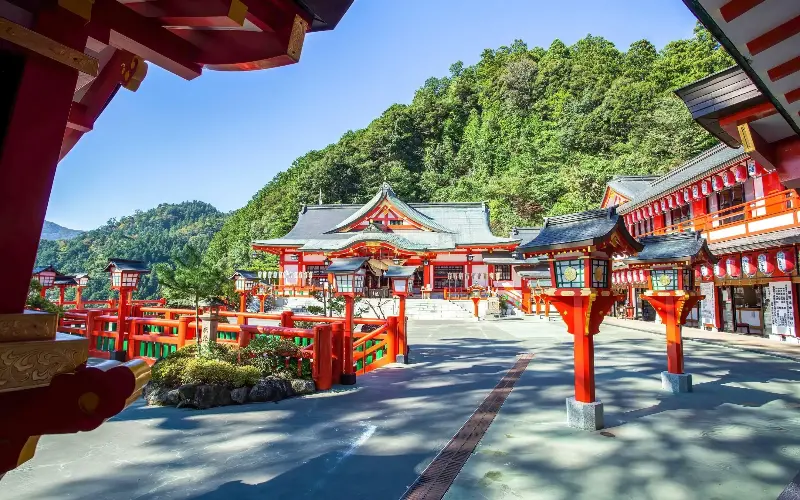
Our next destination offered another window into the past: Tsuwano, a sleepy settlement cradled by wooded volcanoes, with a smaller but attractive samurai district. Recalling Kyoto’s Fushimi Inari Taisha shrine, we climbed through a tunnel of vermilion torii gates snaking up the hillside to Taikodani Inari-jinja. Unlike in Kyoto, we strolled alone. Tsuwano also has something Kyoto lacks: a comprehensive pictorial record of Edo-era life.
It’s 160 years since Kakusai – real name Kurimoto Satoharu – painted the collection of 100 scenes known as the Hyakkeizu, capturing that bygone world. Some depict major sites – the castle, for example, built on Mount Shiroyama in 1295 to defend against invasion by Kublai Khan, and Youmei-ji Temple, with its atmospherically mossy, lichen-splashed cemetery.
Fuelling up on the town’s signature snack, Genji-maki – pancake filled with sweet red-bean paste – we hopped on e-bikes to follow guide Alessandro on a then-and-now tour through 19th-century Tsuwano.
Highlighting similarities with and differences from Kakusai’s evocative images, Alessandro led us through Honmachi, the historic merchants’ district, pausing at a former kimono shop. “Twice a year, traders made the long journey to Kyoto to bring back the latest trends,” he explained. “This shop was like a fashion magazine illustrating new styles.” Pedalling south we traversed Tonomachi, the samurai thoroughfare lined with stately residences, its canals glistening with fat carp introduced to provide food during sieges.
Heading out of town, Alessandro took us to spots little changed since Kakusai’s day: the cave shrine at Naru Falls; Washibara Hachimangu Shrine, where the annual yabusame (horseback archery) competition is still contested each April; and monumental Ippon-sugi cedar, said to be 1,000 years old.
Later we retreated to Wakatsuki, an effortlessly chic boutique hotel housed in a three-century-old sake brewery. With so many original features – beams, sake casks, brewing tanks, furnaces – it’d feel museum-like if it weren’t so, well, cool. The restaurant is far from a museum piece, its innovative cuisine showcasing local ingredients. Maitake mushroom potage, smoked yuan-yaki cod with yuzu fragrance, self-seared wagyu beef and wild boar – you get the picture, if not the aroma and flavour.
Grim castles and gourmet wonders
The largest of our Little Kyotos, Matsue, is famed for triumphs in architecture and literature. Completed in 1611, Matsue Castle is among Japan’s best-preserved bastions. Its 30m-high keep is one of only 12 medieval survivors – Kyoto’s keep was reduced to ashes in 1750. Clambering steep staircases-come-ladders and across the fabled uguisubari or “nightingale floor” – a cunning intruder alarm that chirps at the lightest tread – I recalled a description:
“A vast and sinister shape... fantastically grim the thing is, and grotesquely complex... From under the black scowl of the loftiest eaves, looking east and south, the whole city can be seen at a single glance, as in the vision of a soaring hawk.”
A touch dramatic, perhaps. But so was the life and work of the man who wrote it: Japan’s favourite adopted one-eyed Greek-Irish ghost-story author. If that seems a niche accolade, consider that Lafcadio Hearn is currently the lead character in Japan’s daily morning TV serial, commanding huge audiences. His small former home, in the compact samurai district overshadowed by the castle, draws Japanese fans aplenty. So does the adjacent museum, which traces his travels and his achievements in translating traditional stories of the supernatural recounted by his wife, Setsuko Koizumi. It’s a mystery why his story hasn’t been portrayed on screen before.
Another mystery is how so many small izakaya keep the lights on. Every meal at these closet-sized family-run bars, typically with fewer than 10 counter seats, was sensational and amazing value. Unlike Kyoto’s famed multi-course kaiseki feasts, Kawakyo’s gourmet set menu featuring Matsue’s “Seven Delicacies of Lake Shinji”, will break no banks, clocking in at 6,700 Japanese yen (approximately £30 with change). We savoured whitebait, seabass baked in washi paper, minced eel, tempura prawns the size of a baby’s arm, and dinky, umami-rich shimiji clams.
It’d be disingenuous to pretend such towns truly replicate Kyoto. But, like that memorable meal, they offer tempting tasters without the crowds – or the cost.
How to do it
Inside Japan Tours (0117 4090 716) can tailor self-guided cultural adventures to the Yamaguchi and Shimane regions, with experiences to suit interests and budgets. A superior-grade 12-night trip including activities and stays in Hagi, Tsuwano, Tokyo, Kyoto, Fukuoka and Hiroshima costs from £5,070pp, excluding international flights.