



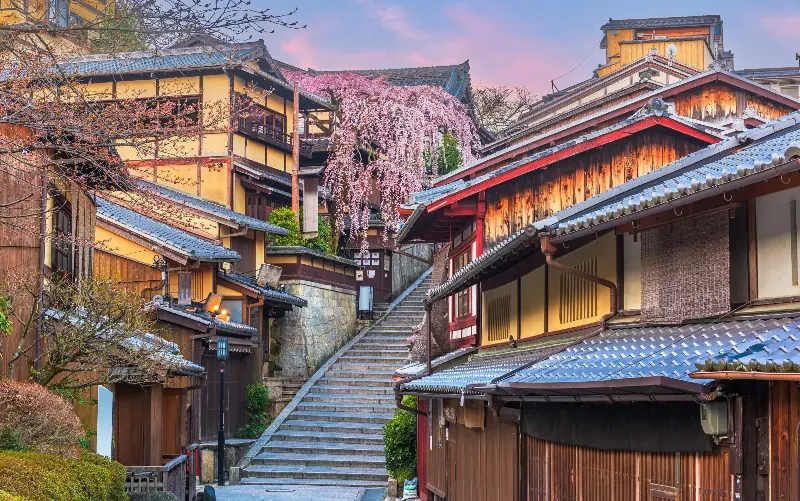
Kyoto needs little introduction: picture glimpsing a geisha disappearing down a narrow alley; the stillness of a stone garden at an ancient Zen temple; a cloud-like trail of cherry blossoms floating above a canal.
This time-capsule city, crowned by mountains, is famed for its cultural richness and depth. With a legacy of more than 1,000 years as Japan’s Imperial capital, Kyoto has paper-thin layers of history, culture, beauty and nature, as well as enchanting, gridded streets.
Today, the city is often in the headlines, not only for its 2,000-strong temples and shrines, the quality of its cuisine and the beauty of its crafts, but for its issues with overtourism. It’s true that visitors numbers are soaring, particularly in key tourist hubs, but look hard enough and you’ll find peaceful corners and little-known gems all over Kyoto. This guide shares places across the spectrum, from local favourites to must-sees worth braving the crowds for.
For more Kyoto inspiration, see our guides to the city’s best hotels, restaurants, bars and things to do.
In this guide:
How to spend the perfect weekend in Kyoto
Day one: morning
Arriving by bullet train at Kyoto Station, it’s hard not to be surprised by the throng of humanity found beneath the futuristic mesh of glass and steel reaching up to the sky. The station embodies how innovation – as much as tradition – is written into Kyoto’s DNA; after all, it is the birthplace of both Nintendo and Japan’s millennia-old tea culture.
For your first stop, head to Nanzenji Temple, a leafy Zen complex in the eastern Higashiyama district. Its soaring Sanmon gate is a threshold on the other side of which 13th-century Kyoto awaits. Once inside, wander along moss-covered pathways to see seasonal foliage reflected on still ponds in tranquil sub-temple gardens and uncover the mix of wood, paper and tatami in Buddhist halls. Continue with a scenic stroll along the nearby Philosopher’s Path – a canal-side pathway lined with cherry trees, old sweet shops, temples and shrines.
Afternoon
For lunch, head to Tan, an intimately crafted, farm-to-table restaurant that serves set menus based on rice, vegetables and fish from the Kyotango region of Kyoto Prefecture. Head northwest in the afternoon to Nishijin, the city’s kimono textile-making hub. Here, lose track of time in the atmospheric Raku Museum, dedicated to the Raku family and their eponymous pottery style, developed and practised here for 14 generations.
Afterwards, head to Tsuruya Yoshinobu, a historic sweet shop that has been making traditional wagashi confectionery for the Imperial family for centuries. Discover a spacious and slightly hidden tearoom upstairs: first pick your wagashi sweet of choice and then watch a white-hatted master meticulously make it in front of you, ingredient by ingredient. Enjoy your treat in the adjacent tearoom, alongside a bowl of whisked matcha.
Not far from here you’ll find Maana Atelier, a hub for experiencing traditional crafts with a modern design edge. Join one of the classes, from tea-dyeing textiles to making your own art panel of traditional tsuchikabe earthen walls, in a renovated machiya wooden townhouse on a quiet Nishijin lane.
Late
Next, tap into a more modern side of Kyoto, with an early evening visit to teamLab Biovortex Kyoto. A sprawling digital art museum from the groundbreaking international art collective, this is a good place to get lost among exploding flowers, seas of bubbles and forests of light crystals.
Later, after the sun disappears behind mountains, indulge in one of the city’s most elevated dining experiences: a traditional banquet-style kaiseki feast at three Michelin star Kikunoi. The dishes are graceful and the setting is as elegant as it is discreet.
Day two: morning
Rise early for a moss immersion at Saihoji – the Moss Temple – found on the city’s western edges. You’ll join a purification process with monks, chanting and copying sutras onto blessed paper, before the moss journey begins. Embrace the still beauty of the millennia-old temple gardens, home to a living cosmos of jewel-green moss. Be sure to book a slot ahead of your trip as advance reservations are essential.
Heading back towards Kyoto’s centre, stop off at Kyoto Gyoen – known simply as Gosho among locals – a rectangular park that flows scenically around the Imperial Palace. This is a lush haven of tall trees and wide stone pathways that is perfect for a seasonal stroll.
Afternoon
For lunch, head further south for a taste of Kyoto-style home cooking at d Shokudo, a hip canteen-style restaurant inside Bukkoji Temple inspired by the idea of “lifelong design”. Sit at contemporary low tables to enjoy some Kyoto-style obanzai seasonal vegetable dishes as well as tasty traditional bean paste sweets and teas. Indulge in a quick post-prandial shop in the D&Department design store next door.
Slow down with a mindfully peaceful kintsugi (ceramic repair) workshop at POJ Studio, a contemporary crafts and lifestyle company spanning a scenic machiya townhouse dating back more than a century. Pick up a kit to take home with you to continue with your new hobby.
Late
As the day comes to a close, recharge at nearby Nine Tails bar at Six Senses Kyoto – home to a delicious medley of craft cocktails imbued with a modern taste of Kyoto. It’s worth noting that Six Senses is also home to an impressive wellness space: it’s the perfect (pre-cocktail) spot for jetlag-busting massages or a dream-like watsu pool therapy.
For dinner, enjoy a relaxed modern meal at Moko, a Michelin-starred restaurant just south of Gosho. Book a counter seat and chat with the chef about the France-meets-Kyoto cuisine.
When to go
Autumn is one of the best times to visit Kyoto, with warm weather and fiery autumn leaves. Winter is cold but the chill is tempered by blue skies, sunshine, hot spring onsen bathing and heated toilet seats. Spring is a poetic riot of blossoms – but it’s also heavingly busy (and expensive), plus often slightly chilly. The only time to be wary of? The heavy summertime heat and humidity, from July to around mid-September.
Where to stay
Luxury living
The Shinmonzen is an exclusive boutique hotel designed by architect Tadao Ando in Kyoto’s prized Gion district. It hovers between a modern take on a traditional ryokan inn and an edgy contemporary gallery. It’s pleasingly a little off the tourist track, with nine art-packed suites overlooking the serene Shirakawa River; guests can watch fireflies dance on the water in summer.
Boutique beauty
Minimal and modern, rooted in simplicity and craftsmanship, Hotel Malda is an intimate urban hideaway in central Kyoto. Behind a discreet latticed cedar wood facade are three spacious colour-themed guestrooms – serene havens of clean lines, crafted textures and artisan design touches – plus a delicious organic café.
Budget bolthole
Inspired by the idea of an art collector’s private residence, node hotel has 25 rooms, a sharp interior in shades of grey – plus a head-turning collection of contemporary artworks, from paintings to installations.
How to get there and how to get around
Kyoto is easily accessible by bullet train, taking just over two hours from Tokyo (the line continues south to Kyushu, via Osaka, Okayama and Hiroshima). Kansai International Airport, around 90 minutes by train from Kyoto Station, has no direct UK flights, but countless good value connections via the Middle East, Asia and Europe. Once in Kyoto, there are buses (crowded around tourist hotspots); plus two easy subway lines. Walking, cycling or quick taxi hops (inexpensive and safe: plus Uber works here) are good ways to get around.
Know before you go
Essential information
Tourist office: Kyoto City Tourist Information; Japan National Tourism Organisation (JNTO)
The basics
Currency: Japanese yen
Telephone code from abroad: +81 (drop first 0)
Time difference: 8 hours ahead of the UK in summer (BST), 9 hours in winter (GMT). There is no daylight savings time in Japan.
Local laws and etiquette
Manners matter in Kyoto. Don’t eat or drink in public, take litter with you and avoid bringing big suitcases onto buses. Talk quietly in temples and shrines, queue patiently, wear socks without holes and if unsure, always be polite and mindful.
Accessibility
It’s not the easiest destination for accessibility. Modern museums, train stations and luxury hotels are generally accessible, but many traditional sites (temples, shrines, gardens) are not.
About our expert
Danielle Demetriou
Danielle swapped London for Tokyo in 2007. Since then, she has explored Japan thoroughly – from snowy Hokkaido to subtropical Okinawa and countless places in between. She writes culture, design, architecture and travel stories and lives in an old machiya townhouse in Kyoto.