



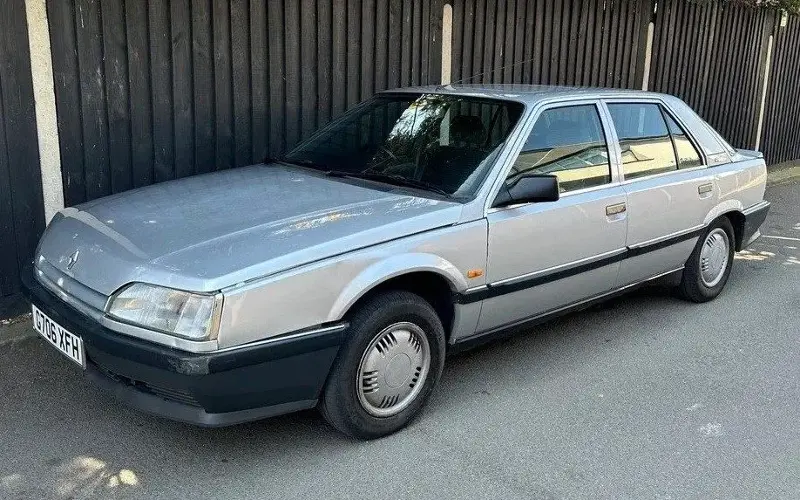
Some of the vehicles in this series featuring rapidly vanishing everyday cars did not achieve their hoped-for success, despite their many positive attributes. The 1989 Renault 25 GTS owned by Kevin Iyaloo is comfortable and rather elegant, but it did not quite possess that late-vintage Yuppie image. It also suffered from one of the worst advertising campaigns in ITV history.
Renault launched the 25 at the end of 1983 as the replacement for the 20/30 range, with UK sales commencing in August 1984. Engine choices were a 2.0-litre four-cylinder and a fuel-injected 2,664cc V6. Trim levels commenced with the TS and progressed via the GTS and the GTX to the dizzying heights of the flagship V6 Injection.
The Telegraph thought that the 25 was “a sort of French Volvo” and that “passengers in particular should like it”. This paper also believed that the 25 should “help to add some badly needed sparkle to the company’s UK sales, after 1983’s disappointing performance”. Car magazine preferred the GTX to the Volvo 740 GLE and the Rover SD1 2300S, citing its “technical superiority” and “fine looks, spaciousness, versatility and ample comfort”.
Meanwhile, the concessionaire informed potential buyers that it was “the best in Europe. That sums up the specification for the Renault 25” and that its lines were “a work of art”. The 25 was also, apparently, “ambitious and strict”, which sounds faintly disquieting. More reassuringly, dealers could also tell you that the TS’s 0.28 drag coefficient was superior to the Audi 100 C3.
In France, the 25 became widely associated with officialdom. A fleet of large Renaults transported dignitaries around D-Day Memorial sites in 1984, with François Mitterrand and Jacques Chirac favouring the V6 models as their official cars. The 25 received a facelift in 1988 to make it “even more beautiful and stylish” with a new grille and bonnet, while its seats were “trimmed in soft new design velours”.
The GTS was now the entry-level model, with remote-control central door locking, power-assisted steering, electric front windows, adjustable steering, velour upholstery and “a 4 x 6 watt Hi-Fi system”. Its 103bhp 1,995cc engine produced a top speed of 110mph and by 1989 a GTS cost £11,990, making it far cheaper than the Ford Granada Mk3 2.0L at £12,465.
In addition, the 25 GTS was far less expensive than the Saab 900i 8V 5-door at £12,795 and the Rover 820 Fastback at £13,133. The Fiat Croma CHT undercut the 25’s price by more than £1,000, but the TS still cost less than the £12,021 Citroën CX 22TRS and the £13,697 Vauxhall Carlton 2.0i GL. Plus, the Renault had “a personality that makes it stand out from the crowd”.
Renault initially aimed to build 200,000 25s per year, but when the Safrane replaced it in February 1992 only 780,976 units had left the Sandouville factory at Le Havre near the mouth of the Seine. Today, only 31 of any type are believed to remain on the road in the UK, of which only six are the GTS. In the UK, the 25 struggled with being front-wheel drive when its Ford, Rover and Vauxhall rivals were conventionally rear-wheel drive in 1984.
A further sales challenge was the lack of a four-door version, even if Robert Opron and Gaston Juchet devised the 25’s hatchback rear styling to resemble a conventional saloon. In addition, UK Renault dealers had a restricted inherited customer base, since the outgoing 20 and especially the 30 were comparatively niche models, while the 25 entered production as the market for large cars was transforming.
In 1983, a Renault manager told the press: “We noticed that people were a bit tired of these strong status symbols, that you must buy this or that, and that they were complaining that the choice was very small – either BMW or Mercedes.” This increasingly proved to be the case during the 1980s, and by 1989 too many young professionals opted for a BMW 316i four-door at £11,635 rather than a 25 GTS.
However, Renault did attempt to lend the 25 a Yuppie appeal with a memorably awful television advertisement. “It’s time to go it alone – I’m starting my own business,” announces the ineffably smug driver, as Mrs Renault worries about the return of their 25 company car. The overall impression was of a 60-second version of Howard’s Way.
Fortunately, when he bought his 25 Iyaloo was less influenced by bad 1980s television commercials than by family tradition: “My father owned a 16 and an 18.” Iyaloo greatly enjoys the comfort and the style of the GTS, although members of the public are sometimes confused about its identity.
But then, only a true connoisseur could appreciate “a new concept in motoring”.
We use the fascinating howmanyleft.co.uk for figures of surviving examples but some cars present more of a challenge than others, so the figures are rarely authoritative. Some pre-1974 records were lost before the DVLA centralised the process, while some cars have their model type misnamed on the V5 registration documents. A further issue is the omission of the exact model name or generation, or distinction between saloon and estate bodystyles.