



London is always being lost and re-found. Every generation harms the city that came before. The Edwardians replaced much of central London with cliffs of classically ornate Portland stone. Few complained. Shock, for example, was muted when the original brick and stucco, four-storey Regent Street of Decimus Burton and John Nash was lost for the Edwardian seven-storey Regent Street of Reginal Bloomfield, Aston Webb and Ernest Newton.
Only after the Second World War did Londoners increasingly resist progress as it became commonplace to dislike new buildings. Modernism is the best recruiting sergeant for “heritage”. But, in truth, although Blitz and traffic modernism were London’s foes, lost buildings are not new but perennial. The city is full of them, from the Londinium that Boudicca burnt to the city squashed beneath the all-conquering Barbican.
London amphitheatre
AD 70–fifth century
In 1988 archaeologists found London’s amphitheatre. Initially timber, with up to 15 tiers of wooden benches, it was rebuilt in the second century of stone and tile and could seat 5,000. Hauntingly, its location still influences modern London’s geography. The abandoned amphitheatre, doubtless still visible as an enclosed depression in the ninth century, was a natural place to call a shire court or moot by which London’s earls might collect taxes and maintain law, leading in turn to the siting of the Guildhall in whose courtyard the amphitheatre was found.
Wych Street
Unknown–1901
Originally Anglo-Saxon, and running between The Strand and Drury Lane, it was a tumbledown amalgam of gable-ended, overhanging, timber-framed, elaborately fenestrated, pre-fire taverns, booksellers, homes and offices, smeared with the soot and stains of a millennium. Criminals conspired in those taverns, most notoriously the Black Lion and the White Lion. In 1900, Wych Street was demolished to clean out the moral and physical degradation and create Kingsway and Aldwych. If it still survived, it would be one of London’s most famous streets, a real life Diagon Alley, thronged by enriching tourists.
The Holbein Gate
1531–1759
When Cardinal Wolsey bungled Henry VIII’s divorce and fell from grace, the king nabbed his palace, doubled it and built a monumental gateway to link the halves across the public highway now called Whitehall. Curiously, a room in this gatehouse became one of Henry VIII’s favourite retreats. It was reportedly here that Henry VIII married Anne Boleyn and Jane Seymour and as he grew old and fat, that he kept his wheelchair or “tramme”. Subsequently called the Holbein Gate, it was one of London’s landmarks until it was demolished for road widening in 1759. Some urban pressures are eternal.
Sir Paul Pindar’s House
1599–1890
Pindar was that staple of London’s history: a self-made man. In 1597, he bought three plots on Bishopsgate, creating a timber-framed house with a jettied front, each storey projecting over the one beneath. As befitted his wealth, Pindar’s façade was impressive, with decorated oak panels and large semi-circular windows. Glass spelt luxury. Surviving the Great Fire, it was later a workhouse and tavern before, in 1890, being demolished by Great Eastern Railways. They presented the façade to the V&A Museum, the sole lost building in this list partly visible in more than a book.
Northumberland House
1605–1874
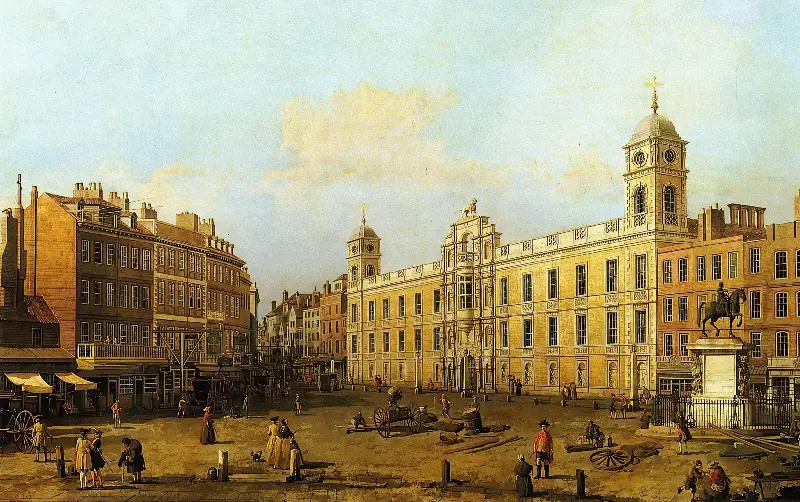
This was one of London’s greatest houses, combining medieval hall, Oxbridge college and renaissance palace. Above were stone letters in an openwork parapet. At a 1619 funeral, one letter fell and killed an unfortunate man named William Appleyard. Uniquely, his burial register records cause of death as a falling letter “S”.
Northumberland House was the last demolished of the Strand’s great palaces. The Duke of Northumberland sold it to the Metropolitan Board of Works who demolished it to ease traffic by creating Northumberland Avenue. In the last photos, the shadow of Nelson’s Column falls across its renaissance façade. New meets old.
St John Horsleydown
1732–1972
Nicholas Hawksmoor is one of England’s three greatest architects. His churches are miraculous, simultaneously familiar and unique. Visit all that survive. One that does not is St John Horsleydown, which stood south of Tower Bridge with its fluted Ionic spire. A gilded weathervane on top was judged by generations of Londoners to resemble a louse, thus gifting the building its Cockney name, “Louse Church”. Gutted in 1940, the surviving spire was taken down in 1948 and the rest of the church, shamefully, demolished in 1972.
Newgate Prison
1188–1904
Home to London’s most fearsome wall, a terrifying barrier of giant rusticated blocks and blind windows, this was a prison that said “I am a prison”, but it did so elegantly for the surrounding streets. They architect, George Dance the Younger, was influenced by Piranesi whom he had met in Rome. Could any modern architect match this union of dignity, utility and terror? It was replaced by the Old Bailey.
The Pantheon
1772–1792
Designed by a young James Wyatt and largely the brainchild of two female entrepreneurs (Miss Ellice and Mrs Cornelys) the Pantheon on Oxford Street was briefly London’s most glamorous building, a theatre, concert-hall and assembly room combined. The rotunda was breath-taking. Visitors flocked. The success was stupendous.
Unlike Rome’s Pantheon, however, it was short-lived, gutted in 1792 – a fire depicted by a sixteen-year-old JMW Turner. Rebuilt as a shopping bazaar it lost its caché. The site is now an art deco Marks & Spencer in sheening black granite. Above, in green letters, it still says “The Pantheon”.
King Square, Finsbury
1820s–1960s
It is too heartbreaking to list all the Georgian streets and squares demolished post-war. Scarred and smoke-smeared, most were reparable but were needlessly replaced with municipal blocks that were less popular, less functional, les resilient and lower density than their predecessors. They gifted their residents less privacy, less dignity and no private gardens. The austerely elegant King Square must suffice. It survived the Luftwaffe but could not endure Finsbury Borough Council’s post-war planning.
Exeter Hall
1831–1907
Once, radicalism came with giant fluted columns and Corinthian capitals. The refined Greek classicism of John Peter Gandy Deering’s Exeter Hall on the Strand was the centre of the anti-slavery campaign and a hotbed of establishment radicalism. Prince Albert made his first public appearance here in 1840. Wilberforce, Livingstone and Shaftesbury spoke here. The YMCA then took over and sold it for demolition.
Westminster Hospital
1834–1951
Facing Westminster Abbey was for a generation the latest word in hospital design and technology with wards grouped around a hollow crescent. Taking advantage of the Gothic design, turrets added in the 1870s contained new flushing lavatories. By 1936 the hospital was too cramped. It departed for Horseferry Road. Demolished in 1951, the site was a car park for 30 years until the 1980s when the “high-tech” QEII Centre landed.
Euston Arch
1837–1962
Seeking “embellishment”, the London & Birmingham Railway commissioned Philip Hardwick to design a Doric Propylaeum, as a gateway to the north. Euston Arch became a symbol of London and the railways. In 1960, for no reason, beyond modernist fashion, British Rail were determined to demolish.
The hopelessly modish Royal Fine Art Commission failed to complain leaving John Betjeman spear-heading a passionate preservation campaign. The contractor offered to re-site it however British Rail insisted. Instead of funding reconstruction, they allegedly transported the stones to the River Lea where they secretly dumped them, like murderers hiding the body.
Columbia Market
1864–1958
This was the single most unsuccessful act of philanthropy in London’s history – the white elephants’ white elephant. Enabled by Parliament, funded (at over £200,000) by Baroness Burdett-Coutts, constructed in a quadrangle of spectacular Flemish Gothic on a two-acre site, Columbia Market was intended to be a toll-free open food and flowers market for the East End.
However, unbending opposition from already-established traders prevented wholesalers from supplying the market. It closed around 1886, was bought by the London County Council in 1915 and demolished for flats between 1958 and 1966. One of London’s greatest, and least remembered, Gothic buildings.
Birkbeck Bank
1902–1965
Forgotten as an institution and as a building, Birkbeck Bank, on Chancery Lane, was a temple to Mammon, a Tardis opening up from a discrete entrance into a huge circular dome. It was not under-decorated. Glazed tiles gleamed. Murals depicted mercantile life in mythology and literature. The dome was framed in cast-iron ribs, gleefully deploying new technology to create old effects. In 1910, as in Mary Poppins, Birkbeck Bank was ruined by a bank run. It was saved by the London County & Westminster Bank, later NatWest. The desperately unloved and unfashionable building was demolished in 1965.
A happy coda: St George’s Bloomsbury
2006–present
Beautiful buildings can be rebuilt. No law of economics or physics stops us recreating lost features. After the war, the battered Inns of Court were substantially rebuilt. Nobody now realises. Their beauty is taken for granted. And in 2008, the World Monument Fund completed the recreation of the eccentric lions and unicorns on the spire of Nicholas Hawskmoor’s sumptuous St George’s Bloomsbury. Demolished by the Victorians, they had previously only been known through engravings such as Hogarth’s Gin Lane. You can see them in the distance. What was lost can be remade.
Nicholas Boys Smith is the founder and chairman of Create Streets and a visiting professor of architecture at the University of Strathclyde. His history of London’s streets, No Free Parking, is available from Bonnier Books.