



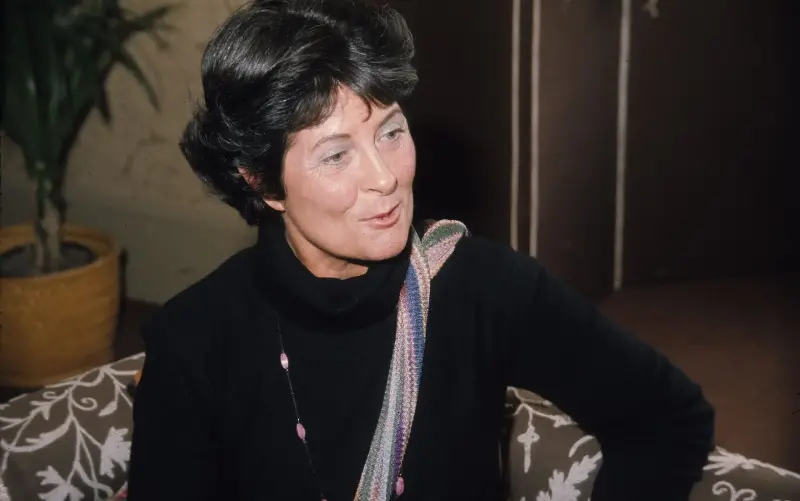
Joan Burstein, who has died aged 100, was dubbed the “fairy godmother” of fashion designers, responsible for introducing Giorgio Armani, Missoni and Ralph Lauren to London through her boutique, Browns.
Having grown up at a time when, as she put it, “nothing was sophisticated”, Joan Burstein was determined to offer her customers the latest rare and beautiful clothes. “It was about sniffing designers out, having the right connections, travelling to America and beyond until people started coming to us,” she recalled.
Collections at Browns were carefully edited to appeal to London’s most stylish and well-heeled set. Prices were correspondingly high. It was not unusual for a T-shirt to cost more than £200, while statement pieces by big names such as Gucci often sold for thousands.
Alongside the impeccably tailored suits were more arresting items: a chainmail harness by Fannie Schiavoni; a Dolce & Gabbana coat that cost £17,000. “I’m terrible with money,” Joan Burstein once confessed, crediting her financial success to her husband and business partner, Sidney. But down the years she demonstrated a keen eye for spotting and nurturing talent.
Calvin Klein got his start in the capital after she approached him in a night club. She bought up John Galliano’s first student collection and put it in Browns’ window display. Other names who flourished under her patronage included Jil Sander and the “Queen of Knits”, Sonia Rykiel. In the early 1980s she turned her focus towards Japan, helping to launch the careers of Rei Kawakubo (of Comme des Garçons) and Issey Miyake.
By the turn of the century, Joan and Sidney Burstein had turned Browns into a mini-empire; the ground-level boutique in South Molton Street grew to swallow up another four properties. There was a bridal store, a menswear shop and a discount store called Labels for Less.
The structure of the original Georgian townhouses made for an eccentric lay-out: small rooms with creaking floors, connected by Escher-style staircases. Staff would greet regular customers by name and take new ones on a tour through the rabbit warren of departments. More recognisable clientele – among them Bianca Jagger and Diana Ross – had special access through a back door.
As the fashion landscape continued to evolve, younger generations helped to keep the brand relevant and bring in new clients. The Bursteins’ daughter, Caroline Collis, was put in charge of the avant-garde offshoot Browns Focus in 1997. Caroline’s own daughter, Charlie Collis, became the company’s website manager – though Joan Burstein professed herself somewhat bemused by the phenomenon of online shopping. Nothing, to her mind, quite matched the feeling that came from walking out of a store clutching a new favourite skirt or piece of knitwear.
Nor was the personal relationship between salespeople and clients one that could easily be replicated remotely. She always instructed her staff at Browns not to let anyone leave the premises “not looking good in what they’ve bought”. A four-storey Browns megastore on Brook Street, which opened in the wake of the Covid-19 pandemic, strove to preserve that ethos by including several private shopping suites – one of them christened Joan in her honour.
She was born Joan Jotner in Camden on February 21 1926, into an East End Jewish family. Her father, Ashley Jotner, was a chiropodist; she inherited her fashion sensibility from her mother Mary, née Pleeth, a tailoress, and two aunts who were court dressmakers in Regent’s Park.
After leaving school she trained as a pharmacist before meeting Sidney Burstein, an East End market trader from a Russian immigrant family, at a party. He chastised her for eating a chocolate eclair: “He said: ‘Put it down. That’s no good for you,’ ” she recalled. “I was captivated by someone telling me what to do.” They were married in 1946.
They set up an underwear and hosiery stall in Ridley Road Market with the aim of saving enough money to buy a shop. Their first big success came with Neatawear, a high street fashion empire with outlets on Oxford Street, Regent Street and Brompton Road. Their plans proved too ambitious, however, and they went bust, losing their house and all its furniture. Friends took in their two children.
There was no option but to start over. In 1968 the Bursteins founded Feathers, a boutique on Kensington High Street. It was an instant success. The atmosphere was more like a club than a shop, with customers gathering to meet friends at weekends. To guard against shoplifters, several people were employed to keep watch on high bamboo ladders.
The couple moved again – somewhat to Joan Burstein’s reluctance – after Sidney bought 27 South Molton Street from the aristocrat Sir William Piggott-Brown in 1970. Six years later they opened a new store on Sloane Street.
There followed a number of individual shops for big-name designers: Calvin Klein in 1979, Ralph Lauren in 1980. Caroline Collis established a neighbouring hair salon called Molton Brown, which evolved over the 1980s into producing opulent fragrances and body washes. Later she presided over Browns Living, the homewares section on her parents’ premises.
Throughout, Joan Burstein strove to attract younger shoppers by embracing the opportunities offered by Browns’ seasonal sales. A personal highlight of her career was an occasion when she marked everything in the store down to £25. “I went a bit mad,” she recalled. “Everybody had a wonderful time, including the staff.”
She also relished selling discounted items through Browns Own Label (later Labels for Less). But she resisted any temptation to cater for a mass audience. “I’m not dressing the world, just the woman who shops at Browns,” she explained. “It’s all about quality and individuality.” That philosophy allowed her to ride out periods of economic downturn, confident in her customers’ enduring desire to own beautiful things. In 2006 she was acknowledged as one of fashion’s great survivors when she was appointed CBE.
A diminutive yet authoritative figure, invariably bedecked in “statement” jewellery, Joan Burstein was held in deep affection by insiders in the fashion industry, who nicknamed her “Mrs B”. She remained closely involved with Browns into her eighties, holding the title of honorary chairman after the company was sold to the online retailer Farfetch in 2015. Though having once declared her ambition to carry on working “until they pick me up off the shop floor”, she finally retired in 2016.
She kept a home in Ibiza, where she danced to a swing band at her 100th birthday party in February.
Sidney Burstein died in 2010, and she is survived by their two children.
Joan Burstein, born February 21 1926, died April 17 2026