



In history, the county town tended to be wherever the monarch, or his or her representative, wanted it to be. Usually, it was either the biggest or most glamorous town in the county. But in the 19th century, when local government grew more organised, the most important consideration became accessibility, with the result that some most unlikely places have become county towns.
Durham and Winchester may have their cathedrals, Oxford and Cambridge their colleges, Chester and Shrewsbury their medieval streets, but England’s less showy county towns have their attractions too (in addition to the cachet of being the seat of power).
Here, then, are England’s 10 most underrated county towns.
Aylesbury, Buckinghamshire
County town officially since 1725, Aylesbury unofficially acquired the title in 1529, when Henry VIII declared it so as a favour to Anne Boleyn’s father, who owned Aylesbury Manor.
The town retains its historic core of cobbled medieval streets centred on 13th-century St Mary’s Church and Market Square, where a vibrant market is held three days a week. In Market Square, alongside local heroes John Hampden and Disraeli, there is a statue of David Bowie, who debuted Ziggy Stardust in Aylesbury’s Friars music club in 1972.
Off Market Square is the 15th-century King’s Head, where Henry VI and Margaret of Anjou honeymooned and Oliver Cromwell pondered. And don’t miss the Roald Dahl Children’s Gallery in Church Street.
Chelmsford, Essex
An important staging post on the Roman road from London to Colchester, Chelmsford has been county town of Essex since 1218.
Two lively markets, one indoor and one outdoor reflect Chelmsford’s history as a market town while a fascinating trail explores the town’s industrial heritage as home to the world’s first purpose-built radio factory established in 1912 by Guglielmo Marconi.
Chelmsford’s 15th-century cathedral, known for its beautifully painted ceilings, puts on a full programme of concerts and events throughout the year, while local history is on display in the Museum of Chelmsford in Oaklands Park, south of the town centre.
Preston, Lancashire
For anyone interested in industrial history, Lancashire’s county town is a must, for Preston was the first of Lancashire’s pioneering cotton towns, a legacy that lives on in its many historic mills and museums.
The house where Richard Arkwright invented the cotton spinning machine that transformed the industry in 1769 still stands and Preston’s elegant Georgian quarter, Winckley Square, boasts a number of fine homes built for cotton merchants.
The town centre has some impressive public buildings, including one of Lancashire’s best museums and art galleries, the Harris. Preston is also proud of its numerous parks beside the River Ribble and England’s highest church spire, rising 309ft above St Walburge’s Church.
Maidstone, Kent
Maidstone sits in the centre of Kent on the River Medway and was formally established as county town in 1889. Long Kent’s major market town, today it is regarded as one of the best shopping towns outside London.
The town centre is peppered with old inns and jettied, half-timbered and pargeted Tudor and medieval buildings, while down by the river a delightful grouping of 14th-century buildings reminds us of where Maidstone started: All Saints Church, with the widest nave in England, the Archbishop’s Palace and College of All Saints, where Archbishops rested on their way between London and Canterbury, and the Stables, occupied today by Europe’s biggest carriage museum.
Nearby, Maidstone Museum occupies a magnificent Elizabethan mansion, Chillington House.
Morpeth, Northumberland
The market town of Morpeth, sitting conveniently on the Great North Road between London and Edinburgh, became county town in 1981.
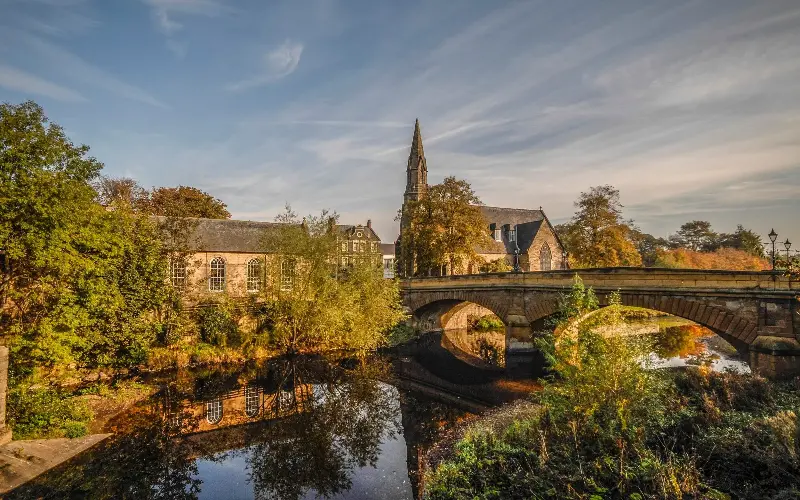
All that remains of its Norman castle is the gatehouse of 1300, while the 13th-century chantry beside the River Wansbeck contains Britain’s only dedicated bagpipe museum. Facing Sir John Vanbrugh’s Town Hall in the town centre is Morpeth’s 17th-century clock tower, which still rings curfew at 8pm every evening.
Morpeth is a place of pilgrimage for those coming to pay their respects to suffragette Emily Wilding Davison, whose grave stands in the churchyard of St Mary the Virgin.
Ipswich, Suffolk
Ipswich became county town in 1974. The town centre is a delightful tangle of traffic-free shopping streets lined with ancient buildings including the aptly named and elaborately pargeted Ancient House, a 15th-century gem containing a museum of local history.
In parkland just to the north is the stunning Tudor Christchurch Mansion housing the Wolsey Art Gallery, with an impressive collection of works by Suffolk artists Thomas Gainsborough and John Constable. More contemporary entertainment can be found on Ipswich Waterfront, bursting with trendy cafes, bars, restaurants and galleries.
Bedford, Bedfordshire
The county town of Bedford is a place of quiet Georgian streets, gentle riverside walks along the Ouse and charming old inns such as the Swan Hotel, built for the Duke of Bedford in 1796.
The handsome St Paul’s Church at the end of Town Bridge stands on the site of the Saxon Minster where King Offa of Mercia is buried. Bedford’s favourite son John Bunyan wrote The Pilgrim’s Progress while in Bedford Gaol and the barn where he later preached is now the site of a Meeting House and Museum in his memory.
Bedford lets its hair down during the biennial Bedford River Festival, held on Ouse in July, with boat races, parades and live music.
Reading, Berkshire
County town since 1867, Reading hides its history well, with its most popular attraction being the huge Oracle shopping centre.
But well worth exploring are the ruins of Reading’s royal abbey, founded in 1121 by Henry I and one of the richest abbeys in Europe. Henry is buried somewhere amongst the ruins and a plaque records that the first English song, “Sumer is icumen in”, was written here by a monk in 1240.
The abbey gatehouse was once a schoolroom attended by Jane Austen and is now a museum. Next door is the infamous Reading Gaol, where Oscar Wilde was incarcerated, which closed in 2013 and is now being converted into a museum and art centre.
Trowbridge, Wiltshire
Trowbridge (“tree bridge”) became county town in 1889. A major weaving centre, it was known during the 19th century as the “Manchester of the West” and The Parade in the town centre is renowned for what Pevsner called a “row of palaces”, some of the finest Georgian houses in Britain, built for the cloth merchants.
A number of interesting town trails take in old mills, a 17th-century lock-up called the Blind House, 14th-century St James’s Church, where George Crabbe, author of Peter Grimes, was rector, and the Jacobethan Town Hall of 1889.
The Trowbridge Museum displays an original Spinning Jenny, one of only five still in existence, and there are boat trips on the Kennet and Avon Canal from the Hilperton Marina on the edge of town.
Guildford, Surrey
The best views of Guildford, Surrey’s county town since 1257, can be had from the top of the Great Tower of its Norman castle, which gazes across the town at Guildford’s stylish modern cathedral, standing proud on Stag Hill to the west.
Concerts and other events take place in the colourful gardens laid out in the castle grounds below while Guildford Museum, located in the castle gatehouse, traces the history of “golden ford” (Guildford) from Saxon times.
Guildford’s cobbled High Street, which slopes down to the River Wey, past Tudor and Georgian facades watched over by the Guildhall’s golden clock, was described by Dickens as “the most beautiful High Street in England”.