



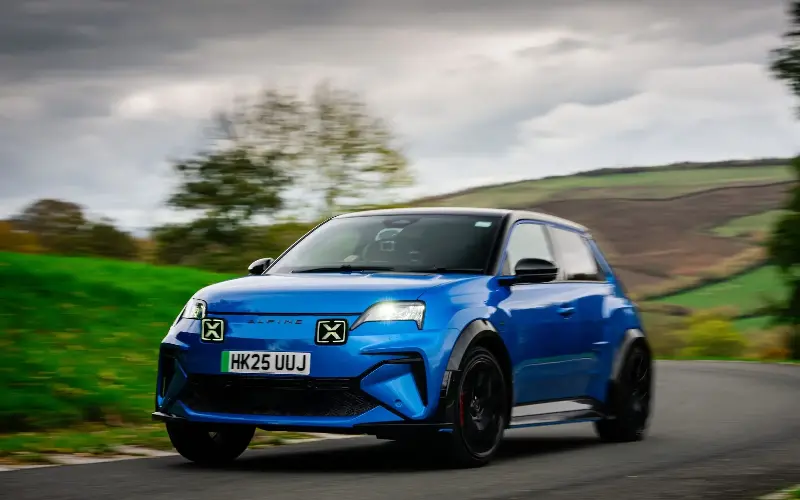
The hills are alive with the sound of... not much actually. Although that’s not entirely accurate, as the chirp of tortured tyres and an unusual whirring pervades the stillness of the rolling Gloucestershire countryside.
I’m at the renowned Prescott Speed Hill Climb, the home of the Bugatti Owners’ Club, north-east of Cheltenham, for a car launch with a difference, as the review process includes learning how to tackle the sinuous ascent in the Alpine A290, a performance version of the 2025 Car of the Year-winning Renault 5 E-Tech.
With a choice of 180hp or 220hp electric motors, the Alpine comfortably exceeds the performance of the 150hp R5, itself no slouch thanks to the instantaneous response of battery power. Perhaps more telling, whether on the road or tackling the hill climb, is the 221lb ft of torque of the top-spec GTS version. For the record, it can accelerate from 0-62mph in 6.4sec.
Alpine is Renault’s performance brand, founded in Dieppe in 1955 by rallying aficionado Jean Rédélé. As with famous Alpines of the past, this is a highly tweaked version of a regular Renault production car (although the company also produced the sublime A110 coupé of 2018, a modern take on Rédélé’s original, rally-winning A110 of the Sixties and Seventies).
More than extra power
Although clearly based on the Renault 5, it has wider wheel arches to accommodate larger 19in alloys with broader tyres, developed for this car by Michelin, while various bodywork addenda provide a suitably pugnacious appearance. In short, it looks like an R5 on steroids.
More pertinently, it has uprated suspension incorporating hydraulic bump stops for comfort allied to precision, along with bespoke anti-roll bars at each end. Also hidden is a revised and reinforced front subframe, which improves the location of the larger electric motor and wider axles. Braking is courtesy of four-piston calipers from Italian specialist Brembo.
Inside are heavily bolstered seats and a new leather-bound steering wheel featuring aluminium controls apparently inspired by Alpine’s adventures in Formula 1. These include a four-position rotary control to select the level of regenerative braking and, most intriguing of all, a red “overtake” button that enables the driver to dial in extra power for up to 10sec.
As with the A290 as a whole, it looks and (mostly) feels substantially similar to the R5 yet elevated in every regard. Sometimes subtly, sometimes not so understated.
Three models
The lineup consists of the GT+, the GT Performance+ and the GTS, all with a 52kWh battery. The starter GT+ has the 180hp motor, with the Performance+ focusing on comfort. The Performance+ variant gains the 220hp motor and an Alpine telemetrics system to analyse your data, should you be so inclined.
The range-topping GTS also has the 220hp motor and incorporates all the luxury equipment from the Performance+, along with special wheels and other finishing touches. Prices range from £30,245 for the GT+ to £34,245 for the GTS after the £3,750 EV grant.
On the road
Before tackling the hill climb I took the GT on the surrounding Cotswolds roads. The first impression – apart from the significant extra urge compared with the R5 – is the responsiveness and agility of the chassis. It has the featherweight, light-on-its-feet feel associated with a 1990s hot hatchback, an impressive feat of engineering considering that it weighs 1,483kg (barely more than the R5, coincidentally).
The handling is assuredly engaging, the steering wonderfully direct and, as with the lovely A110 two-seat coupé, there’s a compliance to the suspension that means it’s not tiring to drive enthusiastically. With increasing speed, these attributes become more pronounced. Bone-shaking it isn’t, although it’s noticeably firmer than the Renault.
More astounding is the mighty grip, particularly at the fore given that the prodigious torque is applied through the front wheels only. It simply grips and goes.
Talking of go, a very brief run in the GTS was a revelation, the extra edge to the performance making it extremely rapid indeed. Yet it’s as involving, agile and supple as its less powerful sister, in its way even more impressive when you consider that most cars with comparable performance tend to be rock hard and unforgiving.
And it goes like a scalded cat when you finger the red overtake button, the ferocity of the seamless power delivery akin to an abrupt turbocharger.
Hill-climb history
Racing up a hillside against the clock is the oldest form of motorsport in Britain, born when pioneering motorists tested their cars against rivals. The Shelsley Walsh hill climb in Worcestershire opened in 1905, predating the first purpose-built circuit at Brooklands by two years.
Prescott, established in 1938 by the Bugatti Owners’ Club (which still owns the venue), is only 1,128 yards in length but, as with all of the UK’s 29 major hill-climb courses, it’s a lot trickier than it might at first appear. The record is held by Matthew Ryder, who took only 34.6sec to ascend in an F1-lookalike single-seat racer in 2024 – and he is one of our instructors for the day.
Upward trajectory
Although I’m an accomplished road driver, my experience of dedicated motorsport courses is limited at best. My trepidation was not helped by some rapid demonstration runs by the hill-climbing professionals in the A290 GTS, plus a damp track with a smattering of slick leaves.
When it came to my turn, two words of instructor Ryder’s advice stood out: late and apex. That translates as: turn in late and almost brush the inside kerbing, the better to maintain speed through the corner then straighten the car as soon as possible for maximum traction towards the next. The track is narrow, but there is still an optimum line for achieving a respectable time.
And, well, it was terrific fun, but as with all of these things it only demonstrates how mind-bogglingly proficient the professionals are. I was over-driving like crazy, meaning a ragged approach to corners when a smooth, controlled style is what pays dividends.
But the way the A290 unerringly grips tenaciously then slingshots away from the curve is nothing short of incredible. And addictive.
The Telegraph verdict
I’m a huge fan of the Renault 5, and the A290 convincingly builds on its myriad strengths. Although that makes the Alpine less of an everyday car, in anybody’s language it remains a compelling performance hatchback.
In fact such is the prodigious power and torque of the GTS that it’s less appealing, on the road at least, than the less powerful GT+, which is the better all-rounder. However, Alpine says that most buyers opt for the barnstorming GTS, which makes perfect sense provided it’s your second (or even third) car.
I understand the continued appeal of classic petrol-powered GTis, but the A290 is a worthy successor, just as involving – but without the engine noise that most of us find enthralling.
For those with the means to own an electrifying second car for fun, the A290 takes a lot of beating.