



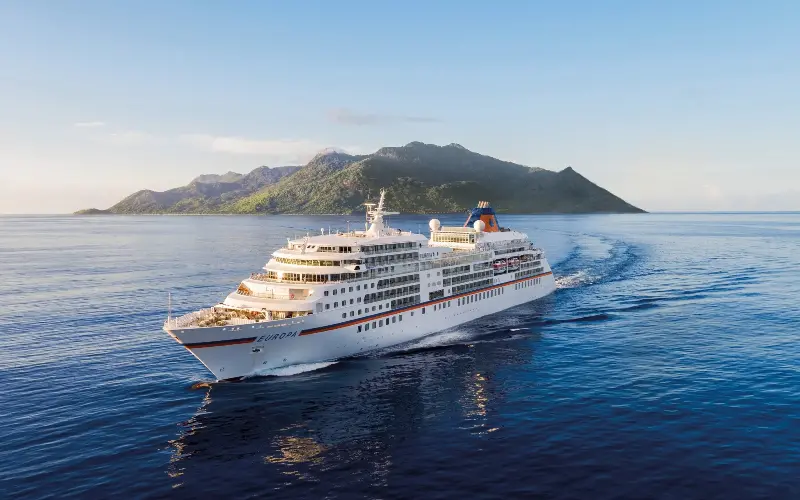
German-based Hapag-Lloyd Cruises is one of the world’s leading luxury and expedition cruise lines with a history that dates back to 1891, when its debut two-month voyage sailed from Cuxhaven to the Mediterranean and back.
Its story after that is long, complicated and interrupted by wars – but also explains why the cruise line is often confused with the container company Hapag-Lloyd. Suffice to say, the cargo and cruise lines became one after a merger in 1970 between two German shipping companies, but were separated in 2008 when the cruise business was sold to the travel giant TUI Group.
The line was renamed Hapag-Lloyd Cruises in 2016 and four years later was sold to TUI Cruises, a joint venture company owned 50/50 by TUI Group and Royal Caribbean International.
Today, the line, headquartered in Hamburg, has five ships: Europa and Europa 2 offer German-style luxury cruises around the world (which means less inclusive than the US ultra-luxury model) while Hanseatic Inspiration, Nature and Spirit are equally luxurious but built for expedition.
For a long time, only Europa 2 and Inspiration were sold internationally. That changed in January 2026, when all five vessels became bilingual – German and English – a move expected to attract more international travellers.
1. Where does Hapag-Lloyd Cruises sail?
Rather than repeating round-trip itineraries, most cruises on Europa and Europa 2 begin in one port and end in another, which literally takes the ships around the world.
Europa started 2026 in the Indian Ocean and will end the year in the Caribbean – also sailing in Africa, Northern Europe and other destinations in between.
Voyages are anywhere from four to 24 days and often have late or overnight port stays, so passengers have more time ashore. For example, an October trip around Greece and Turkey spends two nights in Istanbul, while a November cruise to Spain and Portugal has overnight stays in Lisbon and Barcelona.
Elsewhere, Europa 2 has cruises in Hawaii, South America and the Mediterranean throughout 2026, before heading Down Under, and to the South Pacific, Asia and Japan in the first six months of 2027.
Cruises range from three to 22 days in length. A three-day close-to-home sailing from Hamburg to Kiel in June is a good way to get a taste for the line’s German-style luxury.
Proving that there is more to expedition cruising than the Arctic and Antarctica, Hanseatic Inspiration, Hanseatic Nature and Hanseatic Spirit sail a diverse selection of itineraries through Asia, Alaska, the South Pacific, Northern Europe and more.
That might sound similar to the classic ships, but the difference is they seek out remote places – look out for the Oki Islands in Japan, Homer in Alaska or Mangareva Island in French Polynesia – where instead of docking, passengers might be taken ashore in inflatable Zodiacs.
Naturally, they also visit the polar regions – Antarctica in the northern hemisphere’s winter months and the Arctic in summer.
Spirit will be attempting a 31-day semi-navigation of Antarctica in February 2027, and has an epic 29-day voyage through the Northwest Passage from Seward in Alaska to Kangerlussuaq in Greenland in August 2027.
2. Who does Hapag-Lloyd Cruises appeal to?
Whether on a classic or expedition cruise, passengers will have several things in common. They will be affluent, professional and by a huge majority (around 90 per cent) from German-speaking countries.
Passengers choose Hapag-Lloyd Cruises for the luxurious vessels, lovely service, quality and variety of the cuisine, and because there are no set dining times and no strict dress codes.
On the classic ships, expect guests aged 40 and up, and also families during school holidays. There are also clubs and special excursions for children.
Most expedition cruises are longer, so they attract more mature passengers with time and money who want to travel in luxury while learning about wildlife, the environment and different cultures in remote parts of the world. An explorers’ club for youngsters aged 10-17 runs on selected expedition cruises.
3. The Hapag-Lloyd Cruises fleet
Europa 2 (500 passengers)
Launched in 2013, Europa 2 steered Hapag-Lloyd Cruises away from the notion that luxury means tradition (fixed dining, formal nights) to the concept that it’s all about choice, space and freedom. The look is modern and minimalist, suites are spacious and all have balconies, and passengers can take their pick from seven restaurants, all complimentary, and six bars and lounges. All cruises are conducted in German and English.
Sails to: Australia, New Zealand, Asia, Japan, the Mediterranean, Northern Europe, Hawaii, South America
Europa (400 passengers)
Built in 1999, Europa is the grand dame of the fleet. On board, there are spacious suites, most with private balconies but all with walk-in wardrobes and espresso machines. Penthouses come with butlers, complimentary spirits in the minibar and unlimited Wi-Fi. The Globe Restaurant serves dishes by chef Kevin Fehling; if that’s fully booked, try Pearls for seafood and Venezia for Italian.
Sails to: Indian Ocean, South Africa, Canary Islands, Mediterranean, Northern Europe, the US, Caribbean
Hanseatic Inspiration, Hanseatic Nature, Hanseatic Spirit (all 230 passengers)
Launched between 2019 and 2021, this expedition trio have ice-strengthened hulls, modern looks and cabins and suites, with thoughtful touches such as binoculars and heated bathroom walls for drying coats and gloves, and some with balconies.
As well as a main restaurant and self-service, each has a speciality restaurant (Japanese on Inspiration, French on Spirit, American on Nature). Passenger numbers are held at 199 in Antarctica and Spitsbergen to gain access to more landing sites. All cruises are now conducted in both German and English.
Sails to: Antarctica, the Arctic, the Amazon, Asia, Alaska, Africa, America’s Great Lakes, South America, Northern Europe
4. Accessibility on board
There are two accessible suites on Europa and Europa 2, and one each on the three expedition ships. The line needs advance notice if passengers are planning to bring a wheelchair or a walking frame on board.
5. Loyalty scheme
The Hapag-Lloyd Cruises Club is open to all guests who collect miles for bookings that can be used to pay for drinks, spa treatments and more. There’s a one-off fee of €170pp (£147) to join and an annual charge of €70pp (£61).
About our expert
Jane Archer
Around 25 years ago, Jane never expected to even step on a cruise ship. Now, she spends more than 100 days a year at sea or on the rivers and can’t imagine seeing the world any other way.